Land Grabbing Complaint Resolution: Legal Assistance
Land Grabbing Complaint Resolution – Land grabbing creates serious legal, financial, and personal consequences for property owners. Therefore, immediate legal action becomes…
Land Grabbing Complaint Resolution – Land grabbing creates serious legal, financial, and personal consequences for property owners. Therefore, immediate legal action becomes essential after discovering unauthorized occupation or illegal possession. Land grabbing generally involves unlawful encroachment, fraudulent transfers, forged documents, illegal occupation, or forceful possession claims. Property disputes frequently affect individuals, families, companies, NRIs, trusts, and institutions. Relevant authorities include Revenue Departments, Registration Departments, Municipal Authorities, Police Departments, and District Administrations. Furthermore, Civil Courts, Revenue Authorities, High Courts, and Special Forums may exercise jurisdiction depending upon circumstances. Common legal issues include title disputes, boundary conflicts, forged sale deeds, adverse possession claims, and encroachment allegations. Early legal intervention helps preserve ownership rights effectively. Proper documentation strengthens legal remedies significantly. Consequently, property owners improve their ability to recover possession and protect valuable real estate assets.
Land Grabbing Complaint Resolution: Legal Assistance – Paramount Law House
Common Forms of Land Grabbing
Land grabbing occurs through several unlawful methods. Therefore, property owners should identify warning signs quickly. Fraudsters often exploit documentation gaps and absentee ownership. Common forms include:
- Forged sale deeds.
- Fake power of attorney transactions.
- Illegal boundary alterations.
- Unauthorized occupation.
- Revenue record manipulation.
- Encroachment on vacant land.
Additionally, NRIs frequently face risks involving unattended properties. Companies may encounter disputes regarding industrial and commercial lands. Furthermore, unauthorized constructions often complicate recovery efforts. Lawyers examine ownership records and transaction histories carefully. Early investigation reveals critical evidence supporting legal action. Consequently, affected parties improve chances of recovering possession and preventing further property loss.
Essential Documents for Land Dispute Resolution
Property documentation forms the foundation of successful legal proceedings. Therefore, owners should preserve records carefully. Courts and authorities rely heavily upon documentary evidence while deciding land disputes.
| Document | Purpose |
|---|---|
| Sale Deed | Ownership proof |
| Patta Records | Revenue verification |
| Encumbrance Certificate | Transaction history |
| Property Tax Receipts | Possession evidence |
| Survey Records | Boundary confirmation |
Additionally, registration records help establish lawful ownership. Lawyers review documentation for inconsistencies and irregularities. Furthermore, digital records increasingly support property claims. Strong documentation reduces evidentiary challenges significantly. Proper record maintenance enhances legal protection. Consequently, property owners strengthen their position before courts and authorities.
Filing a Land Grabbing Complaint
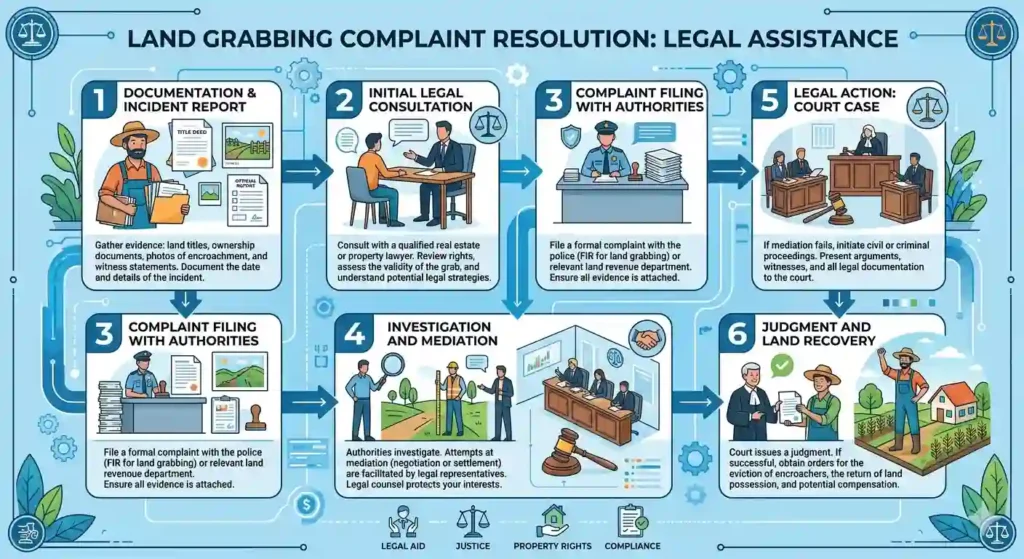
Victims should act promptly after discovering unlawful occupation or fraudulent activity. Therefore, filing appropriate complaints becomes critical. Police authorities may investigate offences involving fraud, forgery, criminal trespass, and cheating. Revenue authorities may address record-related grievances. Common steps include:
• Gathering ownership documents
• Obtaining survey records
• Filing police complaints
• Seeking legal notices
• Initiating civil proceedings
Additionally, nearby police stations often become the first point of contact. Lawyers coordinate complaints before multiple authorities where necessary. Furthermore, early reporting prevents further complications. Proper legal strategy strengthens enforcement efforts. Consequently, complainants improve prospects of obtaining timely protection and recovery.
Civil Remedies for Land Grabbing Victims
Civil remedies provide powerful tools against unlawful possession and interference. Therefore, property owners should evaluate available legal options immediately. Courts may grant relief based upon ownership and possession evidence. Common remedies include:
| Remedy | Objective |
|---|---|
| Injunction | Stop interference |
| Declaration Suit | Confirm ownership |
| Possession Suit | Recover property |
| Mandatory Injunction | Remove encroachment |
| Damages Claim | Recover losses |
Additionally, courts may issue interim orders protecting disputed properties. Lawyers prepare pleadings and supporting evidence strategically. Furthermore, civil proceedings often complement criminal actions. Effective litigation protects ownership rights comprehensively. Consequently, victims secure judicial remedies against unlawful encroachment and dispossession.
Criminal Proceedings Against Land Grabbers
Certain land grabbing activities constitute criminal offences. Therefore, victims may pursue criminal remedies alongside civil proceedings. Fraudulent transactions, forged documents, criminal trespass, intimidation, and cheating frequently attract criminal liability. Relevant offences may arise under the Bharatiya Nyaya Sanhita, 2023. Police authorities investigate allegations according to applicable procedures. Furthermore, the Bharatiya Nagarik Suraksha Sanhita, 2023 governs investigations and prosecutions. Strong evidence supports effective criminal action. Lawyers assist with complaints, witness preparation, and procedural compliance. Criminal proceedings often deter further unlawful conduct. Consequently, victims strengthen property protection through coordinated enforcement strategies.
Role of Revenue and Registration Authorities
Revenue and registration records play important roles during property disputes. Therefore, owners should verify official entries regularly. Revenue authorities maintain land classifications, survey details, and ownership-related information. Registration authorities preserve transaction records and document registrations. Common authorities include:
• Tahsildar Offices
• Revenue Divisional Offices
• District Collector Offices
• Sub-Registrar Offices
• Survey Departments
Additionally, corrections may become necessary where fraudulent entries exist. Lawyers pursue administrative remedies before appropriate authorities. Furthermore, accurate records strengthen litigation outcomes significantly. Effective engagement with government departments improves dispute resolution prospects. Consequently, property owners enhance protection against unlawful claims.
Legal Forums for Land Grabbing Resolution
Several forums may hear land grabbing disputes. Therefore, jurisdiction analysis becomes essential before commencing proceedings. Civil Courts frequently adjudicate ownership and possession disputes. Revenue Authorities address record-related matters in specific situations. High Courts exercise writ jurisdiction where authorities act unlawfully. Additionally, appellate forums review adverse decisions. Lawyers determine appropriate forums according to case facts. Furthermore, proper jurisdiction avoids procedural complications and delays. Strategic forum selection strengthens enforcement efforts significantly. Consequently, litigants pursue remedies through legally competent authorities while protecting procedural rights effectively.
Evidence and Property Dispute Litigation
Evidence often determines the outcome of property disputes. Therefore, owners should preserve records immediately after discovering encroachment or fraud. Relevant evidence may include title deeds, tax receipts, survey reports, photographs, and witness statements. Furthermore, electronic records receive consideration under the Bharatiya Sakshya Adhiniyam, 2023. Courts evaluate documentary authenticity carefully. Important evidence sources include:
- Revenue records.
- Registration documents.
- Survey maps.
- Utility records.
- Photographic evidence.
Additionally, lawyers organize evidence strategically before litigation begins. Strong evidentiary foundations improve judicial outcomes significantly. Consequently, property owners strengthen claims and enforcement efforts.
NRI Property Protection and Legal Assistance
NRIs often face unique property challenges because of distance and management difficulties. Therefore, proactive legal protection remains essential. Fraudsters frequently target vacant properties and absentee owners. Lawyers conduct title verification, property monitoring, and document reviews. Additionally, powers of attorney require careful drafting and verification. Relevant authorities maintain ownership and registration records accessible through lawful procedures. Furthermore, legal audits identify risks before disputes escalate. Early intervention often prevents substantial losses. Strategic legal support protects valuable investments effectively. Consequently, NRIs maintain stronger control over Indian property assets while reducing exposure to fraudulent activities.
Impact of BNS, BNSS and BSA
Modern property disputes often involve criminal and civil components simultaneously. Therefore, understanding applicable legal frameworks remains important. The Bharatiya Nyaya Sanhita, 2023 addresses offences such as forgery, cheating, criminal trespass, and intimidation. Investigation procedures operate under the Bharatiya Nagarik Suraksha Sanhita, 2023. Evidence evaluation follows the Bharatiya Sakshya Adhiniyam, 2023. Additionally, courts assess documentary and electronic records carefully. Lawyers coordinate legal strategies across multiple forums where necessary. Furthermore, compliance with procedural requirements strengthens enforcement effectiveness. Proper evidence collection supports successful claims. Consequently, property owners improve protection against unlawful occupation and fraudulent conduct.
Why Choose Paramount Law House: Property Lawyers 24×7
Paramount Law House: Property Lawyers 24×7 provides comprehensive legal solutions for land grabbing and property disputes. Our team assists individuals, companies, trusts, institutions, and NRIs across complex property matters. Services include title verification, legal notices, civil suits, criminal complaints, revenue proceedings, and High Court litigation. Furthermore, we coordinate actions before police authorities, registration offices, revenue departments, and courts. Every matter receives strategic legal assessment and practical guidance. Strong documentation improves enforcement prospects significantly. Therefore, clients receive effective support throughout dispute resolution processes. Our objective remains protecting ownership rights and recovering lawful possession. Consequently, clients safeguard valuable property assets through experienced legal representation.
FAQs
What is considered land grabbing?
Land grabbing generally involves unauthorized occupation, fraudulent transfer, illegal possession, or encroachment upon another person’s property.
Can I file both civil and criminal cases?
Yes. Many land grabbing matters permit parallel civil and criminal proceedings based upon the facts.
Which documents help prove ownership?
Sale deeds, pattas, encumbrance certificates, tax receipts, and survey records commonly establish ownership claims.
Can NRIs recover illegally occupied properties?
Yes. NRIs may pursue civil, criminal, and administrative remedies through authorized legal representation.
What remedies can courts provide?
Courts may grant possession recovery, injunctions, declarations, damages, and removal of encroachments.
Why should I consult a property lawyer quickly?
Early legal action preserves evidence, prevents further loss, and strengthens recovery and enforcement strategies.
Read More
- Land Purchase Legal Opinion: Expert Advice for Informed Decisions
- Land Sub-division Services: Regulatory Compliance Assurance
- Landlord-Tenant Issue Resolution: Legal Support Available
- Lease Deed Review: Ensure Compliance and Validity
- Legal Heir Certificate Obtained: Smooth Inheritance Process
- Department of Land Resources (DoLR)