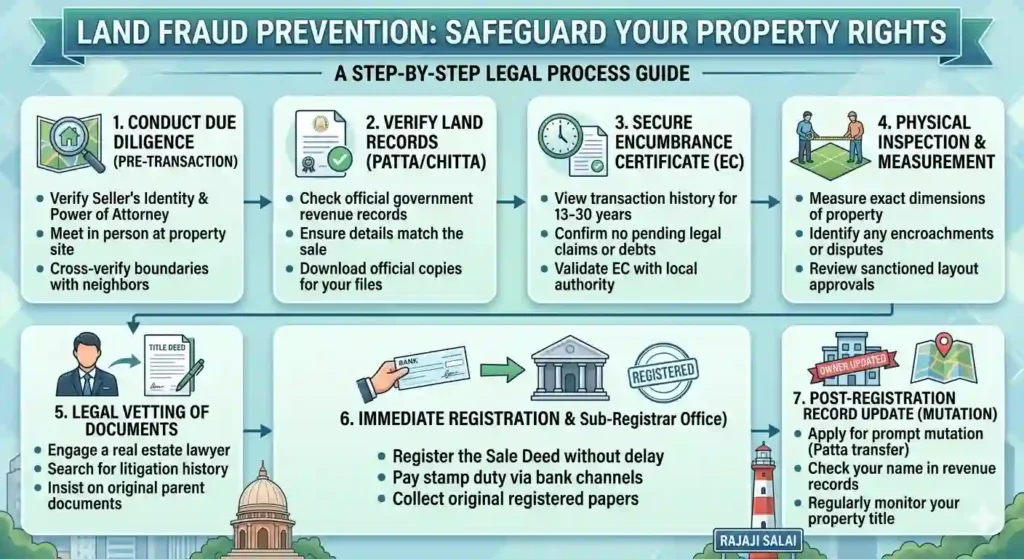
Land Fraud Prevention: Safeguard Your Property Rights
Land Fraud Prevention – Land fraud threatens ownership rights and financial security. Fraudsters exploit documentation gaps and verification failures. Therefore, property buyers…
Land Fraud Prevention – Land fraud threatens ownership rights and financial security. Fraudsters exploit documentation gaps and verification failures. Therefore, property buyers must conduct thorough due diligence. Common schemes involve forged deeds, impersonation, and double sales. Illegal encroachments also create significant ownership disputes. Property fraud affects individuals, companies, NGOs, and NRIs alike. Moreover, digital transactions have increased sophisticated fraudulent practices. Registration records alone may not reveal every risk. Legal scrutiny helps identify defects before transactions conclude. Buyers should verify title history and encumbrances carefully. Revenue authorities maintain important ownership and mutation records. Courts frequently handle disputes involving fraudulent transfers. Professional legal assistance reduces exposure to costly litigation. Consequently, proactive verification remains the strongest defense against property fraud. Landowners who act early often preserve their rights effectively and avoid prolonged legal conflicts.
Land Fraud Prevention: Safeguard Your Property Rights – Paramount Law House
Common Types of Land Fraud Cases
Property fraud appears in several forms across urban and rural areas. However, many victims recognize problems only after registration. Fraudulent transactions often involve fabricated ownership documents. Unscrupulous persons may impersonate genuine owners during sales. Moreover, forged powers of attorney create serious legal complications. Double registration disputes arise when sellers transfer identical properties repeatedly. Encroachments frequently affect vacant land parcels. Illegal mutations sometimes alter revenue records unlawfully. Buyers should understand recurring fraud patterns before investing. Common examples include:
- Forged title deeds.
- Fake power of attorney transactions.
- Double property sales.
- Boundary manipulation disputes.
- Identity-based property fraud.
Awareness strengthens preventive measures considerably. Legal review identifies warning signs early. Consequently, informed buyers reduce transaction risks significantly.
Importance of Title Verification Before Purchase
Title verification remains essential before every property transaction. Buyers should never rely solely on seller representations. Therefore, independent legal examination becomes necessary. Lawyers assess ownership continuity and transaction history. Revenue records provide valuable ownership information. Encumbrance certificates reveal certain registered claims and transactions. Furthermore, court searches may disclose pending litigation. Buyers should examine approvals and land-use permissions carefully. Missing documents often indicate underlying legal concerns. Property verification reduces future ownership disputes substantially. Banks frequently require title scrutiny before lending. Legal opinions provide clarity regarding risks and ownership validity. Investors benefit from professional verification before commitments. Consequently, title examination remains a critical safeguard against land fraud and financial losses.
Essential Property Verification Checklist
A structured verification process minimizes legal and financial risks. Buyers should review every important document carefully. Consider the following checklist:
| Document | Purpose |
|---|---|
| Title Deed | Ownership verification |
| Encumbrance Certificate | Registered transaction history |
| Patta/Revenue Records | Revenue ownership details |
| Approved Layout Plan | Regulatory compliance |
| Tax Receipts | Payment verification |
Additionally, buyers should inspect physical possession status. Survey records help identify boundary discrepancies. Legal professionals evaluate documentation comprehensively. Verification should occur before payment commitments. Proper diligence strengthens transaction security. Consequently, purchasers reduce the likelihood of future disputes and litigation.
Government Departments and Authorities Involved
Several authorities maintain records relevant to property ownership. Understanding their functions supports effective due diligence. Important authorities include:
• Registration Department.
• Revenue Department.
• Survey and Settlement Authorities.
• Municipal Authorities.
• Planning Authorities.
These departments maintain records affecting ownership rights. Therefore, buyers should verify information from multiple sources. Regulatory approvals often determine property usability. Revenue records may reveal ownership inconsistencies. Lawyers frequently coordinate verification with concerned authorities. Administrative errors sometimes create future disputes. Early verification helps resolve discrepancies efficiently. Consequently, informed buyers strengthen protection against fraudulent transactions and defective property titles.
Legal Remedies Against Land Fraud
Victims of land fraud possess several legal remedies. Immediate action often improves recovery prospects significantly. Therefore, affected parties should seek legal advice promptly. Civil proceedings may challenge fraudulent transfers and documents. Courts can grant injunctions preventing further transactions. Declaratory suits help establish lawful ownership rights. Moreover, recovery proceedings may restore possession in appropriate cases. Legal notices often initiate dispute resolution efforts. Evidence preservation remains crucial throughout proceedings. Lawyers assess available remedies according to facts. Strategic litigation protects ownership and financial interests. Timely filing prevents additional complications. Consequently, victims should pursue suitable legal action without unnecessary delay. Professional legal support improves enforcement and recovery opportunities.
Civil Litigation and Property Protection
Civil courts resolve many property ownership disputes. Proceedings commonly arise under the Code of Civil Procedure, 1908. Therefore, proper pleadings and evidence become essential. Courts evaluate title documents and transaction histories carefully. Available remedies include:
- Permanent injunctions.
- Temporary injunctions.
- Declaration of title.
- Recovery of possession.
- Cancellation of fraudulent documents.
Legal representation strengthens case preparation significantly. Documentary evidence often determines outcomes. Property owners should maintain complete transaction records. Courts examine conduct and supporting evidence thoroughly. Strategic litigation protects rights effectively. Consequently, civil remedies remain a primary tool against land fraud.
Criminal Action Against Fraudulent Activities
Certain land fraud cases involve criminal offences. Fraudulent conduct may attract liability under BNS, 2023 provisions. Therefore, victims should evaluate criminal remedies promptly. Complaints may be filed before nearby police stations. Investigations follow procedures under BNSS, 2023. Evidence assessment follows standards under BSA, 2023. Forgery, cheating, and impersonation often trigger criminal proceedings. Moreover, authorities may seize relevant records during investigations. Criminal enforcement complements civil remedies effectively. Victims should preserve documents and communications carefully. Legal advisors assist during complaint preparation and investigations. Early reporting strengthens enforcement efforts. Consequently, criminal proceedings often deter further fraudulent activities and support property protection.
Courts, Tribunals, and Forums for Property Disputes
Property disputes proceed before different forums depending upon circumstances. Jurisdiction influences procedural requirements and available remedies. Important forums include:
• Civil Courts.
• District Courts.
• Revenue Authorities.
• High Courts.
• Consumer Commissions.
Certain matters may involve appellate remedies. Moreover, writ jurisdiction may become available in specific situations. Lawyers evaluate forum suitability carefully. Strategic forum selection improves efficiency and effectiveness. Property owners should understand available legal pathways. Professional guidance simplifies complex procedural requirements. Consequently, choosing the appropriate forum strengthens legal protection efforts.
Best Practices for Long-Term Property Protection
Property owners should adopt preventive measures consistently. Effective planning reduces risks associated with fraudulent claims. Therefore, owners must maintain accurate ownership records. Regular document reviews help identify discrepancies early. Property inspections reveal encroachments and unauthorized occupation. Moreover, owners should update revenue and municipal records promptly. Digital record monitoring strengthens fraud prevention efforts. Legal audits provide additional protection for valuable assets. Family settlements should receive proper documentation and registration. Secure storage prevents loss of critical records. Professional legal reviews support long-term ownership protection. Preventive action costs less than prolonged litigation. Consequently, disciplined property management preserves rights and financial security.
Why Paramount Law House Is Your Trusted Property Partner
Paramount Law House provides comprehensive property law assistance. The firm advises individuals, companies, NGOs, and NRIs. Therefore, clients receive tailored solutions for complex property concerns. Legal services include title verification and document review. Lawyers assess risks before transactions proceed. Property dispute representation remains available before courts and authorities. Moreover, the firm assists with fraud complaints and recovery actions. Regulatory compliance guidance strengthens transaction security. Strategic legal planning reduces future ownership conflicts. Clients benefit from practical and transparent advice. Every matter receives careful legal analysis and attention. Strong advocacy protects valuable property interests consistently. Consequently, Paramount Law House remains a trusted partner for safeguarding property rights and preventing land fraud.
FAQs
1. What is land fraud?
Land fraud involves forged documents, impersonation, illegal sales, fraudulent mutations, or unauthorized transfers affecting lawful ownership rights.
2. How can I verify property ownership before purchase?
Review title deeds, encumbrance certificates, revenue records, approvals, tax receipts, and obtain an independent legal opinion.
3. What should I do if someone fraudulently sells my property?
Seek immediate legal advice, file police complaints, preserve evidence, and initiate civil proceedings for protection and recovery.
4. Can criminal action be taken in land fraud cases?
Yes. Fraud, forgery, cheating, and impersonation may attract criminal proceedings under applicable provisions of BNS, 2023.
5. Which courts handle property fraud disputes?
Civil Courts, District Courts, High Courts, Revenue Authorities, and other competent forums may handle property disputes.
6. How can NRIs protect property located in India?
NRIs should conduct periodic legal audits, monitor records, appoint trusted representatives, and verify all transactions professionally.
Read More
- Land Grabbing Complaint Resolution: Legal Assistance
- Land Purchase Legal Opinion: Expert Advice for Informed Decisions
- Landlord-Tenant Issue Resolution: Legal Support Available
- Land Sub-division Services: Regulatory Compliance Assurance
- Lease Deed Review: Ensure Compliance and Validity
- Department of Land Resources (DoLR)