Legacy Secure: Will Deed Legal Assurance
Will Deed Legal Assurance – A properly drafted Will helps individuals control how their assets pass after death. It can reduce uncertainty…
Will Deed Legal Assurance – A properly drafted Will helps individuals control how their assets pass after death. It can reduce uncertainty among family members and prevent avoidable succession disputes. Moreover, a Will allows the testator to record clear wishes concerning beneficiaries and property. Indian succession law recognises testamentary dispositions subject to applicable statutory requirements. Therefore, the testator should understand personal law, asset ownership, and testamentary capacity. A Will should identify the testator, beneficiaries, assets, and intended distribution clearly. Additionally, suitable executors can help administer the estate according to the testamentary wishes. Paramount Law House provides professional Will drafting, review, registration guidance, and succession dispute support. Legal advice becomes especially important where substantial property, family disagreements, business interests, or overseas assets exist. Ultimately, careful planning provides greater legal certainty while preserving the testator’s freedom.
Legacy Secure: Will Deed Legal Assurance – Paramount Law House
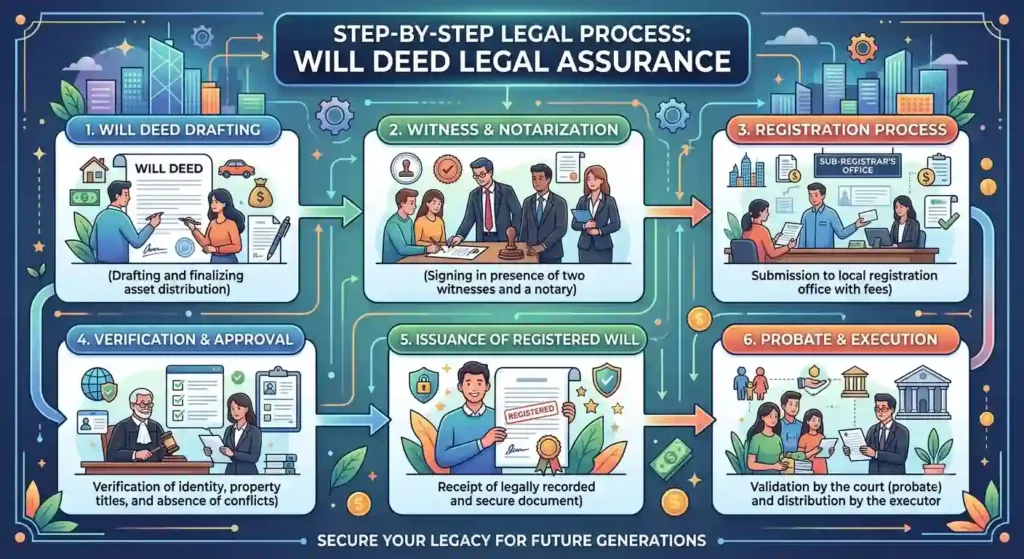
Essential Requirements for Validity
A Will requires careful execution because defects can create disputes after the testator’s death. Generally, the testator must possess testamentary capacity and understand the document’s nature. The testator should make the Will voluntarily without coercion, fraud, or undue influence. Furthermore, applicable law requires appropriate attestation by witnesses. The Indian Succession Act, 1925 contains important provisions concerning testamentary succession and execution. However, personal law can influence succession rights and testamentary arrangements. Therefore, lawyers should examine the testator’s circumstances before preparing the final document. Important considerations include:
- Testator’s identity and testamentary capacity.
- Clear identification of beneficiaries.
- Accurate asset descriptions.
- Proper execution and attestation.
- Appointment of a suitable executor.
- Revocation of inconsistent earlier Wills.
Professional review can reduce ambiguity and strengthen the Will against future challenges.
Choosing Beneficiaries and Executors
A Will should identify beneficiaries clearly enough to minimise interpretation disputes. Names, relationships, and relevant identifying details should remain accurate and consistent. Similarly, an executor should understand the responsibilities associated with estate administration. Therefore, the testator should select someone trustworthy, capable, and available when required. An executor may need to locate assets, settle liabilities, and facilitate lawful distribution. Additionally, professional executors may assist with complex estates involving businesses or multiple jurisdictions. The Will should address significant assets rather than relying upon informal family instructions. Where circumstances change, the testator should review the Will periodically. Marriage, divorce, birth, death, property acquisition, and major financial changes can justify review. Consequently, regular legal review helps keep testamentary instructions aligned with current intentions. Paramount Law House can assist with beneficiary planning, executor selection, Will review, and estate documentation.
Testamentary Capacity and Free Consent
Testamentary capacity remains fundamental to a valid Will. The testator should understand the act of making a Will and its consequences. They should also understand their property and the people who may reasonably expect benefits. Therefore, lawyers should consider capacity carefully when preparing Wills for elderly or vulnerable clients. Medical evidence may sometimes help demonstrate capacity where future disputes appear foreseeable. However, unnecessary medical documentation should not replace proper legal assessment. The testator must also act voluntarily without coercion or undue influence. Family pressure can create later allegations concerning manipulation or improper influence. Accordingly, independent legal consultation can provide useful safeguards during sensitive estate planning. The drafting process should record the testator’s instructions accurately and avoid unexplained changes. These precautions can strengthen the Will’s evidentiary position during future probate or succession proceedings.
Registration and Document Preservation
Registration of a Will is generally optional under the Registration Act, 1908. Nevertheless, registration can provide useful evidence concerning execution and document custody. A registered Will does not automatically become immune from legal challenge. Therefore, parties should understand the distinction between registration and substantive validity. The original document should remain safely preserved and accessible after death. Furthermore, the testator should communicate appropriate information about its existence without unnecessarily disclosing confidential provisions. In Tamil Nadu, registration-related matters involve the Registration Department and competent Sub-Registrar Office. Legal counsel can explain applicable procedures and practical safeguards before registration. Where a Will contains property descriptions, title records should also remain accurate and updated. Consequently, document preservation forms an important part of estate planning. Paramount Law House can assist clients with drafting, execution, registration guidance, custody planning, and subsequent Will review.
Wills, Family Rights and Succession
A Will can distribute property according to lawful testamentary intentions, subject to applicable succession principles. However, not every family property arrangement belongs entirely to the testator. Joint ownership, coparcenary interests, and restricted interests may require separate examination. Therefore, lawyers should establish the testator’s actual ownership before drafting dispositive clauses. The Hindu Succession Act, 1956 may apply to relevant Hindu succession and property questions. Other personal laws can govern succession for different communities. Additionally, contractual, trust, or settlement arrangements may affect available testamentary choices. A Will cannot simply transfer property that the testator does not legally own. Consequently, title verification should precede significant estate planning decisions. Clear advice can prevent beneficiaries from receiving unrealistic expectations. Paramount Law House can examine ownership structures and succession rights before preparing legally coherent testamentary instructions.
Property, Business and Digital Assets
Modern estates frequently include property, bank accounts, securities, businesses, insurance interests, and digital assets. Therefore, estate planning should consider the complete asset portfolio rather than only immovable property. Property descriptions should correspond with title documents and official records. Business interests require additional review because partnership agreements and company documents may govern succession. Similarly, digital assets require practical instructions concerning access, ownership, and lawful transfer. However, passwords and sensitive credentials should not appear casually inside testamentary documents. Instead, secure estate-management arrangements can protect confidential information. Furthermore, NRIs should review Indian assets alongside foreign estate-planning obligations. Cross-border estates may involve tax, foreign-exchange, succession, and jurisdictional issues. Consequently, coordinated professional advice becomes valuable for complex asset structures. Paramount Law House assists clients in developing practical estate plans covering property, investments, business interests, and other lawful assets.
Challenging a Will After Death
Beneficiaries or interested persons may challenge a Will when credible legal grounds exist. Common allegations include lack of capacity, undue influence, fraud, forgery, improper execution, or suspicious circumstances. However, disagreement with a testamentary distribution does not automatically invalidate the Will. Courts examine evidence surrounding execution and the testator’s circumstances carefully. Therefore, challengers should collect medical records, witness evidence, prior Wills, correspondence, and relevant financial documents. A propounder may need to establish due execution and answer legitimate suspicious circumstances. The Bharatiya Sakshya Adhiniyam, 2023 governs general evidentiary principles after replacing the former evidence statute. However, testamentary proceedings also involve applicable succession and procedural rules. Consequently, legal strategy should focus on the actual statutory and evidentiary issues. Early advice can prevent destruction, alteration, or loss of important estate evidence.
Probate, Letters of Administration and Court Proceedings
Probate confirms the legal authority of an executor concerning a Will where applicable. Letters of administration may apply where estate administration requires court authority without suitable probate circumstances. The precise requirement depends upon the governing succession law and jurisdiction. Therefore, families should determine whether probate or another proceeding applies before distributing disputed assets. Courts may require the Will, death certificate, affidavits, witness evidence, and supporting documents. Additionally, objections can create contested testamentary proceedings requiring detailed litigation strategy. Civil procedure principles, including relevant provisions of the Code of Civil Procedure, may influence court proceedings. However, specialised succession provisions also require careful consideration. Consequently, lawyers should select the correct proceeding and competent court based upon current law. Paramount Law House provides assistance with probate petitions, objections, evidence preparation, hearings, and succession litigation.
Remedies Against a Forged or Defective Will
A suspected forged Will requires immediate legal evaluation because estate assets may face further transfer risks. Interested parties can consider appropriate civil, succession, and criminal remedies depending upon evidence. Potential remedies can include:
- Contesting probate or testamentary proceedings.
- Seeking declarations concerning testamentary validity.
- Challenging suspicious execution circumstances.
- Seeking injunctions against property transfers.
- Pursuing cancellation-related civil relief where appropriate.
- Filing criminal complaints for genuine forgery allegations.
The Bharatiya Nyaya Sanhita, 2023 governs applicable offences following replacement of the Indian Penal Code. The Bharatiya Nagarik Suraksha Sanhita, 2023 governs relevant criminal procedure. Police complaints should address genuine criminal allegations rather than ordinary inheritance disagreements. Therefore, counsel should coordinate civil and criminal strategies carefully. Appropriate courts, police authorities, and forums depend upon jurisdiction and facts.
CPC, BNS, BNSS and BSA Considerations
Estate disputes can involve multiple legal frameworks depending upon their nature. The Code of Civil Procedure governs procedural aspects of many civil proceedings, subject to specialised statutes. The Bharatiya Nyaya Sanhita addresses relevant criminal offences arising from conduct such as forgery or cheating. The Bharatiya Nagarik Suraksha Sanhita provides the contemporary criminal procedure framework. The Bharatiya Sakshya Adhiniyam governs general evidentiary principles in applicable proceedings. However, these statutes do not replace succession legislation governing testamentary validity. Therefore, lawyers should identify the correct legal framework before commencing proceedings. A police station may become relevant only where facts disclose a genuine criminal offence. Similarly, civil courts address property and testamentary disputes according to their jurisdiction. Consequently, accurate forum selection prevents procedural mistakes and unnecessary litigation.
NRI Wills and Indian Property
NRIs owning Indian property should consider Indian succession and property laws during estate planning. A Will executed abroad may require careful examination concerning execution, authentication, applicable law, and Indian proceedings. Therefore, NRIs should obtain advice before relying upon foreign testamentary documents for Indian assets. Cross-border estates may also involve tax, foreign-exchange, probate, and jurisdictional questions. Property located in India can create proceedings within Indian courts depending upon applicable law. Furthermore, powers of attorney require careful drafting when representatives handle Indian estate matters. Digital communication can support coordination, but original documents may remain essential. Consequently, NRIs should maintain accessible copies and reliable records of Indian assets. Paramount Law House assists overseas clients with Indian Will drafting, property succession, probate strategy, and local legal representation.
Family Settlement and Alternative Dispute Resolution
Family disputes concerning Wills do not always require prolonged courtroom battles. Mediation can help relatives discuss inheritance concerns while preserving valuable family relationships. Therefore, lawyers can explore settlement options before litigation becomes entrenched. A settlement should clearly identify property, beneficiaries, obligations, timelines, and final claims. Additionally, parties should understand whether registration or court approval applies to the proposed arrangement. Mediation cannot validate forged documents or unlawful transfers. However, it can resolve genuine disagreements concerning interpretation, distribution, or administration. Legal counsel should ensure that negotiated terms protect each party’s lawful rights. Furthermore, written settlement documents should avoid vague promises that create future disputes. Paramount Law House provides negotiation, mediation, settlement drafting, and succession dispute assistance. Accordingly, alternative dispute resolution can provide families with practical solutions while reducing emotional and financial burdens.
Professional Legal Support for Legacy Protection
Effective estate planning combines legal drafting, ownership verification, succession advice, and careful document management. Paramount Law House provides comprehensive assistance for Wills, probate, inheritance disputes, property succession, and estate administration. Counsel can review existing Wills and identify clauses creating avoidable ambiguity. Additionally, lawyers can assess potential challenges involving capacity, undue influence, forgery, or suspicious circumstances. Clients can receive support before execution, after death, or during contested proceedings. The firm can also coordinate with tax and property professionals when specialised advice becomes necessary. Therefore, early legal review can protect testamentary intentions and reduce future family conflict. Every estate requires individual assessment because succession rights and property structures differ significantly. Consequently, clients should avoid copying generic Will templates without professional review. A carefully prepared Will can provide clarity, continuity, and stronger legal assurance for future generations.
Frequently Asked Questions
Is a registered Will legally stronger?
Registration can provide useful evidence, but it does not automatically prevent challenges. Courts can still examine capacity, execution, coercion, fraud, and suspicious circumstances.
Can a Will be challenged after registration?
Yes. Registration does not make a Will immune from challenge. Interested parties can contest validity when legally recognised grounds and supporting evidence exist.
Can NRIs make Wills for Indian property?
Yes. NRIs can make Wills covering Indian assets, subject to applicable succession, execution, registration, foreign-exchange, and jurisdictional requirements.
What happens if someone forges a Will?
A forged Will can face civil and succession challenges. Genuine forgery allegations may also justify criminal proceedings under applicable provisions of the BNS.
Can family members settle a Will dispute?
Yes. Eligible parties can explore mediation or family settlement where legally permissible. Proper documentation should record agreed rights and obligations clearly.
Which court handles Will disputes?
The appropriate court depends upon applicable succession law, property location, jurisdiction, and proceeding type. Legal advice should precede filing probate or contested proceedings.
Read More
- Rent Recovery Services: Effective Solutions for Your Needs
- Property Purchase Agreement Legal Consultation: Expert Advice
- Property Document Verification Services: Ensure Accuracy
- Landlord Legal Support: Protect Your Rights Effectively
- Factory Monitoring Services: Compliance Assurance
- National Legal Services Authority (NALSA)