Property Documentation Review: Ensure Accuracy and Compliance
Property documentation review is the most critical step before any real estate transaction. Paramount Law House: Property Lawyers 24×7 guides clients through…
Property documentation review is the most critical step before any real estate transaction. Paramount Law House: Property Lawyers 24×7 guides clients through every legal layer. Therefore, accurate document verification prevents future disputes and financial losses. Our experienced property lawyers analyse title deeds, sale agreements, encumbrance certificates, and government records thoroughly. Every document must comply with the Registration Act, 1908, and applicable state stamp duty laws. Furthermore, non-compliance exposes buyers to fraudulent title claims and litigation risks. Our team identifies legal defects early and offers remedies swiftly. Property transactions are governed by the Transfer of Property Act, 1882, and the Indian Contract Act, 1872. Consequently, every clause in the sale deed requires careful legal scrutiny. We serve clients across Chennai, Coimbatore, Madurai, and all Tamil Nadu districts. Additionally, our 24×7 helpline ensures you receive legal support at any hour. Trust Paramount Law House for complete, compliant property documentation review services today.
Property Documentation Review: Ensure Accuracy and Compliance – Paramount Law House
Why Property Documentation Review Is a Legal Necessity in India
Understanding the Legal Framework Governing Property Documents
Key Statutes Every Property Buyer Must Know
India’s property law framework is extensive, complex, and jurisdiction-specific. Therefore, buyers must understand the statutes that govern every transaction. The Transfer of Property Act, 1882 defines how immovable property is legally transferred between parties. Additionally, the Registration Act, 1908 mandates compulsory registration of sale deeds above ₹100 value. The Indian Stamp Act, 1899, and relevant state stamp laws require proper duty payment. Furthermore, RERA, 2016 protects buyers in registered real estate projects across India. The Bharatiya Nyaya Sanhita, 2023 (BNS) replaced the IPC and criminalises property fraud under Sections 316–318. The Bharatiya Nagarik Suraksha Sanhita, 2023 (BNSS) governs procedural aspects of property crime prosecution. Moreover, the Bharatiya Sakshya Adhiniyam, 2023 (BSA) determines document admissibility in property disputes. Consequently, buyers who ignore these laws risk title defects and financial losses. Our lawyers ensure full statutory compliance for every property document reviewed.
Title Deed Verification: The First Line of Legal Defence
Title deed verification confirms the seller’s legal ownership and right to transfer. Therefore, this step must always precede signing any sale agreement or paying advance amounts. Our lawyers conduct a minimum 30-year title search through Sub-Registrar office records. Furthermore, we verify the chain of title — every transfer from original owner to current seller. Gaps in title chain signal serious legal risks, including forged documents and benami transactions. The Benami Transactions (Prohibition) Amendment Act, 2016 prohibits property held in fictitious names. Additionally, we cross-check revenue records, patta, chitta, and adangal documents maintained by the Revenue Department. Tamil Nadu’s e-Sevai portals provide digitised land records for faster verification. Moreover, any encumbrance or mortgage on the title is identified through Encumbrance Certificate (EC) searches. We file EC applications at the Sub-Registrar’s office for the past 30 years. Consequently, buyers receive a clear, marketable, and unencumbered title before transaction completion.
Encumbrance Certificate Analysis and Its Legal Significance
An Encumbrance Certificate (EC) lists all registered transactions against a property over a specified period. Therefore, obtaining a thorough EC is a non-negotiable step in property documentation review. The EC is obtained from the Sub-Registrar’s office under the Registration Act, 1908. Furthermore, it reveals mortgages, sale deeds, gift deeds, partition deeds, and court attachments registered against the property. A nil-encumbrance EC confirms the property is free from legal and financial liabilities. Additionally, any discrepancy in the EC must be investigated through BNSS-mandated revenue records and court registers. Our lawyers verify ECs for residential plots, flats, agricultural lands, and commercial properties. Moreover, Tamil Nadu’s TNREGINET portal now provides online EC access for faster preliminary review. Buyers in Chennai must also check CMDA and DTCP approval status alongside the EC. Consequently, a clean EC combined with verified approvals ensures a legally sound property purchase. Paramount Law House delivers thorough EC analysis for every client.
Common Legal Issues Identified During Document Review
Property document review frequently uncovers serious legal defects that buyers overlook. Therefore, professional legal scrutiny protects buyers from expensive post-purchase disputes. Below are the most common issues our lawyers identify:
- Forged Title Documents: Fake sale deeds, fraudulent power of attorney, and fabricated revenue records are increasingly common in Chennai and suburban areas.
- Benami Transactions: Properties registered in fictitious or third-party names violate the Benami Transactions Act, 2016 and invite confiscation by Income Tax authorities.
- Undisclosed Mortgages: Sellers sometimes conceal existing bank mortgages, leading buyers into double-charged property liabilities.
- Illegal Constructions: Buildings without CMDA, DTCP, or panchayat approval violate the Tamil Nadu Town and Country Planning Act, 1971.
- Land Use Violations: Agricultural land converted for residential use without proper permission violates Tamil Nadu Land Reforms Act provisions.
- Disputed Successions: Properties inherited without probate or family settlement deeds create co-ownership disputes under Hindu Succession Act, 1956.
- Government Land Encroachment: Properties encroaching on poramboke, government, or forest land face demolition and criminal prosecution under BNS, 2023.
Furthermore, each issue requires a specific legal remedy. Consequently, engaging property lawyers before purchase is the wisest investment a buyer can make.
Jurisdiction and Forums for Property Documentation Disputes in Tamil Nadu
Courts, Tribunals, and Government Departments Handling Property Matters
Property disputes in Tamil Nadu are adjudicated across multiple forums depending on the issue type. Therefore, knowing the correct forum prevents delay and procedural dismissals. The following table outlines relevant forums and their jurisdictions:
| Forum / Department | Jurisdiction / Function | Applicable Law |
|---|---|---|
| Civil Court (District Court) | Title disputes, partition suits, injunctions | CPC, 1908; TPA, 1882 |
| High Court of Madras | Writ petitions, revision, appeals | Constitution Art. 226/227 |
| RERA Tamil Nadu (TNRERA) | Builder-buyer disputes in registered projects | RERA, 2016 |
| Consumer Forum (DCDRC/SCDRC/NCDRC) | Deficiency in property services | Consumer Protection Act, 2019 |
| Revenue Divisional Officer (RDO) | Patta transfer, land classification disputes | Tamil Nadu Revenue Recovery Act |
| Sub-Registrar Office | Document registration, EC, certified copies | Registration Act, 1908 |
| CMDA / DTCP | Building approvals, planning permissions | TN Town & Country Planning Act, 1971 |
| Income Tax Department | Benami property investigations | Benami Transactions Act, 2016 |
| Local Police Station | FIR for fraud, cheating, forgery in property | BNS, 2023; BNSS, 2023 |
| Lok Adalat | Pre-litigation property settlement | Legal Services Authorities Act, 1987 |
Additionally, police stations near Chennai — including Anna Nagar, T. Nagar, Adyar, Tambaram, and Chrompet — frequently register property fraud FIRs. Furthermore, Economic Offences Wing (EOW) investigates large-scale property fraud cases under BNSS provisions. Consequently, victims must engage lawyers promptly to initiate the correct legal proceedings.
Filing Property Fraud Complaints Under BNS and BNSS, 2023
The Bharatiya Nyaya Sanhita, 2023 introduced modernised criminal provisions for property fraud. Therefore, understanding these provisions is essential for every property buyer and owner. Section 316 of BNS defines cheating and covers fraudulent property sales to multiple buyers. Section 318 addresses cheating by personation, commonly used in power of attorney frauds. Furthermore, Section 336 of BNS criminalises forgery of documents, including fabricated sale deeds. The Bharatiya Nagarik Suraksha Sanhita, 2023 governs the procedure for FIR filing, investigation, and trial. Additionally, under BNSS Section 173, Zero FIRs can be registered at any police station regardless of jurisdiction. Victims must approach the nearest police station — in Chennai, Anna Nagar or Egmore stations handle property fraud proactively. Moreover, BNSS mandates investigation completion within 60 days for property offences. The Bharatiya Sakshya Adhiniyam, 2023 determines which documents are admissible as evidence in property trials. Consequently, preserving original title documents and transaction records is legally critical. Paramount Law House assists clients in filing complaints and managing criminal property proceedings.
RERA Tamil Nadu: Protecting Flat Buyers From Builder Defaults
RERA, 2016 established the Real Estate Regulatory Authority to protect apartment and plot buyers. Therefore, every builder undertaking projects above 500 sq.m. must register with TNRERA. Buyers can verify project registration on the TNRERA portal before making any payment. Furthermore, builders must disclose project approvals, completion timelines, and financial details compulsorily. Section 12 of RERA mandates compensation for misrepresentation in project advertisements. Additionally, Section 18 entitles buyers to refund with interest for project delays. TNRERA, located in Chennai, adjudicates complaints against builders efficiently. Moreover, non-registered builders face penalties up to 10% of project cost under RERA. Our lawyers file TNRERA complaints and appear in hearings to secure buyer remedies. The TNRERA Appellate Tribunal in Chennai hears appeals against TNRERA orders. Consequently, flat buyers must register complaints within the limitation period prescribed under RERA. Paramount Law House provides dedicated RERA litigation support across all Tamil Nadu districts today.
Complete Property Documentation Review Process by Paramount Law House
Step-by-Step Document Verification Methodology
Checklist of Documents Reviewed by Our Property Lawyers
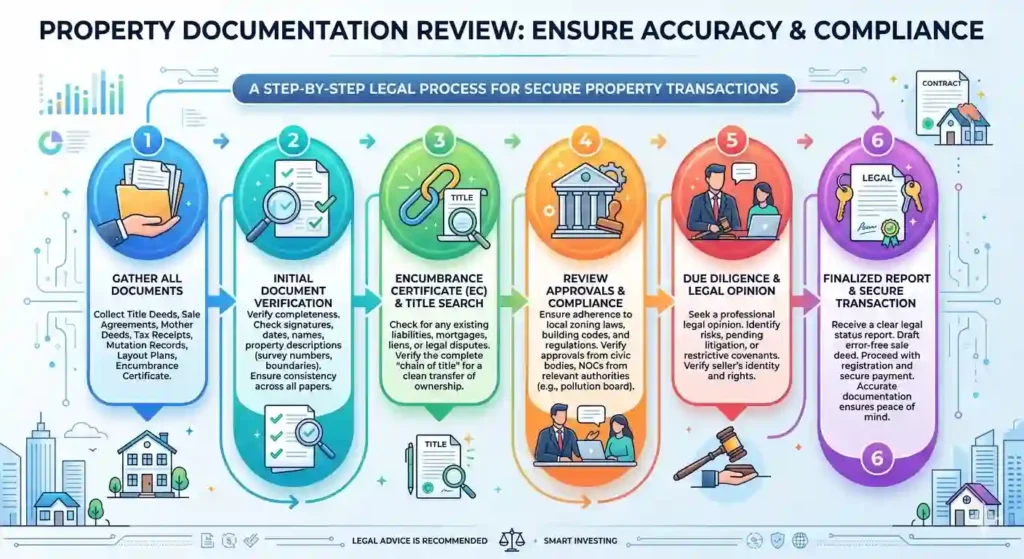
A systematic document checklist prevents gaps in property legal due diligence. Therefore, our lawyers follow a structured, court-tested review methodology for every client. The numbered list below covers essential documents reviewed at Paramount Law House:
- Original Title Deed / Mother Document — The root document establishing ownership chain from original patta holder or government grant.
- Encumbrance Certificate (EC) — Minimum 30-year EC from Sub-Registrar office confirming no mortgage, lien, or court attachment exists.
- Patta & Chitta — Revenue records from the Tahsildar confirming legal possession and land classification in the revenue department.
- Approved Building Plan — CMDA, DTCP, or local body-sanctioned building plan ensuring lawful construction compliance.
- Completion / Occupancy Certificate — Issued by the local body confirming the building meets all approved construction specifications.
- Latest Tax Paid Receipt — Property tax receipts from Chennai Corporation or respective local body confirming no arrears exist.
- Electricity and Water Connection Documents — TANGEDCO and CMWSSB records confirming lawful utility connections for the property.
- Sale Agreement / Agreement for Sale — Reviewed for compliance with Indian Contract Act, 1872 and Transfer of Property Act, 1882.
- Power of Attorney (if applicable) — Verified for authenticity, notarisation, and registration under the Registration Act, 1908.
- Court Orders / Partition Deeds — Any court decree or family settlement relating to the property must be verified for legal finality.
Furthermore, agricultural land requires additional documents including A-Register extract, survey sketch, and FMB sketch from the Survey Department. Consequently, our lawyers customise the checklist based on property type and location.
Legal Remedies Available for Property Documentation Defects
When document defects are discovered, various legal remedies are available under Indian law. Therefore, prompt legal action protects the buyer’s investment and prevents title loss. Our lawyers assess defects and recommend the most effective remedy in every case. Firstly, Specific Performance suits under the Specific Relief Act, 1963 compel sellers to execute proper sale deeds. Additionally, Declaration suits under CPC Order VII establish legal title in disputed property matters. Cancellation of fraudulent documents is sought through Civil Courts under Section 31 of the Specific Relief Act. Furthermore, Injunction suits prevent sellers from creating third-party interests during dispute resolution. Criminal complaints under BNS Sections 316 and 336 address fraud and forgery in property documents. Moreover, Consumer complaints before DCDRC Chennai address developer deficiencies in documentation delivery. RTI applications filed with Sub-Registrar offices reveal concealed registration records and government encumbrances. Additionally, Writ Petitions before the Madras High Court challenge illegal revenue entries and government orders. Lok Adalat settlements provide fast, cost-effective resolution for pre-litigation property document disputes. Consequently, every defect type has a matching legal remedy our lawyers deploy strategically.
Stamp Duty and Registration Compliance: Avoiding Legal Penalties
Stamp duty payment is a statutory obligation under the Indian Stamp Act, 1899 and state stamp laws. Therefore, underpayment of stamp duty renders sale deeds inadmissible in courts under BSA, 2023. Tamil Nadu charges stamp duty at 7% of the market value or guideline value, whichever is higher. Additionally, registration charges of 4% are levied separately on all compulsorily registrable documents. Undervaluation of property to reduce stamp duty attracts penalty proceedings by the Inspector General of Registration. Furthermore, the Sub-Registrar can impound documents where insufficient stamp duty is detected during registration. Penalties up to 10 times the deficit duty amount are imposed on undervalued property documents. Moreover, our lawyers calculate correct stamp duty and advise on guideline value compliance before registration. Electronic payment of stamp duty through SHCIL or bank challans is now mandatory in Tamil Nadu. Consequently, stamp duty compliance must be verified before executing any sale deed, gift deed, or partition deed. Paramount Law House ensures full stamp duty and registration compliance for every property document.
Agricultural and Uzhavar Land Documentation: Special Legal Considerations
Agricultural land transactions involve additional legal layers beyond standard property documentation. Therefore, buyers of farmland in Tamil Nadu must verify land classification documents carefully with our lawyers. The Tamil Nadu Land Reforms (Fixation of Ceiling on Land) Act, 1961 restricts ownership beyond prescribed limits. Additionally, conversion of agricultural land to non-agricultural use requires District Collector approval under state land use rules. FMB (Field Measurement Book) sketch from the Survey and Land Records Department confirms land boundaries accurately. Furthermore, A-Register extract from the Village Administrative Office confirms the recorded ownership and land type. Lands classified as “Nattham” or “Ayacut” have specific restrictions on sale and use applicable under revenue law. Moreover, temple lands, government poramboke, and water body buffer zones cannot be purchased or registered legally. Our lawyers verify all these classifications before advising clients on agricultural land purchases. TNRERA does not cover agricultural land projects, so common law remedies apply. Consequently, agricultural land buyers require specialised legal review that Paramount Law House provides comprehensively.
Power of Attorney in Property Transactions: Risks and Legal Safeguards
Power of Attorney (POA) transactions are among the highest-risk categories in property documentation. Therefore, buyers must exercise maximum caution when purchasing property through a POA holder. The Supreme Court in Suraj Lamp & Industries v. State of Haryana (2012) held that POA sales do not transfer title. Furthermore, only registered and duly stamped POA documents are legally recognised under the Registration Act, 1908. General Power of Attorney for property sales must be registered with the Sub-Registrar’s office compulsorily. Additionally, POA granted to relatives or strangers can be revoked anytime by the original principal legally. Our lawyers verify the POA holder’s authority, registration status, and the principal’s current legal capacity. Moreover, death of the principal automatically terminates the POA before transaction completion occurs legally. Criminal misuse of POA is prosecuted under BNS Sections 316 and 318 for cheating and personation. BNSS provisions ensure faster investigation and trial of POA fraud cases in Chennai courts. Consequently, every POA-based property transaction demands thorough legal scrutiny before any payment is made.
Digital Property Records and E-Governance Portals in Tamil Nadu
Tamil Nadu has significantly digitised property records through multiple government e-governance portals. Therefore, buyers can now conduct preliminary verification online before engaging lawyers for full review. The TNREGINET portal (https://tnreginet.gov.in) provides online EC, document search, and guideline value verification services. Additionally, the EODB Tamil Nadu portal enables building plan approvals and occupancy certificate tracking digitally. Patta and chitta records are accessible through the Tamil Nilam portal operated by the Revenue Department. Furthermore, the CMDA portal allows buyers to verify approved layouts and planning permission status in Chennai. TANGEDCO’s online portal confirms electricity connection status and outstanding dues for the property. Moreover, the BBMP and Chennai Corporation portals verify property tax payment status and assessment records. RTI applications filed electronically with these departments help obtain concealed records efficiently. The BSA, 2023 recognises electronically maintained records as admissible evidence in property disputes today. Consequently, digital verification complements physical document review, and our lawyers use both methods comprehensively. Paramount Law House integrates e-governance portal searches into every property documentation review process.
Frequently Asked Questions: Property Documentation Review
1. What is property documentation review?
Property documentation review is legal verification of title deeds, ECs, patta, building approvals, and sale agreements to ensure accuracy, compliance, and clear ownership before any property transaction.
2. Why do I need a lawyer for property document review?
Lawyers identify hidden legal defects, encumbrances, forged documents, and title chain gaps that laypeople miss, protecting you from fraud, disputes, and financial loss under Indian property laws.
3. What laws govern property documentation in India?
Key laws include Transfer of Property Act 1882, Registration Act 1908, Stamp Act 1899, RERA 2016, BNS 2023, BNSS 2023, BSA 2023, and the Benami Transactions (Prohibition) Act, 2016.
4. What is an Encumbrance Certificate and why is it important?
An EC lists all registered transactions — mortgages, sales, attachments — against a property. A clear EC confirms no legal or financial liability, making it essential before buying any property in Tamil Nadu.
5. Which court handles property title disputes in Chennai?
Property title disputes in Chennai are filed in the City Civil Court or District Court. Appeals go to the Madras High Court. TNRERA handles builder-buyer disputes in registered real estate projects.
6. Can I file a criminal complaint for property fraud in Tamil Nadu?
Yes. Under BNS 2023 Sections 316 and 336, FIRs for property fraud and forgery are filed at the nearest police station. Zero FIRs are accepted at any station under BNSS 2023 Section 173.
7. What stamp duty is applicable on property in Tamil Nadu?
Tamil Nadu levies 7% stamp duty and 4% registration charges on property market value or guideline value — whichever is higher — under the Indian Stamp Act, 1899 and Tamil Nadu Stamp Rules.
8. Is a Power of Attorney sale legally valid in India?
No. The Supreme Court ruled in 2012 that POA sales don’t transfer title. Only registered sale deeds transfer legal ownership. POA-based sales carry high fraud risk and must be reviewed by lawyers.
9. What remedies are available for flat buyers against builder delays?
Under RERA 2016 Section 18, buyers get refund with interest for builder delays. TNRERA in Chennai adjudicates these complaints. Consumer forums and civil courts provide additional remedies for aggrieved flat buyers.
10. How does Paramount Law House help in property documentation review?
Paramount Law House offers 24×7 property documentation review covering title search, EC analysis, RERA compliance, stamp duty verification, and legal opinion — safeguarding clients across all Tamil Nadu districts comprehensively.
Read More
- Property Exchange Deed Assistance: Expert Guidance
- Property Fraud Prevention: Legal Protection in Place
- Property Gift Deed Drafting: Ensure Legally Valid Documents
- Property Gift Deed Rules Clarified: Legal Expertise
- Property Litigation Representation: Experienced Lawyers
- Digital Land Records (Pan-India initiative)