How to Verify Property Ownership Before Buying Land in India?
Verify Property Ownership – Title verification protects buyers from ownership disputes, mortgages, forged documents, and competing claims. A buyer should never rely…
Verify Property Ownership – Title verification protects buyers from ownership disputes, mortgages, forged documents, and competing claims. A buyer should never rely solely on the seller’s statements or possession. Instead, examine the complete title history and supporting revenue records. The Registration Act, 1908 requires registration for several instruments affecting rights in immovable property. Therefore, obtain the registered sale deed and previous parent documents. Check whether every transfer follows a legally traceable chain. Also verify whether the seller acquired the property through sale, gift, partition, settlement, inheritance, or court order. Examine names, survey numbers, boundaries, measurements, and property descriptions carefully. Furthermore, compare documents with government records before paying substantial consideration. In Tamil Nadu, buyers should examine Patta, Chitta, FMB, TSLR, and A-Register information. Professional title due diligence can identify defects before registration. Consequently, legal verification reduces financial risks and strengthens the buyer’s ownership position.
How to Verify Property Ownership Before Buying Land in India? – Paramount Law House
Examine the Parent Documents and Title Chain
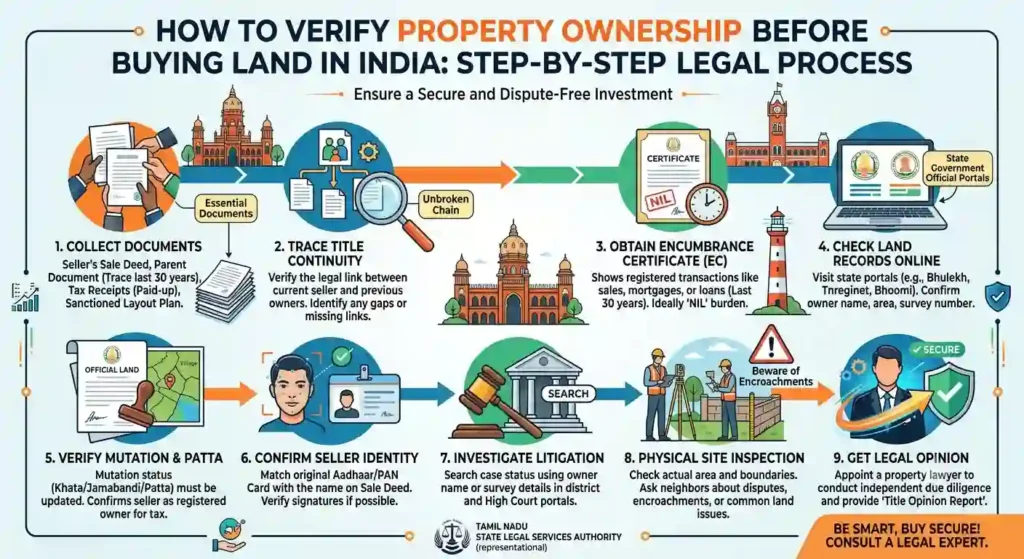
Parent documents establish how ownership moved from earlier owners to the present seller. Begin with the earliest available registered document creating or transferring the title. Then examine every subsequent conveyance until the proposed transaction. Important documents may include sale deeds, partition deeds, settlement deeds, gift deeds, release deeds, and probate orders. Also examine legal-heir documents when inheritance created the seller’s title. Every document should contain consistent names, survey details, boundaries, and measurements. Moreover, check whether earlier owners possessed transferable rights. A missing link can create serious title concerns despite a recent registered deed. Registration alone does not guarantee that the seller possesses perfect ownership. Therefore, buyers should investigate the underlying title independently. The Registration Act also regulates compulsory registration and evidentiary consequences concerning registrable instruments. Obtain certified copies where originals remain unavailable. Finally, have a property lawyer prepare a written title opinion before executing the agreement.
Search Encumbrances, Mortgages and Pending Transactions
An encumbrance search helps identify registered mortgages, charges, transfers, and other recorded interests. Buyers should obtain an Encumbrance Certificate covering an appropriate historical period. However, an EC should not become the only title-verification document. Some claims may remain outside registration records or require separate investigation. Therefore, inspect loan documents, bank releases, court orders, and possession records where circumstances demand. Ask the seller to disclose existing loans and financial liabilities. Additionally, verify whether any mortgage has received a proper release or discharge. Check whether the property appears in litigation involving ownership, partition, inheritance, recovery, or injunctions. eCourts services can assist with court-case searches using available case details. A lawyer should also examine whether notices, attachments, or prohibitory orders affect the property. Furthermore, inspect the Sub-Registrar’s records for recent transactions. Prompt investigation can expose hidden financial or litigation risks. Consequently, buyers should postpone major payments until satisfactory legal due diligence confirms marketable title.
Verify Patta, Chitta, FMB and Revenue Records
Tamil Nadu land records provide important information for verifying survey details and revenue entries. Buyers should compare the seller’s documents with Patta, Chitta, FMB, TSLR, and A-Register records. Check the district, taluk, village, survey number, subdivision, extent, classification, and recorded holder. However, revenue records do not independently establish perfect legal title in every situation. Therefore, treat them as important supporting evidence rather than substitutes for title documents. The government land-record system allows citizens to access several Tamil Nadu land records online. Additionally, physical records may require verification through the concerned revenue authorities. Check whether subdivision changes correspond with registered transactions. Furthermore, investigate discrepancies between the deed and revenue records immediately. A surveyor can verify boundaries and physical measurements when necessary. This step becomes particularly important for agricultural land and disputed boundaries. Consequently, buyers should combine revenue verification with registration searches and professional title examination. Such coordinated checks provide stronger protection against defective property purchases.
Confirm Seller Identity, Capacity and Authority
A buyer must establish that the proposed seller legally possesses authority to transfer the property. Verify the seller’s identity against the registered title documents and government records. Check whether the seller acts individually, jointly, through a power of attorney, or as a legal representative. For inherited property, identify every legal heir and examine succession documents. For jointly owned property, obtain consent and signatures from every necessary co-owner. Furthermore, verify whether any owner lacks legal capacity or requires representation. A power-of-attorney transaction requires careful examination of its scope, validity, execution, and revocation status. Corporate sellers require additional checks involving board authority and company records. Trust-owned properties require examination of trust deeds and applicable permissions. Therefore, authority verification should precede agreement execution. Any unexplained mismatch should trigger further legal investigation. Buyers should avoid relying on photocopies supplied without independent verification. Consequently, identity and authority checks help prevent impersonation, unauthorised sales, and later ownership challenges.
Legal Due Diligence and Purchase Protection
Verify Registration and Government Records
Registration records provide essential evidence concerning previously registered transactions involving the proposed property. Obtain certified copies of relevant deeds from the appropriate registration authority. Section 57 of the Registration Act provides mechanisms for obtaining copies from registration records. Compare certified copies with documents supplied by the seller. Check registration numbers, dates, parties, consideration, property schedules, and identifying descriptions. Also examine whether later instruments altered or transferred earlier interests. In Tamil Nadu, buyers should use the Registration Department’s available online services wherever appropriate. However, online searches should complement, rather than replace, professional document examination. Additionally, verify whether the property description matches current survey and revenue records. Registration documents must describe property sufficiently for identification under the statutory framework. Therefore, discrepancies deserve immediate clarification. A property lawyer can prepare a title-flow chart showing every ownership transfer. This process makes missing links easier to identify. Ultimately, certified registration records provide stronger evidence than informal copies or seller assurances.
Check Court Cases, Attachments and Injunctions
Litigation searches help determine whether another person challenges ownership or possession. Search relevant court records using seller names, property details, and available case information. eCourts can provide useful information concerning pending and decided cases. Buyers should investigate civil suits involving declaration, partition, cancellation, specific performance, possession, or injunction. Additionally, examine cases involving mortgage recovery, insolvency, succession, or competing ownership claims. A pending case does not automatically make every sale invalid. However, litigation can significantly affect marketability, possession, financing, and future transactions. Therefore, buyers should obtain professional advice whenever court proceedings appear. Check whether courts have issued injunctions, attachments, status-quo orders, or other restrictions. Lawyers can inspect pleadings and orders rather than relying on case-status summaries alone. Furthermore, examine whether previous judgments affect the property’s title chain. Prompt litigation due diligence reduces the chance of purchasing disputed land. Consequently, buyers should treat unresolved court proceedings as serious transaction risks requiring specific legal advice.
Identify Land Classification and Government Restrictions
Land classification can determine whether the proposed purchase and intended development remain legally permissible. Buyers should identify whether land is agricultural, residential, commercial, industrial, government, assigned, temple-related, or otherwise restricted. In Tamil Nadu, revenue and land-administration authorities maintain records relevant to classification and land administration. Check whether planning permissions, conversion approvals, layout approvals, or other permissions apply. Furthermore, examine acquisition notifications, road reservations, waterbody classifications, and government claims. Certain lands may carry statutory restrictions on transfer or development. Therefore, buyers should verify applicable local planning and revenue requirements before purchase. Survey records can also reveal whether public roads or water channels affect the property. A qualified surveyor should inspect boundaries when records contain inconsistencies. Additionally, municipal or local-body records may reveal planning restrictions. These checks become crucial when purchasing plots for construction. Consequently, legal due diligence should cover both ownership and permissible land use. A clear title alone does not guarantee unrestricted development rights.
Review Stamp Duty and Registration Requirements
A legally effective property transaction requires proper documentation, stamping, execution, and registration wherever applicable. Buyers should identify the correct instrument before signing the transaction. A sale deed generally records the final transfer of ownership according to applicable law. The Registration Act identifies several instruments requiring compulsory registration. Buyers should also verify applicable stamp duty and registration charges under Tamil Nadu law. Understamping or incorrect documentation can create financial and legal complications. Therefore, obtain professional drafting advice before executing an agreement or deed. Check whether the consideration, property description, parties, and possession terms remain accurate. Additionally, ensure necessary identification and execution requirements are satisfied. Registration should occur before treating the transaction as fully completed where registration remains legally necessary. Buyers should retain certified copies and registration acknowledgements after completion. Furthermore, reconcile registered documents with revenue records following the transaction. Proper post-registration follow-up strengthens the documentary record. Consequently, legal assistance can reduce execution mistakes and prevent avoidable registration disputes.
Special Precautions for NRIs and Inherited Property
NRIs purchasing Indian land require additional diligence concerning inheritance, authority, foreign-exchange rules, and documentation. An NRI buyer should verify whether the proposed property falls within permissible acquisition categories. Inherited property requires examination of the deceased owner’s title and succession documents. Obtain death certificates, legal-heir evidence, wills, probate documents, and previous deeds where relevant. Furthermore, identify every person holding a potential inheritance interest. A power of attorney used by an overseas party requires careful verification. Buyers should also consider applicable FEMA rules when transactions involve non-resident parties. Therefore, professional advice should cover both property law and applicable foreign-exchange requirements. NRIs should avoid signing documents based solely on informal assurances from relatives or agents. Certified documents and properly executed authorisations provide stronger protection. Additionally, verify tax obligations connected with the proposed transaction. Cross-border transactions may require coordinated advice from property and tax professionals. Consequently, advance planning helps NRIs avoid defective execution, inheritance disputes, and regulatory complications.
Remedies for Defective Property Transactions
Buyers can pursue different remedies when title defects, fraud, misrepresentation, or contractual breaches emerge. The appropriate remedy depends upon the transaction stage and evidence available. A buyer may seek cancellation, refund, specific performance, declaration, injunction, damages, or other relief. Courts may grant appropriate relief according to applicable facts and statutory requirements. Additionally, interim injunctions can protect possession or prevent further transfers in suitable cases. Where forged documents or deliberate deception appear, criminal remedies may also become relevant. India’s current criminal framework includes BNS, BNSS, and BSA, replacing the earlier IPC, CrPC, and Evidence Act framework. Buyers should therefore obtain current legal advice before initiating criminal proceedings. Police complaints may become appropriate when evidence indicates forgery, cheating, impersonation, or related offences. However, contractual disputes do not automatically constitute criminal offences. Therefore, lawyers should assess evidence before recommending police action. Civil courts, criminal courts, registration authorities, revenue authorities, and other forums may have different jurisdictions. Prompt legal strategy can preserve evidence and prevent further transfers.
Role of Courts, Authorities and Legal Professionals
Property disputes often require coordination among registration, revenue, planning, police, and judicial authorities. The appropriate forum depends upon the specific legal issue. Registration disputes may require proceedings involving the concerned registration authorities or competent courts. Revenue matters may involve Tahsildars, Revenue Divisional Officers, or other designated authorities. Civil courts can address appropriate title, possession, injunction, declaration, and contractual disputes. Criminal courts may address offences supported by evidence under current criminal laws. The CPC continues governing civil procedure subject to applicable statutory provisions. Meanwhile, BNS, BNSS, and BSA govern relevant criminal offences, procedure, and evidence. Therefore, forum selection requires careful legal assessment. Buyers should preserve agreements, receipts, bank records, communications, title documents, and registration records. Furthermore, lawyers can issue notices and seek urgent interim relief when necessary. In complex cases, surveyors, document experts, accountants, and advocates may work together. Consequently, professional property-law support provides stronger protection than informal negotiation alone. Early advice also improves the prospects of settlement or successful litigation.
Practical Property Buyer Checklist
A disciplined verification checklist can substantially reduce property ownership risks before purchase. Buyers should complete the following checks before committing substantial funds:
- Verify the complete title chain and parent documents.
- Obtain registration records and relevant certified copies.
- Examine the Encumbrance Certificate and mortgage records.
- Verify Patta, Chitta, FMB, TSLR, and A-Register details.
- Confirm seller identity, authority, and ownership capacity.
- Search court cases, injunctions, attachments, and competing claims.
- Confirm land classification and applicable development restrictions.
- Conduct a physical survey and boundary inspection.
- Verify tax, approval, conversion, and local-body records.
- Obtain an independent written property title opinion.
The Registration Act requires adequate property identification within registrable documents. Therefore, document and survey consistency remains essential. Buyers should avoid rushing transactions because sellers promise immediate discounts. Furthermore, payment schedules should reflect satisfactory legal due diligence. A written agreement should clearly address title defects, refunds, representations, and default consequences. Consequently, systematic verification provides better protection than relying on market reputation or possession.
Recent Tamil Nadu Registration Development
Tamil Nadu property buyers should remain aware of recent developments concerning original title documents and registration rules. The Tamil Nadu Government Gazette recorded developments following a Supreme Court judgment dated April 7, 2025. The Gazette states that the Supreme Court declared Rule 55-A(i) of the Tamil Nadu Registration Rules ultra vires the Registration Act. The Government subsequently proposed legislative action addressing the underlying fraud and impersonation concerns. Therefore, buyers should avoid relying on outdated assumptions concerning mandatory production of original parent documents. The current legal position should be checked before each transaction. Importantly, this development does not eliminate the need for comprehensive title verification. Buyers should still investigate ownership, encumbrances, prior transfers, litigation, and revenue records. Additionally, lawyers should verify the latest statutory and administrative position before registration. Consequently, current professional advice remains valuable for Chennai and Tamil Nadu transactions. This approach protects buyers against both historical title defects and evolving registration requirements.
How Paramount Law House Can Help Property Buyers
Paramount Law House provides legal support for property buyers seeking secure ownership and informed purchase decisions. Our due-diligence process can examine title deeds, parent documents, registration records, revenue records, encumbrances, and litigation. We can identify ownership gaps, conflicting claims, mortgage concerns, boundary issues, and documentation inconsistencies. Furthermore, our lawyers can prepare property title opinions and advise clients before agreements or registrations. Buyers facing fraud can receive guidance regarding civil remedies and appropriate criminal-law action. We can also assist with legal notices, injunction proceedings, declaration suits, cancellation claims, specific-performance disputes, and property negotiations. Where necessary, representation can involve civil courts, registration authorities, revenue authorities, police authorities, tribunals, or other competent forums. NRI buyers can receive coordinated assistance concerning inherited property, powers of attorney, and cross-border documentation. Therefore, early legal consultation can prevent expensive disputes. Property purchases involve substantial financial commitments, making professional due diligence particularly important. Paramount Law House helps clients make legally informed property decisions while reducing avoidable ownership and litigation risks.
Frequently Asked Questions
Can I buy land without checking the title?
No. Always verify the title chain, registration records, encumbrances, revenue records, litigation, boundaries, and seller authority before paying substantial consideration.
Is Patta proof of absolute ownership?
Patta supports revenue records but does not always establish perfect legal title. Buyers should examine registered deeds, succession records, and the complete title chain.
Should I obtain an Encumbrance Certificate?
Yes. An EC helps identify recorded transactions and encumbrances. However, it should complement complete legal title verification and litigation searches.
Can an NRI buy land in India?
NRI property purchases depend on applicable FEMA rules and property categories. Obtain professional advice before signing agreements or transferring substantial funds.
What if the seller has forged documents?
Preserve evidence immediately and seek legal advice. Depending on the facts, civil remedies and criminal proceedings under current BNS and BNSS provisions may apply.
Which lawyer should verify property ownership?
Choose a property lawyer experienced in title due diligence, registration, revenue records, litigation searches, documentation, and local Tamil Nadu property laws.
Read More
- Empowerment Defined: Power of Attorney Deed Advice
- Legacy Secure: Will Deed Legal Assurance
- Rent Recovery Services: Effective Solutions for Your Needs
- Property Purchase Agreement Legal Consultation: Expert Advice
- Property Document Verification Services: Ensure Accuracy
- Commissionerate of Land Administration, Tamil Nadu