Joint Ownership of Property: Legal Support Available
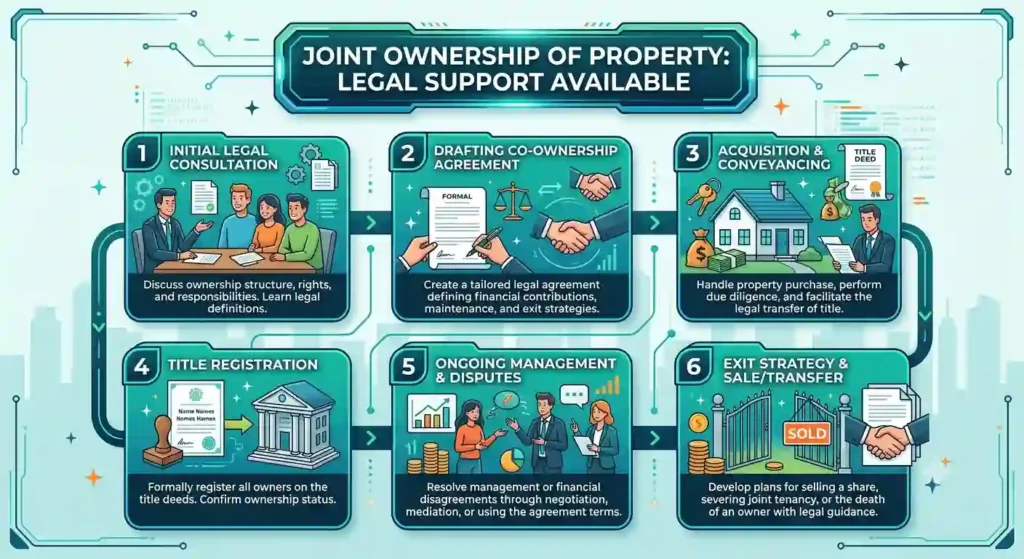
Joint ownership allows two or more persons to hold legal rights over the same property. Therefore, clear documentation reduces future ownership disputes….
Joint ownership allows two or more persons to hold legal rights over the same property. Therefore, clear documentation reduces future ownership disputes. Paramount Law House advises families, spouses, siblings, investors, companies, partnerships, NRIs, and co-owners regarding property rights and obligations. Our lawyers prepare ownership agreements, partition deeds, family settlements, sale documents, and litigation strategies. Moreover, legal advice protects investments while preventing unnecessary conflicts. Joint ownership may arise through purchase, inheritance, gift, succession, or family arrangements. Proper legal planning safeguards possession, title, revenue records, and financial interests. Timely legal intervention ensures compliance with applicable property laws while protecting every co-owner’s lawful rights before competent authorities and courts.
Joint Ownership of Property: Legal Support Available – Paramount Law House
Common Legal Issues in Joint Ownership
Jointly owned properties frequently generate legal disagreements among co-owners. Every dispute requires careful legal evaluation and documentary verification. Furthermore, prompt legal action preserves valuable ownership rights.
Common legal issues include:
- Partition disputes
- Illegal sale
- Boundary disputes
- Title conflicts
- Inheritance claims
- Co-owner possession disputes
- Unauthorized construction
- Encroachment
- Mutation disputes
- Family settlement conflicts
- Gift deed challenges
- Mortgage disputes
- Tenancy issues
- Easement disputes
- Revenue record errors
Experienced legal representation minimizes litigation while protecting ownership interests through practical legal solutions.
Laws Governing Jointly Owned Property
Important Statutory Framework
Several Indian statutes regulate joint ownership and property disputes. Accordingly, lawyers evaluate title documents, succession rights, and statutory provisions before initiating proceedings.
| Law | Purpose |
|---|---|
| Transfer of Property Act, 1882 | Property transfers |
| Partition Act, 1893 | Partition proceedings |
| Registration Act, 1908 | Property registration |
| Specific Relief Act, 1963 | Injunctions and declarations |
| Code of Civil Procedure, 1908 | Civil litigation |
| Bharatiya Nyaya Sanhita, 2023 | Criminal offences |
| Bharatiya Nagarik Suraksha Sanhita, 2023 | Criminal procedure |
| Bharatiya Sakshya Adhiniyam, 2023 | Evidence |
Our advocates determine applicable laws before preparing customized legal strategies for every property dispute.
Resolving Joint Property Disputes Effectively
Courts, Authorities and Jurisdiction
Forums Handling Property Disputes
Jurisdiction depends upon property location, valuation, and dispute nature. Therefore, selecting the proper forum improves procedural efficiency and successful outcomes.
Relevant authorities include:
- Civil Court
- District Court
- High Court
- Supreme Court
- Sub-Registrar Office
- Revenue Department
- Tahsildar Office
- Municipal Corporation
- Local Police Station
- Survey Department
Nearby police stations investigate criminal trespass, forgery, cheating, criminal intimidation, document fabrication, and land-related offences under applicable criminal laws.
Legal Process for Joint Ownership Matters
Property litigation follows structured procedural requirements. Initially, advocates verify title documents and revenue records. Subsequently, suitable legal proceedings protect ownership interests.
Legal services include:
- Title verification
- Legal notice
- Partition suit
- Declaration suit
- Permanent injunction
- Temporary injunction
- Mediation
- Settlement drafting
- Appeal
- Execution proceedings
- Registration advice
- Mutation assistance
Early legal planning reduces prolonged litigation while strengthening documentary evidence and legal rights.
Remedies and Professional Legal Support
Comprehensive Property Law Assistance
Joint ownership disputes demand experienced legal analysis and strategic representation. Therefore, Paramount Law House provides complete legal assistance from documentation through final decree execution. Our advocates advise individuals, families, builders, companies, societies, trusts, NGOs, and NRIs regarding ownership rights, succession, transfers, partition, and possession. Furthermore, we prepare pleadings, written statements, affidavits, sale deeds, release deeds, settlement agreements, and appeals. Applicable laws include the Transfer of Property Act, Partition Act, Registration Act, Specific Relief Act, Code of Civil Procedure, Bharatiya Nyaya Sanhita, Bharatiya Nagarik Suraksha Sanhita, and Bharatiya Sakshya Adhiniyam. Professional legal support preserves valuable property rights while minimizing future ownership disputes.
Available Legal Remedies
Courts provide several remedies for joint property disputes. Every remedy depends upon documentary evidence and statutory rights. Consequently, timely legal advice improves successful resolution.
Available remedies include:
- Partition decree
- Declaration of title
- Permanent injunction
- Temporary injunction
- Recovery of possession
- Mesne profits
- Cancellation of documents
- Specific performance
- Mutation correction
- Revenue appeals
- Mediation
- Settlement
- Criminal complaint
- Appeal
- Execution petition
Professional legal representation ensures effective protection of co-owners’ lawful interests throughout every stage of litigation.
Frequently Asked Questions
1. Can one co-owner sell jointly owned property alone?
Generally, a co-owner may transfer only their lawful share unless every co-owner provides required consent.
2. How can joint property be divided legally?
Co-owners may execute a partition deed or file a partition suit before the competent civil court.
3. Can an NRI claim inherited joint property in India?
Yes. NRIs may enforce inheritance and ownership rights through authorized legal representatives and competent courts.
4. What documents establish joint ownership?
Registered sale deeds, partition deeds, revenue records, mutation entries, succession documents, and registered agreements establish ownership.
5. Can illegal construction by one co-owner be challenged?
Yes. Aggrieved co-owners may seek injunctions, demolition orders, damages, or other lawful remedies before competent authorities.
6. Why should co-owners consult a property lawyer?
Legal advice prevents documentation errors, protects ownership rights, resolves disputes efficiently, and strengthens court proceedings.
Read More
- Land Acquisition Guidance: Navigate Legal Procedures
- Land Development Joint Venture Agreement Review: Legal Expertise
- Land Fraud Prevention: Safeguard Your Property Rights
- Land Grabbing Complaint Resolution: Legal Assistance
- Land Purchase Legal Opinion: Expert Advice for Informed Decisions
- Department of Land Resources (Ministry of Rural Development)