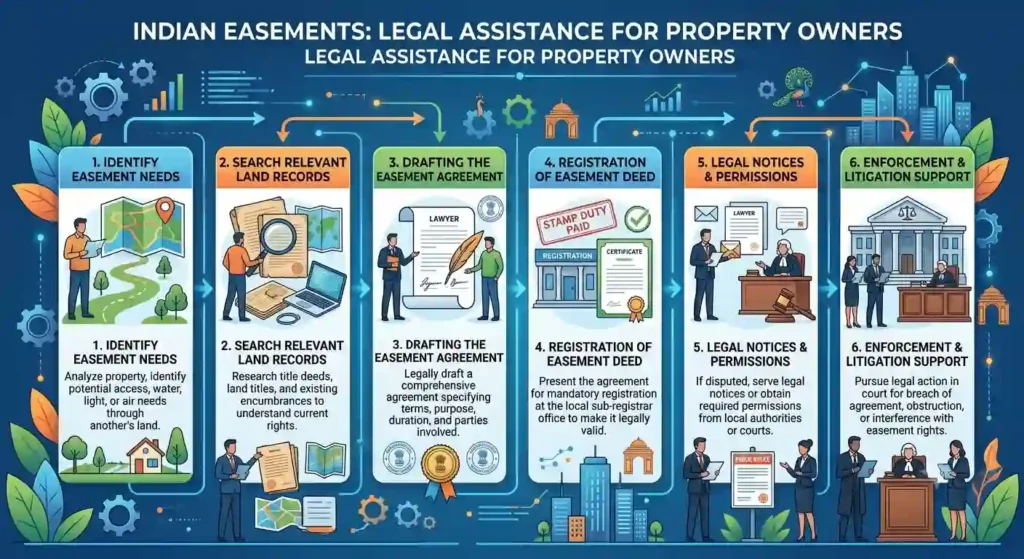
Indian Easements: Legal Assistance for Property Owners
Legal Assistance for Property Owners – Easement law protects a property owner’s right to use another person’s land for a specific lawful…
Legal Assistance for Property Owners – Easement law protects a property owner’s right to use another person’s land for a specific lawful purpose. Therefore, it plays a crucial role in resolving access, drainage, and utility disputes. Indian Easements Act, 1882 governs these rights across residential, commercial, and agricultural properties. Property owners often face conflicts regarding right of way, water access, light, air, and drainage usage. Consequently, legal clarity prevents long-term disputes and costly litigation. Paramount Law House: Property Lawyers 24×7 assists owners, builders, NRIs, and developers in protecting easement rights. Early legal guidance ensures proper documentation, survey verification, and compliance with property records. Moreover, courts evaluate necessity, prescription, and express grants before recognizing easement claims. Therefore, understanding easement rights strengthens ownership protection and reduces boundary-related conflicts across urban and rural properties in India.
Indian Easements: Legal Assistance for Property Owners – Paramount Law House
Importance of Easement Rights for Property Protection
Easement rights ensure peaceful enjoyment of property without unlawful interference from neighboring landowners. Therefore, property disputes often arise when access or utility rights get obstructed. Legal experts evaluate property deeds, survey maps, municipal records, and historical usage before advising clients. Easement claims may arise due to necessity, long-term use, or contractual agreements. Common disputes include blocked pathways, restricted water flow, encroached access roads, and utility line interference. Consequently, legal intervention becomes necessary to restore property rights. Courts prioritize evidence of continuous and lawful usage before granting easement relief. Additionally, NRIs frequently face property access disputes in ancestral lands. Early legal review prevents escalation into civil suits and protects ownership interests effectively.
Key Types of Easements Recognized in India
Easement rights in India are categorized based on usage and legal origin. Therefore, understanding these types helps property owners identify enforceable rights. Common easements include:
- Right of way easement
- Right to light and air
- Water drainage easement
- Utility installation easement
- Support easement for structures
- Prescriptive easement due to long usage
- Easement by necessity
Each easement type requires specific legal proof. Consequently, courts examine documentation, usage history, and necessity before recognition. Property lawyers evaluate facts before initiating legal action.
Legal Elements Required to Prove Easement Rights
To establish easement rights, property owners must satisfy legal conditions under Indian law. Therefore, courts require strong evidence before granting relief. Key elements include:
| Requirement | Legal Purpose |
|---|---|
| Dominant property | Benefited land |
| Servient property | Burdened land |
| Continuous use | Proof of long-term usage |
| Peaceful enjoyment | No dispute history |
| Legal necessity | Justification of right |
| Documentary proof | Evidence support |
Proper legal documentation strengthens claims before civil courts and tribunals. Consequently, structured evidence improves litigation success.
Common Easement Disputes Faced by Property Owners
Property disputes involving easements arise frequently in urban and rural areas. Therefore, timely legal support becomes essential. Common disputes include:
- Blocked access roads
- Drainage obstruction
- Water supply disputes
- Encroached pathways
- Utility line interference
- Boundary disagreements
- Construction obstruction
- Shared property misuse
Legal professionals analyse property records and municipal approvals before filing cases. Consequently, structured legal action ensures protection of ownership rights.
Legal Framework Governing Easements in India
The Indian Easements Act, 1882 governs all easement rights across India except certain regions. Additionally, property disputes follow the Code of Civil Procedure, 1908 for litigation processes. Criminal acts such as trespass, illegal obstruction, or property damage may invoke provisions under Bharatiya Nyaya Sanhita, 2023 (BNS). Investigation procedures follow Bharatiya Nagarik Suraksha Sanhita, 2023 (BNSS), while evidence rules fall under Bharatiya Sakshya Adhiniyam, 2023 (BSA). Courts assess ownership records, municipal approvals, and historical usage before granting relief. Therefore, legal compliance ensures stronger protection of property rights in easement disputes across India.
Legal Issues Commonly Seen in Easement Disputes
Easement disputes often involve overlapping civil and property law issues. Therefore, courts evaluate multiple legal factors before judgment. Common issues include:
- Encroachment on access paths
- Blocking drainage systems
- Denial of utility connections
- Illegal construction interference
- Boundary disputes
- Misuse of shared pathways
- Violation of easement agreements
- Interference with property enjoyment
Civil courts and district courts primarily handle such disputes. Early legal advice ensures proper case strategy and jurisdiction selection.
Jurisdiction, Courts, and Government Authorities in Easement Disputes
Easement disputes require correct jurisdiction to ensure effective legal remedies and timely resolution. Therefore, property owners must identify the proper forum before filing cases. Civil Courts and District Courts primarily handle easement suits under property law principles. Additionally, High Courts may intervene through appellate or writ jurisdiction when legal errors occur. Revenue authorities and municipal bodies also play a supporting role in land records, boundary verification, and property mapping. Consequently, coordination between legal and administrative systems becomes essential. Paramount Law House: Property Lawyers 24×7 assists clients in selecting the correct forum and preparing jurisdiction-specific pleadings. Moreover, courts examine title deeds, survey records, and long-term usage evidence before granting easement relief. Proper jurisdiction strengthens case validity and reduces procedural rejection risks in property litigation.
Government Departments and Property Authorities Involved
Several government departments assist in resolving easement-related disputes and verifying property rights. Therefore, administrative coordination supports judicial decision-making. Key authorities include:
- Revenue Department for land records
- Municipal Corporation for building approvals
- Survey and Settlement Department for boundary maps
- Electricity and Water Boards for utility rights
- Sub-Registrar Office for property deeds
- Panchayat or local bodies for rural disputes
- Town Planning Authorities for urban layouts
Each department provides essential records for easement claims. Consequently, legal verification depends on accurate documentation from these agencies.
Legal Remedies Available in Easement Disputes
Indian law provides multiple remedies for protecting easement rights and restoring property access. Therefore, courts offer both preventive and compensatory relief. Common remedies include:
| Remedy Type | Purpose |
|---|---|
| Permanent injunction | Prevent obstruction |
| Mandatory injunction | Restore access |
| Damages | Compensation for loss |
| Declaratory relief | Confirm easement right |
| Temporary injunction | Immediate protection |
| Restoration order | Reopen blocked access |
| Court direction | Prevent future violations |
| Cost recovery | Litigation expenses |
Legal remedies depend on evidence strength and statutory compliance. Consequently, proper drafting improves judicial outcomes.
Evidence and Documentation Required in Easement Cases
Strong documentation plays a decisive role in easement litigation. Therefore, property owners must preserve all relevant records before filing cases. Essential evidence includes:
- Sale deeds and title documents
- Survey maps and layout plans
- Historical usage records
- Municipal approval documents
- Photographs and video evidence
- Utility connection proofs
- Witness statements
- Revenue records
The Bharatiya Sakshya Adhiniyam, 2023 (BSA) governs admissibility of evidence. Consequently, structured documentation strengthens legal arguments in court.
Common Legal Issues in Easement Litigation
Easement disputes frequently involve overlapping property and civil law issues. Therefore, courts assess multiple legal factors before judgment. Common issues include:
- Encroachment on access paths
- Blocking of drainage or water flow
- Illegal construction affecting rights
- Disputed boundary lines
- Interference with utility services
- Misuse of shared property access
- Violation of easement agreements
- Refusal of right of passage
Civil courts primarily resolve these disputes under property law principles. Early legal intervention ensures stronger protection of ownership rights.
Police Assistance, Criminal Trespass, and Property Protection Measures
Certain easement disputes escalate into criminal acts requiring immediate legal action and police intervention. Therefore, property owners should act quickly when obstruction involves force or intimidation. Illegal trespass, criminal intimidation, property damage, and wrongful restraint may attract provisions under the Bharatiya Nyaya Sanhita, 2023 (BNS). Investigation procedures follow the Bharatiya Nagarik Suraksha Sanhita, 2023 (BNSS), while evidentiary standards rely on the Bharatiya Sakshya Adhiniyam, 2023 (BSA). Property owners may approach the nearest police station, jurisdictional station house officer, or local crime branch depending on severity. Lawyers assist in drafting complaints, preserving evidence, and initiating parallel civil proceedings. Consequently, coordinated legal action strengthens both criminal protection and civil easement enforcement.
Role of Paramount Law House in Easement Disputes
Paramount Law House: Property Lawyers 24×7 provides comprehensive legal support for easement disputes across residential, commercial, and industrial properties. Therefore, property owners receive end-to-end assistance from consultation to litigation. Services include title verification, property documentation review, injunction suits, boundary dispute resolution, and enforcement of easement rights. Lawyers also represent clients before Civil Courts, District Courts, Revenue Authorities, and High Courts. NRIs and urban developers benefit from structured legal strategies for access rights, utility disputes, and construction conflicts. Moreover, legal experts coordinate with government departments to obtain survey records and municipal approvals. Professional representation ensures compliance with the Code of Civil Procedure, 1908 (CPC), strengthening litigation outcomes and protecting long-term property interests.
Litigation Strategy and Legal Process in Easement Cases
Successful easement litigation depends on structured legal preparation, strong evidence, and correct procedural compliance. Therefore, property owners must follow a systematic legal approach. Key litigation steps include:
- Legal consultation and case assessment
- Title deed and record verification
- Evidence collection and documentation
- Filing civil suit for injunction or declaration
- Seeking interim relief from court
- Presenting witness and expert evidence
- Final hearing and arguments
- Execution of court order
Courts evaluate necessity, continuous usage, and legal ownership before granting easement relief. Consequently, well-prepared cases achieve stronger judicial outcomes.
Protecting Property Rights Through Expert Easement Legal Support
Easement law plays a crucial role in maintaining peaceful property enjoyment and resolving access disputes. Moreover, proper legal guidance ensures protection against unlawful obstruction and boundary conflicts. Paramount Law House: Property Lawyers 24×7 delivers strategic legal solutions for property owners, NRIs, builders, and businesses across India. Experienced lawyers handle injunction suits, declaration suits, criminal complaints, and appellate proceedings before competent courts. Therefore, timely legal intervention prevents escalation and protects ownership rights effectively. With strong documentation, correct jurisdiction, and professional representation, property owners can secure long-term legal protection under Indian property laws and civil procedures.
Frequently Asked Questions
1. What is an easement right in property law?
It is a legal right allowing a property owner to use another’s land for specific purposes like access, drainage, or utilities.
2. Which law governs easements in India?
The Indian Easements Act, 1882 governs easement rights along with property and civil procedure laws in India.
3. Which court handles easement disputes?
Civil Courts and District Courts handle easement disputes, while High Courts handle appeals and complex property law matters.
4. Can easement rights be legally stopped?
Yes, courts can stop or modify easements if they are misused or no longer legally justified.
5. What remedies are available in easement cases?
Courts may grant injunctions, damages, restoration of access, declarations, and protection orders for property rights.
6. Why should I hire a property lawyer for easement issues?
A property lawyer ensures correct legal strategy, documentation, court representation, and protection of ownership and access rights.
Read More
- Industrial Land Law Consultation: Expert Guidance
- Injunction Order Representation: Protect Your Property Interests
- Joint Ownership of Property: Legal Support Available
- Land Acquisition Guidance: Navigate Legal Procedures
- Land Development Joint Venture Agreement Review: Legal Expertise
- Ministry of Law & Justice – Government of India