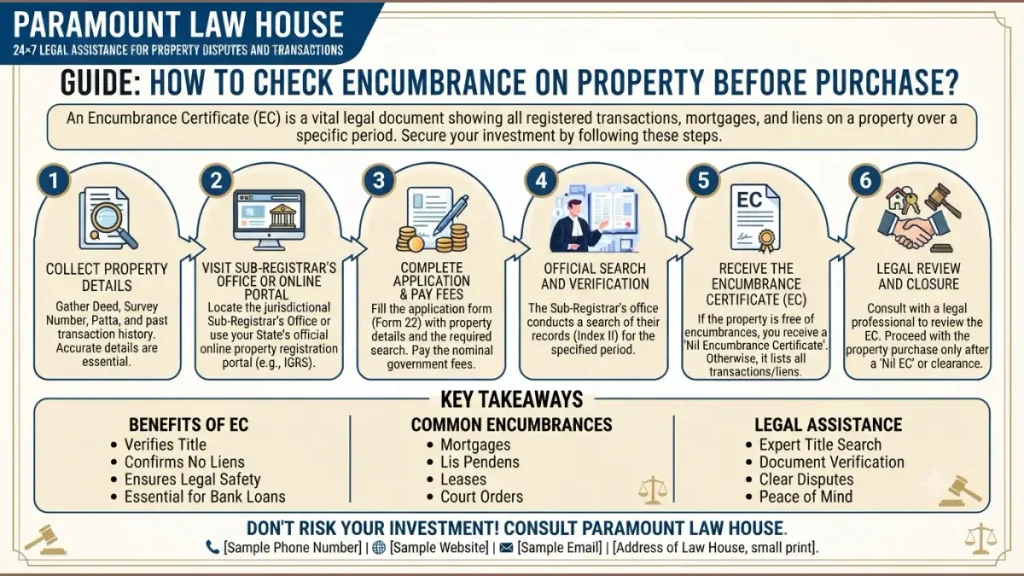
Paramount Law House: 24×7 legal assistance for property disputes and transactions
An Encumbrance Certificate records registered transactions affecting a property during the searched period. Therefore, buyers commonly use it to identify mortgages, sales,…
An Encumbrance Certificate records registered transactions affecting a property during the searched period. Therefore, buyers commonly use it to identify mortgages, sales, releases, settlements, and other registered dealings. The certificate generally connects property details with registration records maintained by the Registration Department. However, an EC does not independently establish perfect title over the property. Unregistered arrangements, certain court proceedings, family claims, possession disputes, and other issues may remain outside its entries. Consequently, buyers should treat the EC as one part of comprehensive property due diligence.
In Tamil Nadu, the Inspector General of Registration provides Encumbrance Certificate services through the state e-services system. A purchaser should compare every EC entry with the corresponding registered document. Any mismatch requires immediate legal examination before payment. Furthermore, the search period should cover the complete relevant ownership chain. A limited search can miss earlier mortgages, transfers, or competing interests. Paramount Law House can coordinate document verification and provide transaction-focused legal assistance.
An EC can reveal registered burdens, but it cannot answer every title question. For example, a family dispute may exist without a corresponding registered transaction. Similarly, an inheritance claim may require examination of wills, legal-heir documents, partition records, or succession proceedings. Therefore, buyers should obtain the parent documents and trace ownership backward through each transfer. Revenue records also require separate verification because patta, chitta, adangal, and related entries serve different administrative purposes. In Chennai, property tax records provide another useful cross-check for ownership and assessment details.
The Greater Chennai Corporation provides property-tax status and assessment services through its official portal. Additionally, buyers should verify whether construction approvals correspond with the property description. A lawyer should investigate litigation databases, court records, and available tribunal records when circumstances create concerns. Thus, an EC should support a title investigation rather than replace it. This approach reduces risks involving defective title, undisclosed mortgages, forged documents, illegal possession, and competing ownership claims.
A purchaser should build a complete chain of title before signing the final sale deed. First, obtain the proposed seller’s current title deed and every material parent document. Next, compare names, survey numbers, subdivision numbers, boundaries, extent, document numbers, and registration dates. The same property description should remain consistent throughout the chain. Any unexplained change can indicate subdivision, amalgamation, correction, transfer, or documentation problems. Buyers should also inspect release deeds, settlement deeds, partition deeds, gift deeds, mortgage deeds, and powers of attorney. Moreover, certified copies can help verify documents when originals appear unavailable or incomplete. Tamil Nadu’s e-services system includes certified-copy services alongside EC services. The following checklist supports a practical document review:
- Current title deed and prior parent deeds.
- EC covering the appropriate historical period.
- Certified copies of relevant registered instruments.
- Patta, chitta, adangal, and survey records.
- Property-tax receipts and assessment information.
- Approved building and planning documents.
- Identity and authority documents of the seller.
A property lawyer should reconcile these records before recommending completion.
Revenue records can provide valuable information about land classification, possession-related entries, survey details, and administrative records. However, buyers should understand that revenue entries do not automatically replace registered title documents. Therefore, the purchaser should compare the patta details with the registered deed and physical property. Survey numbers and subdivision numbers deserve particular attention because errors can affect identification. Likewise, adangal information may provide useful agricultural land details where applicable.
Buyers should investigate changes caused by subdivision, reassignment, resurvey, acquisition, or government proceedings. Additionally, the relevant Taluk office, Revenue Department records, and applicable online services may require review. A mismatch between revenue records and registered documents should never receive casual treatment. Instead, the buyer should seek written clarification and legal advice before proceeding. Furthermore, boundary verification through a qualified surveyor can identify physical discrepancies. Such verification becomes especially important for vacant plots and inherited properties. Paramount Law House can assist with coordinating document reviews, title opinions, revenue-record checks, and transaction safeguards.
Tamil Nadu provides Encumbrance Certificate issuance and EC download services through its e-services framework. Buyers should use accurate property particulars while requesting the search. These particulars may include district, sub-registrar jurisdiction, village, survey number, subdivision, and other identifying information. The requested period should reflect the property’s complete relevant transaction history. After receiving the EC, examine each entry carefully instead of checking only the latest transaction. Match each document number against certified copies and the seller’s title documents.
If the EC shows a mortgage, release deed, settlement, or sale, obtain the underlying instrument. Then verify whether the transaction corresponds with the current seller’s claim. A clean-looking EC should still undergo wider title verification. Furthermore, the buyer should check whether any relevant records fall outside the selected search period. The Tamil Nadu e-services listing currently identifies EC issuance, EC download, certified-copy issuance, and certified-copy download as Registration Department services. Professional legal review can identify inconsistencies that a basic search may overlook.
Mortgage entries deserve immediate attention because they can indicate a lender’s registered interest in the property. A buyer should identify the mortgagee, document number, date, secured transaction, and release status. If a release deed appears later, verify that the release covers the same property and mortgage. Similarly, a settlement deed can alter ownership and may involve family relationships requiring deeper title investigation.
Release deeds also require careful scrutiny because a partial release may not discharge every property interest. Therefore, buyers should obtain certified copies rather than relying solely on descriptions appearing within the EC. Bank-financed properties require additional confirmation from the lending institution. The purchaser should avoid paying the entire consideration until the mortgage is lawfully discharged or appropriately handled during registration. Moreover, a sale agreement should contain specific safeguards when loan closure remains pending. Legal counsel can structure escrow, bank settlement, document delivery, and registration conditions. These measures reduce the risk of purchasing property subject to an unresolved financial encumbrance or competing registered interest.
An EC cannot substitute for a litigation search because property disputes can arise from many legal relationships. A purchaser should investigate civil suits, appeals, execution proceedings, injunctions, partition disputes, specific-performance claims, and possession proceedings. Depending on the property, proceedings may also involve the High Court, District Courts, Commercial Courts, Debt Recovery Tribunal, consumer forums, revenue authorities, or other competent bodies. The exact forum depends upon the nature of the dispute and statutory jurisdiction. Therefore, legal due diligence should examine the seller’s disclosures and available court records. Buyers should also ask whether any notice, attachment, decree, interim order, or settlement affects the property. Under the Code of Civil Procedure, courts can grant and enforce remedies involving injunctions and specific performance. The Specific Relief Act also addresses possession, declarations, and specific performance. Consequently, a pending proceeding may materially affect a proposed transaction even when the EC appears clear.
Court orders can affect the practical ability to sell or transfer property. Therefore, buyers should investigate whether any decree, attachment, injunction, receiver appointment, or execution proceeding concerns the property. An attachment can create serious transaction risks, particularly when a judgment creditor seeks enforcement against the asset. Likewise, an injunction may restrict alienation, construction, possession, or other actions.
The Code of Civil Procedure contains provisions governing injunctions and enforcement of decrees. Buyers should therefore request litigation declarations from sellers and verify material claims independently. Furthermore, legal counsel should examine orders rather than relying on case titles alone. A pending matter may have changed substantially through settlement, dismissal, appeal, stay, or final judgment. The purchaser should preserve copies of relevant orders and pleadings. If necessary, counsel can seek certified copies from the concerned court. This process helps identify legal remedies before a transaction becomes irreversible. Paramount Law House can assist with litigation due diligence, title opinions, court-document review, and transaction risk assessment.
Property fraud may involve forged sale deeds, fabricated powers of attorney, impersonation, altered records, duplicate agreements, or fraudulent authority claims. Buyers should examine signatures, registration details, identity documents, photographs, consideration details, and execution circumstances. Digital copies should also receive careful scrutiny when parties exchange documents electronically. Under the Bharatiya Nyaya Sanhita, 2023, forgery provisions address false documents and false electronic records.
Section 336 specifically addresses forgery, while related provisions address forged court records and public registers. Therefore, suspicious documents require prompt legal evaluation rather than informal negotiation. A purchaser should preserve the original documents, digital communications, payment records, and transaction correspondence. Additionally, independent verification with the relevant registration office can help identify inconsistencies. If criminal conduct appears possible, the buyer may consider appropriate police remedies alongside civil proceedings. However, the exact offence and procedure depend upon the facts and available evidence. Paramount Law House can assist with property fraud complaints, document review, civil remedies, criminal-law coordination, and evidence preservation.
Property-related fraud can create both civil and criminal consequences. The Bharatiya Nyaya Sanhita, 2023 governs offences including relevant forms of cheating and forgery. The Bharatiya Nagarik Suraksha Sanhita, 2023 governs criminal procedure, including investigation-related processes. Its statutory forms include police notices concerning investigations and FIR-linked proceedings. The Bharatiya Sakshya Adhiniyam, 2023 provides the current evidentiary framework, including provisions concerning electronic records and certificates. Therefore, buyers should preserve emails, messages, scanned deeds, payment records, call records, and relevant digital files. A criminal complaint does not automatically resolve civil title rights. Similarly, a civil suit does not prevent appropriate criminal remedies when offences are established. Legal counsel should determine the correct combination of remedies. The evidence should also remain authentic and traceable. Proper preservation can strengthen proceedings before police authorities and courts. Consequently, early legal advice can prevent evidence loss and procedural mistakes.
A complete property investigation should examine records maintained by different government departments. The Registration Department verifies registered instruments and provides EC-related services. The Revenue Department maintains land-related administrative records, including relevant patta and survey information. Local bodies maintain property-tax and assessment records for properties within their jurisdictions.
In Chennai, the Greater Chennai Corporation provides property-tax status, assessment, payment, and related citizen services. These records should correspond with the seller’s title documents and physical property. Furthermore, buyers should verify planning permissions where buildings or developments exist. Depending on location, the relevant planning authority may include CMDA or another competent local planning authority. Waterbody, poramboke, acquisition, road-widening, and land-use issues may require additional verification. Therefore, a lawyer should identify the departments relevant to the property’s location and nature. A single document rarely provides complete legal assurance. Cross-verification reduces risks arising from inconsistent government records. Paramount Law House can coordinate a structured property due-diligence process covering registration, revenue, taxation, planning, and litigation records.
Property-tax records provide useful administrative information about assessment, usage, location, and tax payments. In Chennai, the Greater Chennai Corporation provides online property-tax status and assessment facilities. Buyers should compare the assessment details with the sale deed and actual property. Differences in owner name, address, built-up area, usage, or property identification numbers may require clarification. Additionally, outstanding tax liabilities should be identified before closing.
A buyer should request recent tax receipts and verify their authenticity. However, payment of property tax does not independently establish ownership. It also does not cure defects in title. Therefore, municipal records should support, rather than replace, title verification. The Greater Chennai Corporation also provides mechanisms for assessment, name transfer, objections, and related property-tax services. Buyers should preserve receipts and assessment records obtained during due diligence. Furthermore, lawyers should distinguish taxation records from ownership evidence. This distinction helps prevent false confidence during property transactions and supports better contractual safeguards.
A purchaser should create a property due-diligence file before transferring substantial money to the seller. The file should contain every document necessary to establish identity, title, possession, approvals, taxation, and transaction history. At minimum, buyers should collect the following records:
- Current sale deed and complete parent document chain.
- EC covering the appropriate historical period.
- Certified copies of material registered instruments.
- Patta, chitta, adangal, and relevant survey records.
- Property-tax assessment and recent payment receipts.
- Approved building or planning documents, where applicable.
- Seller identity and authority documents.
- Existing loan and mortgage-release documentation.
- Litigation disclosures and available court orders.
- Physical survey and boundary verification records.
Each document should receive cross-verification rather than isolated acceptance. Moreover, inconsistencies should be recorded in a written due-diligence report. This method creates an audit trail for the transaction. It also helps lawyers identify missing documents quickly. Paramount Law House can organise these materials into a structured title-verification report before registration.
A property title verification checklist should address legal ownership, registration history, possession, government records, financial liabilities, and litigation. Buyers should avoid informal verification because important issues can easily remain undocumented. A useful checklist can include the following categories:
| Verification Area | Key Records | Main Risk |
|---|---|---|
| Title | Sale and parent deeds | Defective ownership |
| Encumbrance | EC and certified copies | Mortgage or prior transfer |
| Revenue | Patta and survey records | Land identity mismatch |
| Municipal | Tax assessment and receipts | Outstanding liabilities |
| Planning | Approved plans and permissions | Unauthorised construction |
| Litigation | Court searches and orders | Injunction or competing claim |
| Finance | Bank release documents | Unreleased mortgage |
| Possession | Physical inspection | Occupant or boundary dispute |
Additionally, each issue should receive a clear status such as verified, pending, disputed, or requiring clarification. This approach helps purchasers make informed contractual decisions. It also provides lawyers with a reliable evidence trail during negotiations.
A well-drafted sale agreement should allocate responsibility for undisclosed encumbrances and title defects. The seller should provide accurate representations concerning ownership, mortgages, litigation, attachments, possession, and third-party claims. The agreement should also require delivery of original documents before or at the agreed closing stage. Furthermore, the purchaser can require the seller to discharge identified liabilities before registration. Where a bank loan exists, the agreement should specify the repayment and release process.
Appropriate indemnity clauses can address losses arising from specified title defects or undisclosed claims. However, contractual wording cannot replace independent legal due diligence. Therefore, buyers should complete the EC and title investigation before committing substantial consideration. The agreement should also contain appropriate termination and refund mechanisms for material title problems. Additionally, the parties should specify responsibility for taxes, registration expenses, pending dues, and document delivery. These provisions can reduce later disputes. Paramount Law House can draft or review sale agreements with transaction-specific safeguards for buyers, sellers, investors, and property developers.
Buyers often face pressure to pay advances before completing legal verification. A safer approach requires documentary verification before substantial financial commitment. If an advance becomes necessary, the agreement should clearly state its purpose, refund conditions, and consequences of defective title. The buyer should avoid relying on oral assurances concerning mortgage closure or pending litigation. Instead, every important representation should appear in written contractual documents. Furthermore, payment trails should remain transparent through traceable banking channels.
Cash arrangements can create serious evidentiary and tax complications. The purchaser should also specify that registration remains conditional upon satisfactory title verification. If a bank mortgage exists, payment arrangements should coordinate with the lender and release documentation. Where title concerns remain unresolved, legal counsel should recommend an appropriate transaction structure. Depending on circumstances, this may include escrow arrangements, conditional closing, staged payments, or cancellation rights. These safeguards reduce exposure to avoidable financial disputes. Consequently, legal review before payment can prove more economical than litigation after registration.
When due diligence reveals a material encumbrance, buyers should pause the transaction until the issue receives legal resolution. A purchaser should not assume that the seller can remove every burden quickly. First, obtain the relevant registered document and understand the nature of the encumbrance. Next, identify the person or institution holding the interest. Then determine whether the burden can be lawfully discharged before registration. If a mortgage exists, the buyer may require documented loan closure and release.
If a third-party claim exists, further investigation may become necessary. Similarly, litigation requires examination of pleadings, orders, and current case status. Buyers should document every concern in writing and preserve communications with the seller. Depending on the agreement, cancellation or refund rights may also arise. The Specific Relief Act addresses contractual and property-related remedies, including specific performance and recovery of possession. However, the available remedy depends on facts, contractual terms, limitation, evidence, and jurisdiction. Early legal intervention can prevent avoidable financial exposure.
Property disputes can require civil remedies when ownership, contractual rights, possession, or competing claims become contested. Depending on the facts, a party may seek declaration, possession, injunction, cancellation, or specific performance. The Specific Relief Act expressly addresses recovery of immovable property and specific performance of contracts. The Code of Civil Procedure provides procedural mechanisms for civil suits and injunction-related relief. Therefore, the correct remedy requires analysis of the transaction documents and disputed rights.
A buyer may also need interim protection where a property faces imminent alienation or alteration. Courts consider statutory requirements and factual circumstances before granting such relief. Consequently, parties should avoid assuming that every property dispute receives identical treatment. Jurisdiction can depend on property location, subject matter, monetary value, and applicable statutory provisions. Legal counsel should identify the appropriate civil court, High Court, tribunal, or statutory forum. Paramount Law House can assist with pleadings, interim applications, evidence preparation, negotiation, mediation, and property litigation strategy.
A police complaint may become relevant where facts indicate forgery, cheating, impersonation, fraudulent document creation, or other criminal conduct. The Bharatiya Nyaya Sanhita, 2023 contains provisions addressing forgery involving documents and electronic records. The complainant should provide a chronological statement supported by documents and transaction evidence.
Useful materials can include agreements, registered deeds, EC copies, payment proofs, identity documents, messages, emails, and relevant recordings. Additionally, the complainant should identify the disputed property and explain the alleged fraudulent conduct clearly. The appropriate police station generally depends on territorial and procedural jurisdiction. In Chennai, examples include J2 Adyar Police Station, Guindy Police Station, and K4 Police Station, but the correct station depends upon the facts. The Tamil Nadu Police also provides grievance-related mechanisms and citizen-facing services. Legal advice can help coordinate criminal complaints with parallel civil remedies when appropriate.
Digital evidence increasingly forms part of property transactions because buyers and sellers exchange documents electronically. Relevant evidence may include emails, messaging applications, scanned deeds, payment confirmations, electronic signatures, property advertisements, and digital photographs. The Bharatiya Sakshya Adhiniyam, 2023 contains provisions concerning electronic and digital records. Its statutory schedule includes certification requirements relating to electronic records. Therefore, parties should preserve original electronic sources whenever possible.
Screenshots alone may not provide the complete evidentiary context. Buyers should retain relevant files with metadata, timestamps, source information, and surrounding communications. They should also avoid editing or repeatedly converting original files. Furthermore, physical documents should remain safely preserved and properly indexed. A lawyer can identify which materials require certification or additional evidentiary foundation. This approach can strengthen proceedings before civil courts, criminal courts, and other competent forums. Evidence preservation should begin as soon as suspicious conduct appears. Delay can result in lost messages, unavailable accounts, damaged originals, or disputed authenticity.
The correct forum depends on the legal issue, property location, transaction structure, and governing statute. Ordinary title and possession disputes commonly proceed before competent civil courts. Appeals or constitutional issues may reach the High Court under appropriate jurisdiction. Certain financial disputes can involve specialised tribunals, including the Debt Recovery Tribunal where statutory requirements apply. Consumer-related property disputes may involve consumer commissions when the statutory relationship and cause of action satisfy applicable requirements.
Commercial disputes may involve Commercial Courts where the statutory framework applies. Revenue issues can require proceedings before competent revenue authorities. Therefore, buyers should not select a forum merely because another property dispute used that forum. The underlying cause of action determines the appropriate legal route. The Code of Civil Procedure remains an important procedural statute for civil litigation. Meanwhile, specialised statutes may prescribe distinct procedures, appeals, or jurisdictional limits. Paramount Law House can assess the dispute and identify appropriate legal support, forum strategy, documentation, negotiation, mediation, and litigation assistance.
Professional legal assistance should begin before the buyer signs binding transaction documents. A property lawyer can conduct title verification, EC review, parent-document analysis, litigation searches, revenue-record checks, and contractual review. Additionally, counsel can verify seller authority, powers of attorney, inheritance documents, company ownership, and mortgage releases. Buyers may also require surveyor coordination when boundaries or measurements appear inconsistent.
Tax professionals may become relevant when the transaction creates tax compliance questions. Where construction exists, planning professionals may help verify sanctioned plans and development permissions. Furthermore, lawyers can draft sale agreements containing appropriate indemnities, representations, warranties, default clauses, and closing conditions. After registration, counsel can assist with mutation, name transfer, possession documentation, and dispute management. This broader legal support provides continuity from due diligence through completion. Paramount Law House offers property dispute and transaction assistance tailored to the legal circumstances of the property. A careful buyer should seek advice before making irreversible commitments. Ultimately, systematic verification remains the strongest practical safeguard against avoidable property disputes.
Before making a substantial property payment, the buyer should complete a final document reconciliation. First, compare the current deed with the complete parent-document chain. Next, confirm that the EC covers the necessary historical period and matches the registered instruments. Then verify patta, survey details, municipal assessment, tax payments, and physical boundaries. Also, confirm that known mortgages have valid release documentation. Review litigation disclosures and investigate any identified court proceedings. Check building approvals and planning permissions where applicable. Confirm the seller’s identity, authority, and execution capacity. Preserve copies of every document relied upon during negotiations. Finally, ensure the sale agreement contains appropriate protection for undisclosed title defects. A practical final checklist includes:
- Current title verified.
- EC reviewed against certified documents.
- Parent chain completed.
- Revenue records reconciled.
- Taxes checked.
- Litigation investigated.
- Mortgages discharged or contractually controlled.
- Planning approvals verified.
- Seller authority confirmed.
- Agreement reviewed by counsel.
This process creates a documented basis for proceeding. However, complex properties may require deeper searches before registration.
Professional property legal assistance becomes especially important when documents contain inconsistencies or the transaction involves unusual circumstances. Such circumstances include inherited property, joint ownership, missing parent deeds, disputed boundaries, old mortgages, powers of attorney, company-owned property, court proceedings, or multiple claimants. NRI transactions may also require additional authority and execution checks. Similarly, redevelopment projects can require planning, builder, association, and title verification.
A lawyer can distinguish curable defects from fundamental title problems. Furthermore, counsel can communicate with banks, registration officials, revenue authorities, opposing claimants, and other stakeholders. Early intervention can support negotiation before disputes escalate into expensive litigation. Where litigation already exists, lawyers can examine orders and identify appropriate remedies. The objective remains accurate legal assessment rather than merely obtaining a clean-looking EC. Paramount Law House provides 24×7 legal assistance for property disputes and transactions, including title verification, encumbrance review, documentation, litigation support, and transaction advice. Buyers should therefore complete legal due diligence before paying significant consideration or signing irreversible documents.
Frequently Asked Questions
1. Is an Encumbrance Certificate enough to verify property title?
No. An EC mainly reflects registered transactions. Buyers should also verify title deeds, parent documents, revenue records, taxes, litigation, approvals, possession, and other relevant claims.
2. How far back should I check the Encumbrance Certificate?
The search period should cover the relevant ownership chain. Older properties may require a longer historical search. A property lawyer can determine the appropriate period.
3. Can an EC miss a property dispute?
Yes. Certain claims, litigation, possession disputes, family rights, and unregistered arrangements may not appear in an EC. Therefore, litigation and title searches remain necessary.
4. What should I do if the EC shows a mortgage?
Obtain the mortgage document and verify its status. Require valid release documentation before completing the purchase unless proper bank-controlled closing arrangements exist.
5. Can I complain to the police about property document fraud?
Yes, where facts indicate offences such as forgery or cheating. Preserve documents and digital evidence, then seek legal advice about appropriate criminal and civil remedies.
6. Which records should Chennai property buyers verify?
Verify EC, registered deeds, parent documents, revenue records, property-tax records, planning approvals, litigation, possession, mortgages, and seller authority before registration.