Property Purchase Agreement Legal Consultation: Expert Advice
A property purchase agreement creates important rights and obligations between buyer and seller. Therefore, buyers should verify ownership before signing or paying…
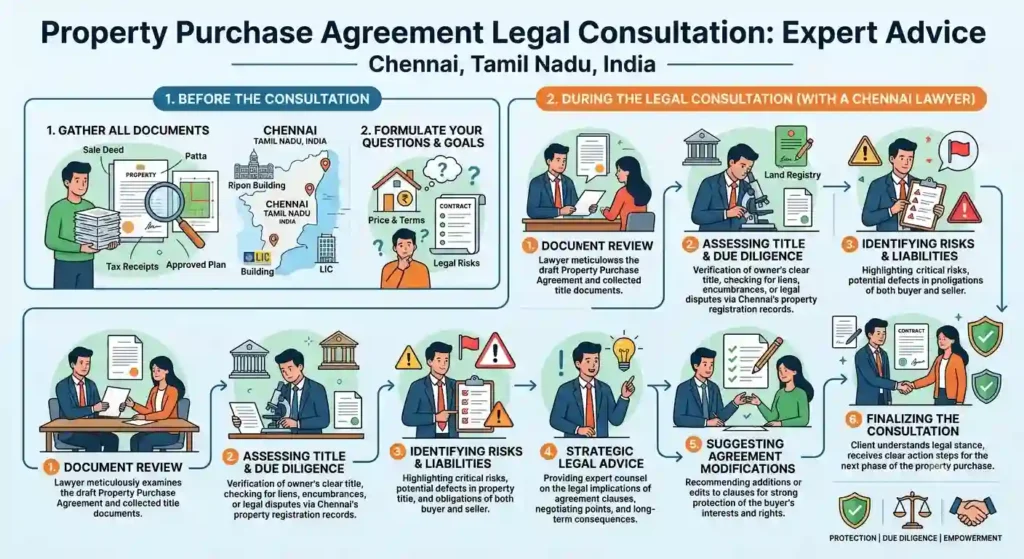
A property purchase agreement creates important rights and obligations between buyer and seller. Therefore, buyers should verify ownership before signing or paying substantial consideration. A lawyer should examine the parent deed, sale deed, encumbrance certificate, patta, and revenue records. Additionally, the advocate should verify the seller’s identity and authority to sell. Any mortgage, attachment, litigation, lease, or prior agreement requires careful investigation. Buyers should also compare registration records with documents supplied by the seller. Furthermore, lawyers can identify defects that ordinary document reviews may overlook. A proper title search reduces risks involving disputed ownership and hidden claims. Consequently, buyers gain greater confidence before committing funds. Paramount Law House can conduct legal due diligence and explain identified risks clearly. The consultation should also consider property location, transaction value, development status, and proposed payment schedule. Thus, early legal advice can prevent expensive property disputes after execution.
Property Purchase Agreement Legal Consultation: Expert Advice – Paramount Law House
Examine Encumbrance and Liabilities
An encumbrance search helps identify registered transactions affecting the proposed property purchase. Buyers should obtain current encumbrance certificates from the appropriate registration authority. However, an encumbrance certificate does not establish complete title by itself. Therefore, lawyers should examine title documents alongside registration and revenue records. Outstanding mortgages, court attachments, charges, leases, and agreements can create serious complications. Additionally, buyers should verify property tax payments and applicable municipal dues. Developers may also have project-level loans, approvals, or contractual obligations. Furthermore, lawyers should investigate whether any litigation concerns the property or seller. A written legal opinion can identify discovered risks and recommend suitable protections. Consequently, buyers can negotiate stronger contractual safeguards before signing. Paramount Law House assists clients with property document review and legal due diligence. The review should also confirm survey numbers, boundaries, measurements, access rights, and approved usage. Thus, comprehensive verification supports safer property transactions.
Verify Planning and Approvals
Property purchases require more than checking ownership documents and registration history. Buyers should verify planning permissions, building approvals, land-use permissions, and applicable development restrictions. Additionally, apartments require examination of sanctioned plans, completion documents, and association-related records. Commercial properties may require additional licences and zoning permissions. Therefore, legal consultation should consider the property’s actual use and intended future use. Buyers should compare physical features with approved plans and official records. Furthermore, unauthorised construction can create financial and regulatory problems later. Lawyers can identify necessary certificates and approvals before the agreement becomes binding. Consequently, purchasers can avoid acquiring properties carrying undisclosed regulatory risks. Paramount Law House can coordinate legal due diligence concerning property approvals and contractual conditions. Buyers should also investigate road access, common areas, easements, and utility connections. Thus, planning verification forms an essential part of responsible property purchase advice.
Drafting Strong Purchase Agreements
Essential Contract Terms
Sale Consideration and Payment
A property purchase agreement should clearly state the total consideration and payment schedule. Therefore, every instalment should have a defined amount, due date, and payment method. The agreement should identify advance payments, booking amounts, deposits, and balance consideration separately. Additionally, parties should specify whether taxes, stamp duty, registration charges, and other expenses apply. Any adjustment against previous payments should appear clearly in the agreement. Furthermore, cash transactions can create evidentiary and regulatory concerns. Buyers should prefer traceable banking channels and preserve payment confirmations. Lawyers can draft clauses addressing delayed payments, default interest, refund obligations, and termination rights. Consequently, financial disputes become easier to prevent and resolve. Paramount Law House reviews payment clauses according to the transaction structure and negotiated commercial terms. The agreement should also explain consequences when either party fails to complete registration. Thus, precise payment provisions protect both parties and reduce avoidable disagreements.
Possession and Registration
The agreement should specify when possession will occur and when the final sale deed will register. Therefore, parties should establish clear completion dates and responsibility for registration formalities. Buyers should confirm that the seller can deliver vacant and lawful possession. Additionally, the agreement should address existing tenants, occupants, licences, and service arrangements. Developers should provide possession according to contractual commitments and applicable project regulations. Furthermore, delayed registration or possession may trigger contractual remedies. Lawyers can include provisions concerning extensions, default, compensation, termination, and refund. Consequently, both parties understand their obligations before the transaction progresses. Paramount Law House can assess whether possession conditions adequately protect the purchaser’s interests. Buyers should avoid accepting possession without verifying documents and physical property conditions. Thus, coordinated possession and registration procedures reduce future litigation risks. Clear contractual timelines also help establish evidence if a dispute later reaches court or tribunal.
Representations and Warranties
Representations and warranties protect buyers against inaccurate statements concerning property ownership and condition. Therefore, sellers should confirm their lawful ownership and authority to transfer the property. The agreement should address mortgages, litigation, attachments, notices, tenancy, and third-party claims. Additionally, sellers should disclose material defects known to them where legally relevant. Developers should make accurate statements about approvals, specifications, amenities, and delivery commitments. Furthermore, contractual warranties should identify consequences for breach. Lawyers can draft indemnity provisions covering specified losses caused by inaccurate representations. Consequently, buyers receive stronger contractual protection against undisclosed problems. Paramount Law House can negotiate warranties based on property type and transaction risks. Buyers should also ensure that seller obligations survive registration where appropriate. Thus, careful drafting improves enforceability and reduces uncertainty after completion. Every representation should remain accurate and supported by available documentation.
Legal Risks and Dispute Resolution
Remedies and Appropriate Forums
Breach of Purchase Agreement
Legal Notice and Negotiation
A seller’s failure to perform contractual obligations can create significant financial and legal consequences. Therefore, buyers should document defaults through payment records, correspondence, and agreement terms. A lawyer can issue a legal notice demanding performance, refund, compensation, or another contractual remedy. Additionally, negotiation may resolve disputes without immediate litigation. However, settlement terms should protect the buyer’s legal rights and financial interests. Lawyers can assess whether accepting revised timelines or refunds remains commercially sensible. Furthermore, every settlement should clearly record obligations, deadlines, and consequences of future default. Consequently, parties can avoid repeated disputes about informal promises. Paramount Law House assists clients with legal notices, negotiations, settlement drafting, and dispute strategy. Buyers should preserve emails, messages, receipts, bank statements, and meeting records. Thus, evidence preservation strengthens both negotiation and potential proceedings. Early intervention can also prevent unnecessary escalation and protect available remedies.
Specific Performance and Refund
Buyers may seek specific performance when contractual requirements and applicable law support such relief. Alternatively, refund, damages, interest, or cancellation may become appropriate depending upon circumstances. Therefore, lawyers should analyse the agreement, conduct of parties, readiness, and statutory requirements. The Specific Relief Act, 1963 provides the principal statutory framework for specific performance. Additionally, limitation requirements can significantly affect available remedies. Buyers should act promptly after discovering contractual default or refusal. Furthermore, courts assess pleadings and evidence according to applicable legal standards. Consequently, complete documentation remains essential for successful property litigation. Paramount Law House can evaluate whether specific performance, refund, injunction, or damages provides the stronger strategy. Buyers should avoid delaying legal consultation while negotiations continue indefinitely. Thus, timely advice can preserve procedural options and reduce avoidable prejudice. The chosen remedy should reflect the transaction’s commercial objectives and available evidence.
Injunction and Property Protection
An injunction can protect property interests when a party threatens unlawful transfer or interference. Therefore, buyers should seek legal advice when sellers attempt competing sales or create third-party interests. The Code of Civil Procedure, 1908 contains provisions concerning temporary injunctions and civil procedure. Lawyers can assess whether interim protection satisfies applicable legal requirements. Additionally, evidence should demonstrate the contractual relationship and threatened harm. Courts may consider factors including prima facie case, balance of convenience, and irreparable injury. Furthermore, applicants should disclose material facts honestly during urgent proceedings. Consequently, accurate pleadings become essential for obtaining protective orders. Paramount Law House can assess injunction strategy alongside contractual and title remedies. Buyers should avoid confrontational self-help measures that create additional legal problems. Thus, court-supervised protection often provides a safer approach. Appropriate injunctions can preserve the property’s status while the underlying dispute receives judicial consideration.
Current Indian Laws and Evidence
CPC, BNS, BNSS and BSA
Civil Procedure and Property Claims
Property purchase disputes commonly involve contractual, ownership, possession, and registration-related legal issues. Therefore, civil proceedings may invoke the Code of Civil Procedure, 1908. The CPC governs important procedural matters, including pleadings, interim applications, evidence procedures, and execution. Additionally, courts determine jurisdiction according to property location, parties, valuation, and applicable statutory provisions. Lawyers should identify the correct civil court before commencing proceedings. Furthermore, limitation periods require careful examination before filing claims. Consequently, buyers should obtain advice immediately after serious contractual breaches arise. Paramount Law House can evaluate jurisdiction, limitation, necessary parties, and appropriate civil remedies. Courts may grant declarations, injunctions, possession, specific performance, damages, or other suitable relief. Therefore, the remedy should match the underlying legal issue and available evidence. Proper procedural planning reduces unnecessary delays and jurisdictional objections. Buyers should preserve the original agreement and every related transaction document.
Criminal Fraud and Forgery
Some property transactions involve allegations of cheating, impersonation, forgery, or fraudulent document creation. Therefore, criminal law may become relevant when evidence indicates conduct beyond a contractual disagreement. The Bharatiya Nyaya Sanhita, 2023 now provides India’s principal criminal offence framework. The Bharatiya Nagarik Suraksha Sanhita, 2023 governs criminal procedure. Additionally, police complaints should contain factual allegations supported by available documentary evidence. Buyers should avoid exaggerating contractual disputes into unsupported criminal accusations. Furthermore, the appropriate police station may depend upon territorial and statutory considerations. Lawyers can advise on complaints, investigation-related procedures, and coordination with civil proceedings. Consequently, clients can pursue proportionate remedies without confusing criminal and civil jurisdictions. Paramount Law House can evaluate suspected fraud and advise on legally sustainable action. Criminal proceedings do not automatically determine contractual or property title rights. Thus, separate civil remedies may remain necessary.
Digital Evidence Under BSA
Property transactions increasingly generate electronic evidence through email, messaging, online payments, and digital registration systems. Therefore, buyers should preserve electronic communications immediately after discovering a dispute. The Bharatiya Sakshya Adhiniyam, 2023 governs evidentiary principles concerning electronic records. Section 63 addresses specified requirements concerning admissibility of electronic records. Buyers should preserve original files, devices, transaction confirmations, and relevant metadata where available. Additionally, screenshots should retain sufficient context and should not replace original records unnecessarily. Lawyers can identify evidence requiring appropriate certification or supporting documentation. Furthermore, digital evidence may establish negotiations, payments, representations, notices, and admissions. Consequently, careful preservation can strengthen contractual and property proceedings. Paramount Law House can advise clients regarding evidence collection and litigation documentation. Clients should avoid altering, deleting, or selectively editing potentially relevant electronic material. Thus, disciplined evidence management supports credible legal presentation.
Government Authorities and Professional Assistance
Registration and Revenue Authorities
Sub-Registrar and Registration Records
The Sub-Registrar plays an important role in property document registration and record maintenance. Therefore, buyers should verify registration details before completing significant transaction stages. Certified copies can help confirm previous registered instruments and transaction particulars. Additionally, parties should verify property descriptions, survey numbers, boundaries, and registration identifiers. Registration records, however, may not conclusively resolve substantive title disputes. Therefore, buyers should combine registration searches with independent legal title verification. Revenue records can provide additional information regarding land administration and possession-related entries. Furthermore, discrepancies between records require careful professional examination. Lawyers can prepare representations or advise clients regarding appropriate administrative and judicial remedies. Consequently, buyers receive a more complete understanding of property documentation. Paramount Law House assists clients with registration-related legal review and property due diligence. Buyers should retain certified copies and acknowledgements for future reference. Thus, official records become valuable evidence during later negotiations or litigation.
Revenue, Municipal and Development Authorities
Property transactions can involve several authorities beyond the registration department. Revenue authorities may maintain land-related records, while municipal bodies administer property taxation and building matters. Development authorities may regulate planning permissions, layouts, zoning, and construction approvals. Therefore, legal consultation should identify authorities relevant to the property’s location and intended use. Buyers should verify applicable land-use restrictions before finalising contractual commitments. Additionally, unpaid municipal dues can create practical transaction difficulties. Developers may require approvals from multiple agencies before delivering completed projects. Furthermore, authority records can reveal inconsistencies requiring further investigation. Lawyers can advise buyers on representations, document verification, and regulatory compliance. Consequently, coordinated verification reduces risks arising from incomplete administrative records. Paramount Law House can assist with authority-related legal issues affecting property purchases. Buyers should obtain updated records close to completion. Thus, government-record verification supports informed purchasing decisions and stronger contractual protection.
Consumer and Real Estate Forums
Certain property disputes may fall within consumer or real estate regulatory frameworks. Therefore, buyers should determine whether the transaction involves a developer, builder, service deficiency, or project-related statutory issue. Consumer Commissions may provide remedies where applicable consumer-law requirements are satisfied. RERA authorities and tribunals may address specified real estate regulatory disputes. Additionally, contractual arbitration clauses can affect dispute-resolution strategy. Lawyers should examine the agreement before choosing a forum. Furthermore, parallel proceedings may create procedural complications when pursued without careful planning. Consequently, forum selection requires analysis of jurisdiction, relief, limitation, and statutory applicability. Paramount Law House can assess whether civil courts, Consumer Commissions, RERA authorities, arbitration, or other forums remain appropriate. Buyers should avoid filing identical claims mechanically before multiple authorities. Thus, strategic forum selection can save time and litigation costs. A case-specific legal opinion helps identify the strongest available pathway.
Comprehensive Property Legal Support
Due Diligence and Documentation
End-to-End Purchase Assistance
Professional property legal consultation can protect buyers from avoidable contractual and title-related risks. Therefore, lawyers should review the transaction from initial negotiation through registration and possession. Services may include:
- Title search and document verification.
- Encumbrance and litigation checks.
- Agreement drafting and negotiation.
- Stamp duty and registration guidance.
- Possession and completion review.
Additionally, lawyers can identify missing documents and recommend appropriate safeguards. Furthermore, clients receive clearer explanations of legal risks before committing substantial funds. Paramount Law House provides property purchase agreement legal consultation tailored to individual transaction circumstances. The firm can also assist with notices, negotiations, injunctions, specific performance, cancellation, and dispute proceedings. Consequently, clients gain structured legal support throughout the transaction lifecycle. Buyers should provide complete documents to enable accurate legal assessment. Thus, early professional involvement often costs less than resolving serious property disputes later. Careful documentation remains the foundation of a secure property purchase.
Support for NRIs and Remote Buyers
NRIs frequently purchase or manage Indian property while living outside the country. Therefore, remote transactions require careful document verification, authorisation, communication, and registration planning. Lawyers can review powers of attorney and confirm whether proposed representatives possess suitable authority. Additionally, NRIs should understand applicable foreign exchange and tax considerations before completing transactions. Property title, local registration requirements, and state-specific procedures also require attention. Furthermore, remote buyers need reliable systems for receiving certified documents and transaction updates. Paramount Law House can coordinate legal due diligence, agreement review, documentation, and representation in India. Lawyers can also advise on disputes involving possession, title, developers, or sellers. Consequently, NRIs can manage Indian property transactions with greater procedural clarity. Clients should use properly executed authorisations and retain transaction records securely. Thus, professional local representation can reduce practical difficulties arising from distance.
Legal Protection Before Signing
A purchase agreement deserves careful legal review before signature, payment, or possession. Therefore, buyers should never rely solely upon standard templates or verbal assurances. Every transaction has unique title, financial, regulatory, possession, and risk considerations. Lawyers can identify clauses requiring modification and explain their practical consequences. Additionally, legal review can prevent ambiguous obligations from becoming future disputes. Furthermore, a properly negotiated agreement creates clearer remedies when either party defaults. Paramount Law House offers expert legal consultation for property purchase agreements and related disputes. Buyers should provide all available documents before requesting final advice. Consequently, lawyers can assess the transaction comprehensively rather than reviewing isolated clauses. Timely consultation also allows negotiation before contractual positions become difficult to change. Thus, expert advice provides practical protection from hidden risks. A carefully drafted agreement supports smoother registration, possession, and long-term ownership.
Frequently Asked Questions
Why should I consult a property lawyer?
A property lawyer verifies title, encumbrances, approvals, payment terms, possession clauses, and dispute risks before signing. This reduces expensive problems later.
What documents should I provide?
Provide title deeds, encumbrance certificates, tax records, approvals, identity documents, previous agreements, and payment details. Additional documents may apply depending on the property.
Can a lawyer draft the purchase agreement?
Yes. A lawyer can draft or review the agreement, negotiate protective clauses, and address payment, possession, default, indemnity, registration, and dispute-resolution provisions.
What if the seller breaches the agreement?
Depending on the facts, you may seek specific performance, refund, damages, injunction, cancellation, or other appropriate relief. Prompt legal advice helps preserve available remedies.
Can NRIs obtain property legal assistance?
Yes. NRIs can obtain Indian legal representation for title checks, agreement review, powers of attorney, registration, negotiations, and property disputes.
Which forum handles property disputes?
The appropriate forum depends upon the dispute. Options can include civil courts, Consumer Commissions, RERA authorities, arbitration, or other competent forums.
Read More
- Property Document Verification Services: Ensure Accuracy
- Landlord Legal Support: Protect Your Rights Effectively
- Factory Monitoring Services: Compliance Assurance
- Document Legal Verification: Ensure Authenticity and Legitimacy
- Building Monitoring Services: Protect Your Investment
- Ministry of Housing and Urban Affairs – RERA