Property Document Verification Services: Ensure Accuracy
Property Document Verification Services – Secure ownership before investment: Property document verification protects buyers from defective titles, hidden claims, and fraudulent transactions….
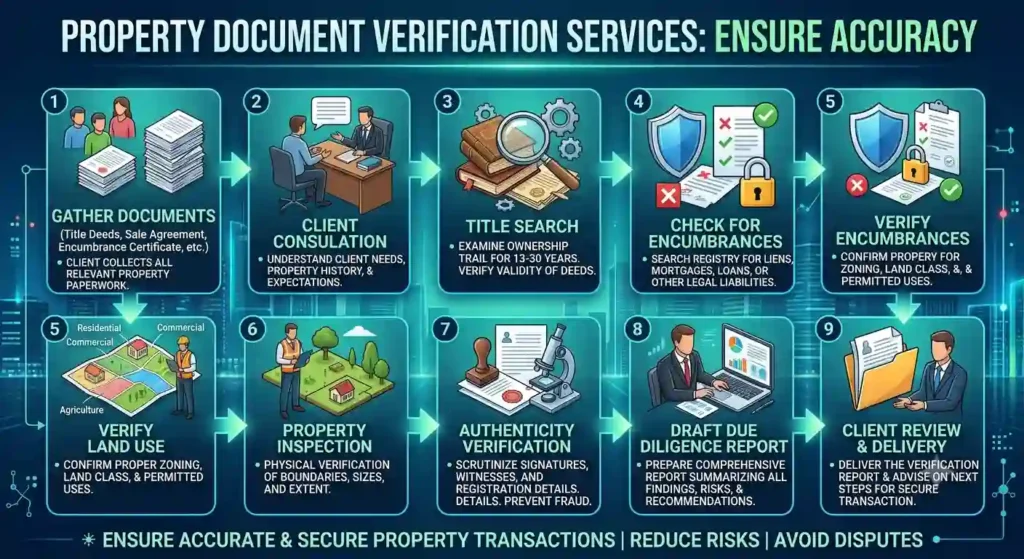
Property Document Verification Services – Secure ownership before investment: Property document verification protects buyers from defective titles, hidden claims, and fraudulent transactions. A lawyer examines ownership history, registered instruments, encumbrances, approvals, and possession records. Moreover, the Transfer of Property Act, 1882 governs several important principles concerning transfers and property interests. The Registration Act, 1908 regulates registration of documents and related procedures. Therefore, buyers should verify title before paying substantial consideration or signing agreements. Paramount Law House provides property legal due diligence for residential, commercial, industrial, and land transactions. The review can identify ownership gaps, mortgages, litigation, restrictions, and documentation errors. Furthermore, lawyers can coordinate searches with registration authorities and other government departments. Proper verification reduces financial risks and strengthens contractual protection. Consequently, professional property document verification offers practical legal support before purchase, development, mortgage, lease, or resale.
Property Document Verification Services: Ensure Accuracy – Paramount Law House
Documents Required for Verification
Essential property papers: A complete verification usually requires several documents from the seller, developer, or current owner. These documents help establish ownership, transaction history, property identity, and legal compliance. Key records commonly include:
- Parent or mother deeds.
- Current sale or gift deed.
- Encumbrance Certificate.
- Patta, Chitta, or relevant revenue records.
- Approved building plans and permits.
- Property tax receipts.
- Legal-heir or succession documents.
- Previous agreements and release deeds.
Additionally, lawyers may require powers of attorney, partition deeds, settlement deeds, court orders, or mortgage releases. The Registration Act contains provisions addressing registrable documents and registration procedures. Therefore, missing documents should receive immediate legal attention. Paramount Law House compares documents chronologically and checks consistency across records. This process can expose unexplained ownership changes, inconsistent property descriptions, or incomplete transfers.
Title Search and Ownership History
Tracing the title chain: Title verification examines how ownership moved from earlier owners to the present seller. Lawyers generally trace registered transactions through relevant historical documents and registration records. Each transfer should connect logically with the preceding ownership instrument. Furthermore, lawyers compare names, survey numbers, boundaries, measurements, and property descriptions across documents. The Transfer of Property Act provides important rules governing transfers of immovable property. Consequently, a defective link can create substantial transaction risk. Title searches may identify inheritance claims, family settlements, partitions, releases, mortgages, or prior sales. Therefore, purchasers should avoid relying solely upon the latest sale deed. A comprehensive title opinion considers the entire ownership chain and available supporting records. Additionally, counsel should investigate whether earlier transactions involved minors, trusts, companies, or authorised representatives. Paramount Law House prepares structured title verification reports highlighting risks, missing links, and recommended remedies.
Encumbrance Certificate Examination
Checking registered liabilities: An Encumbrance Certificate can help identify registered transactions and certain recorded encumbrances affecting property. However, buyers should understand its limitations before treating it as complete title proof. Lawyers compare the certificate against title deeds, mortgage releases, court records, and other available documents. Moreover, registration records remain important because the Registration Act governs registered instruments and registration processes. An incomplete search period can leave earlier transactions undiscovered. Therefore, the search period should match the property’s ownership history and transaction requirements. Counsel should also investigate possible equitable claims, possession disputes, and unregistered arrangements where circumstances justify further enquiry. Furthermore, discrepancies between the EC and original documents require careful investigation. Buyers should never assume a clean EC automatically guarantees marketable title. Professional verification combines registration searches with broader legal and factual due diligence. This approach helps identify hidden risks before financial commitments become difficult to reverse.
Revenue Records and Land Classification
Checking government land records: Revenue records provide valuable information concerning land identity, classification, possession, and revenue administration. Depending upon the property and State, relevant records may include patta, Chitta, Adangal, FMB, mutation entries, or other records. Lawyers compare these records against registered title documents and physical property details. Furthermore, classification issues can affect development potential and transaction suitability. Agricultural land, assigned land, government land, waterbody areas, and restricted properties require additional scrutiny. Therefore, buyers should verify applicable zoning, conversion, planning, and land-use requirements. Revenue records alone do not always establish conclusive ownership. Consequently, legal professionals should assess them alongside registered deeds and other evidence. The Registration Act also addresses property descriptions and maps within registration procedures. Paramount Law House coordinates title and revenue-record review for Chennai and Tamil Nadu transactions. Early verification can prevent disputes involving boundaries, classification, possession, mutation, and government restrictions.
Building Approvals and Planning Compliance
Verifying construction legality: Buyers purchasing developed property should verify planning approvals, sanctioned plans, completion documents, and applicable local permissions. Building violations can create financial, regulatory, and litigation risks after purchase. Lawyers should compare sanctioned plans with the property’s actual construction. Moreover, RERA applies important regulatory protections to qualifying real estate projects. The official RERA framework includes promoter duties, allottee rights, project registration, and appellate mechanisms. Therefore, purchasers should verify project registration where RERA applies. Additional checks may involve planning authorities, local bodies, fire approvals, environmental permissions, and utility connections. Consequently, legal due diligence should cover both title and development compliance. A registered deed does not automatically cure unauthorised construction. Paramount Law House can examine approval documents and identify potential compliance concerns. This approach helps buyers understand legal risks before executing sale agreements or completing registration.
Seller Identity and Authority Verification
Confirming the seller’s legal capacity: Property verification should establish that the proposed seller possesses authority to transfer the property. Lawyers verify identity documents, ownership records, powers of attorney, corporate authorisations, succession documents, and relevant court orders. Where a company owns property, counsel should examine corporate authority and applicable filings. Similarly, inherited property may require legal-heir documents, probate, succession evidence, or release instruments. Furthermore, a power of attorney requires careful scrutiny regarding scope, validity, execution, and revocation. The Registration Act contains provisions concerning presentation, execution, and registration of documents. Therefore, buyers should not rely upon informal assurances regarding authority. Counsel should verify whether every person required for the transaction has properly participated. This becomes particularly important for jointly owned, ancestral, inherited, trust, and company properties. Paramount Law House provides seller-authority verification before agreements and registrations. Proper scrutiny reduces impersonation, unauthorised-sale, and defective-authority risks.
Litigation and Court Record Checks
Searching for property disputes: Property may face pending litigation even when the seller presents apparently valid documents. Therefore, lawyers should investigate relevant court proceedings involving the property, owner, developer, or transaction. Searches may cover civil courts, High Courts, tribunals, RERA authorities, revenue forums, and other competent bodies. The Code of Civil Procedure, 1908 remains important for civil litigation and procedural remedies. Lawyers should examine injunctions, declarations, partition suits, specific-performance claims, mortgage disputes, and execution proceedings. Furthermore, orders affecting possession or transfer can materially alter transaction risk. A property search should therefore extend beyond registration records when circumstances warrant broader investigation. Additionally, local police complaints may indicate allegations involving forgery, cheating, trespass, or document fraud. Such complaints require independent legal assessment before drawing conclusions. Paramount Law House can identify appropriate forums and remedies based on the dispute. Comprehensive litigation checks provide stronger protection than document inspection alone.
Mortgage, Loan, and Charge Verification
Checking financial claims: Buyers should determine whether lenders, financial institutions, or other creditors hold enforceable interests over property. Mortgage documents, release deeds, bank correspondence, and registration records can reveal important financial obligations. Additionally, company-owned property may involve charges recorded through corporate systems. Lawyers should confirm that existing loans receive lawful discharge before completion. Furthermore, payment arrangements should clearly allocate responsibility for clearing outstanding liabilities. A seller’s promise to settle a loan later may create unnecessary transaction risk. Therefore, buyers should obtain appropriate releases or lender confirmations before completing the purchase. Where mortgages involve banks or financial institutions, counsel should examine original title documents and discharge procedures. Property transactions involving companies may also require corporate-record verification. Paramount Law House coordinates legal review of mortgages, charges, releases, and transaction conditions. This process helps prevent purchasers from inheriting unexpected financial claims after registration.
Stamp Duty and Registration Compliance
Ensuring registration accuracy: Stamp duty and registration requirements depend upon the nature of the instrument and applicable State law. Incorrect valuation, inadequate stamping, or defective documentation can create legal and financial consequences. The Registration Act governs important aspects of registration, including documents requiring registration and registration procedures. Therefore, buyers should verify applicable stamp duty before executing transaction documents. Lawyers can review consideration, market value, property classification, exemptions, and registration requirements. Furthermore, document descriptions should match official property records accurately. Errors involving survey numbers, boundaries, names, or measurements can complicate future transactions. Consequently, legal review should occur before signing rather than after registration. Paramount Law House can coordinate document preparation with registration requirements and transaction timelines. Buyers should retain registered copies, payment receipts, and supporting documents securely. Accurate registration strengthens evidentiary records while reducing avoidable procedural disputes.
Due Diligence for NRIs and Overseas Owners
Protecting overseas property interests: NRIs frequently require additional verification because they may manage property from outside India. Lawyers should verify title, powers of attorney, tax records, possession, tenancy, mortgages, and local litigation. Furthermore, documents executed abroad may require appropriate authentication or legalisation procedures. A carefully drafted power of attorney can facilitate lawful property management and transaction representation. However, its scope should match the intended transaction precisely. NRIs should also verify whether local property restrictions affect the proposed transaction. Additionally, banking, taxation, repatriation, and FEMA considerations may require separate professional advice. Property documents should remain consistent across Indian registration and revenue records. Therefore, remote ownership should never rely solely upon agents or informal representatives. Paramount Law House provides NRI property document verification and transaction support through authorised representatives. This service helps overseas owners identify title risks, fraudulent dealings, unauthorised possession, and defective documentation before major losses occur.
Property Fraud and Forgery Risks
Detecting fraudulent documents: Forged deeds, impersonation, fabricated powers of attorney, altered records, and fraudulent registrations can create serious property disputes. Lawyers should compare original documents with certified registration records and supporting government records. Suspicious signatures, inconsistent stamps, unusual transaction sequences, and unexplained corrections require further investigation. Furthermore, fraudulent property dealings may involve civil and criminal consequences under applicable laws. The Bharatiya Nyaya Sanhita, 2023 contains offences concerning cheating, forgery, and related misconduct. Therefore, buyers should promptly seek legal advice when suspicious documents emerge. Depending upon circumstances, complaints may involve police stations, registration authorities, civil courts, or other competent forums. Counsel can assess whether injunctions, declarations, cancellation, recovery, or criminal complaints remain appropriate. Additionally, affected owners should preserve originals and avoid making alterations. Paramount Law House can coordinate civil and criminal remedies where property fraud overlaps. Early action can help protect possession, evidence, and legal interests.
Dispute Resolution and Legal Remedies
Choosing the correct remedy: Property disputes require remedy selection based upon ownership, possession, documents, and procedural circumstances. Civil remedies may include declaration, cancellation, injunction, specific performance, partition, possession, or recovery claims. Furthermore, RERA remedies may apply to qualifying disputes involving registered real estate projects. The official RERA framework provides regulatory and appellate mechanisms for eligible matters. Registration disputes may require approaches to competent registration authorities and statutory appellate forums. Criminal complaints may become appropriate where evidence indicates forgery, cheating, criminal breach, or other offences. Therefore, one dispute can sometimes require coordinated civil, regulatory, and criminal strategies. Counsel should avoid filing unnecessary proceedings that create duplication or inconsistent positions. Paramount Law House assesses jurisdiction before selecting courts, tribunals, authorities, or police forums. Proper forum selection can improve efficiency and protect limitation periods. Timely legal advice remains essential when documents reveal serious ownership or transaction defects.
Why Choose Paramount Law House
Professional property verification support: Paramount Law House provides structured legal due diligence for buyers, sellers, investors, developers, companies, and NRIs. The service focuses on ownership, title continuity, encumbrances, approvals, litigation, and transaction documentation. Moreover, lawyers can identify missing records and recommend practical corrective steps. Property verification may cover:
- Title and parent-document review.
- Encumbrance and registration searches.
- Revenue-record examination.
- Litigation and dispute checks.
- Approval and RERA compliance review.
- Seller authority verification.
- Transaction-document drafting support.
Therefore, clients receive a practical assessment before committing significant funds. Counsel can also recommend injunctions, declarations, cancellation, specific performance, or other remedies where disputes arise. Furthermore, the firm can coordinate proceedings before courts, tribunals, authorities, and registration offices. Accurate legal due diligence reduces uncertainty and strengthens informed decision-making. Property buyers should obtain professional verification before signing binding agreements or paying substantial advances.
Frequently Asked Questions
What is property document verification?
It is a legal review of title, ownership, encumbrances, approvals, litigation, and related records before purchasing property.
Is an Encumbrance Certificate enough?
No. An EC is important, but lawyers should compare it with title deeds, revenue records, court records, and other documents.
Can a lawyer verify inherited property?
Yes. Counsel can examine succession documents, legal-heir records, wills, probate, partitions, releases, and previous title instruments.
Can NRIs obtain property verification services?
Yes. NRIs can appoint Indian lawyers to verify title, litigation, powers of attorney, possession, and registration records.
What remedies exist for fraudulent property documents?
Depending upon circumstances, remedies can include cancellation, declaration, injunction, possession claims, criminal complaints, and statutory proceedings.
Why verify property before registration?
Verification identifies ownership defects, mortgages, litigation, forged documents, approval problems, and other risks before the transaction becomes difficult.
Read More
- Landlord Legal Support: Protect Your Rights Effectively
- Factory Monitoring Services: Compliance Assurance
- Document Legal Verification: Ensure Authenticity and Legitimacy
- Building Monitoring Services: Protect Your Investment
- DTCP Land Approval Services: Ensure Compliance and Approval
- NGDRS – National Generic Document Registration System