Housing Development Law Consultation: Expert Advice
Housing Development Law Consultation – Buying or developing property demands careful legal planning from the beginning. Every housing project carries legal risks…
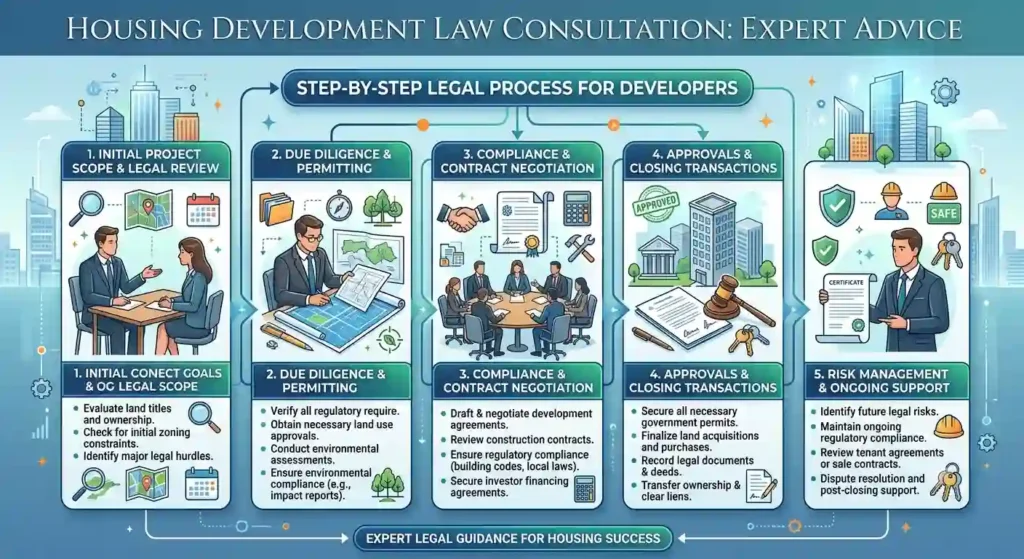
Housing Development Law Consultation – Buying or developing property demands careful legal planning from the beginning. Every housing project carries legal risks affecting owners, developers, builders, investors, societies, and financial institutions. Therefore, professional legal consultation reduces disputes before they become expensive litigation. Paramount Law House assists clients with housing development approvals, title verification, contractual compliance, and dispute resolution. Our lawyers evaluate applicable Central and State laws before recommending practical legal solutions. Moreover, clients receive advice matching current judicial developments and statutory amendments. Legal consultation covers residential layouts, apartments, villas, plotted developments, redevelopment projects, and affordable housing schemes. Important authorities include RERA Authorities, Municipal Corporations, CMDA, DTCP, Revenue Departments, Registration Departments, and Local Planning Authorities. Courts, Consumer Commissions, Civil Courts, High Courts, and the Supreme Court provide judicial remedies whenever disputes arise. Recent procedural provisions under BNSS, evidentiary principles under BSA, criminal liability under BNS, and civil remedies under CPC strengthen legal protection wherever applicable.
Housing Development Law Consultation: Expert Advice – Paramount Law House
Why Housing Development Laws Matter for Every Stakeholder
Housing development laws regulate ownership, planning, approvals, construction quality, environmental compliance, and consumer protection. Consequently, every participant benefits from legal certainty throughout the project lifecycle. Builders require statutory approvals before commencing construction. Landowners require valid title documents before transferring development rights. Purchasers require legal verification before investing significant amounts. Banks require marketable titles before approving housing loans. Furthermore, government authorities supervise compliance with planning regulations and public safety standards. Common legal issues include unauthorized construction, delayed possession, fraudulent sales, defective construction, illegal layouts, title disputes, encroachments, and contractual breaches. Legal consultation minimizes financial exposure while improving regulatory compliance. Applicable authorities include RERA Authorities, Registration Departments, Revenue Authorities, Municipal Corporations, Town Planning Authorities, Pollution Control Boards, Electricity Boards, and Water Supply Departments. Appropriate legal strategies reduce unnecessary litigation while protecting valuable real estate investments.
Common Housing Development Legal Issues Requiring Professional Advice
Housing development projects frequently involve overlapping legal and regulatory obligations. Therefore, timely legal review prevents avoidable complications during construction or property transfers.
| Legal Issue | Concerned Authority | Primary Remedy |
|---|---|---|
| Title dispute | Civil Court | Declaration and injunction |
| Project delay | RERA | Compensation and completion |
| Unauthorized construction | Municipal Authority | Demolition appeal or regularization |
| Defective construction | Consumer Commission | Compensation |
| Encroachment | Civil Court | Recovery of possession |
| Fraudulent sale | Police, Criminal Court | Criminal prosecution under BNS |
Professional legal consultation also covers:
- Title investigation
- Sale agreement review
- Development agreement drafting
- Joint venture documentation
- Builder compliance
- Apartment documentation
- Registration support
- Due diligence
- Litigation strategy
- Risk assessment
Moreover, lawyers coordinate with architects, surveyors, engineers, valuers, and government departments whenever technical clarification becomes necessary.
Due Diligence Before Purchasing Housing Development Property
Property buyers should complete comprehensive legal due diligence before signing agreements. Consequently, informed decisions reduce future litigation and financial loss. Lawyers verify ownership history, parent documents, encumbrance certificates, revenue records, approved layouts, sanctioned building plans, completion certificates, occupancy certificates, and tax payments. They also verify pending litigation affecting the property. Furthermore, RERA registration details deserve careful examination whenever applicable. Legal professionals review development agreements, sale deeds, power of attorney documents, mortgage records, and court orders. They identify hidden liabilities before buyers commit substantial investments. Additional verification covers environmental permissions, land classification, road access, utility connections, and zoning compliance. Banks appreciate legally verified properties because lending risks decrease substantially. Comprehensive documentation strengthens future resale opportunities while improving investment security. Early legal consultation ultimately prevents prolonged disputes involving multiple authorities and stakeholders.
Title Verification Forms the Foundation of Every Housing Project
A valid property title establishes lawful ownership and transferability. Therefore, title verification remains the most important legal exercise before development begins. Lawyers examine original title deeds spanning several decades whenever necessary. They identify missing links, fraudulent transfers, forged documents, adverse claims, and pending encumbrances. Moreover, they verify survey records, patta, chitta, adangal, mutation entries, and land revenue records. Registration Department records provide valuable ownership confirmation. Revenue authorities maintain additional land classification details. Courts recognize documentary evidence supported through applicable provisions under the BSA. Civil remedies under CPC remain available whenever ownership disputes emerge. Criminal misconduct involving forged documents, cheating, criminal breach of trust, or fraudulent transactions attracts provisions under the BNS. Police complaints may become appropriate where criminal offences accompany civil disputes. Proper title verification significantly reduces litigation risks throughout future property transactions.
Development Agreements Require Precise Drafting and Legal Protection
Development agreements define responsibilities between landowners and developers. Consequently, careful drafting protects commercial interests while reducing contractual conflicts. Lawyers specify project timelines, construction obligations, revenue sharing, approval responsibilities, indemnity clauses, termination rights, force majeure provisions, dispute resolution mechanisms, and default consequences. Every clause should eliminate ambiguity before execution. Registration requirements receive equal attention wherever applicable. Additionally, legal professionals ensure compliance with stamp duty laws and registration procedures. Financial institutions frequently examine these agreements before extending project finance. Well-drafted agreements simplify enforcement before Civil Courts, Commercial Courts, Arbitration Tribunals, or High Courts whenever disputes occur. Proper contractual documentation also reduces allegations involving fraud, misrepresentation, suppression, or breach. Strong legal drafting creates certainty for developers, investors, lenders, purchasers, and landowners throughout the housing development lifecycle.
Regulatory Approvals Prevent Future Construction Disputes
Every housing development project requires multiple statutory approvals before construction starts. Therefore, developers should secure permissions before marketing residential units. Authorities commonly examine land use, zoning, environmental compliance, structural safety, drainage systems, fire safety, road connectivity, and infrastructure availability. Municipal Corporations, CMDA, DTCP, Local Planning Authorities, Pollution Control Boards, Electricity Departments, Water Supply Boards, and Fire Services issue relevant permissions. Furthermore, RERA registration becomes mandatory for qualifying projects. Failure to obtain approvals may trigger penalties, demolition proceedings, prosecution, or compensation claims. Legal professionals coordinate approval documentation while monitoring regulatory compliance. Proper approval management improves investor confidence and project credibility. Early compliance also minimizes delays during financing, construction, registration, possession, and occupancy. Systematic legal supervision ultimately safeguards both developers and homebuyers against avoidable regulatory disputes.
RERA Compliance Strengthens Consumer Confidence
The Real Estate Regulatory framework promotes transparency, accountability, and timely project completion. Consequently, developers must comply with disclosure obligations and registration requirements wherever applicable. Buyers receive valuable legal remedies against delayed possession, misleading advertisements, defective construction, and contractual violations. Lawyers represent clients before the appropriate RERA Authority and Appellate Tribunal whenever disputes arise. Moreover, legal consultation includes agreement review, compliance audits, documentation verification, compensation claims, and appeal preparation. RERA proceedings often resolve disputes faster than traditional civil litigation. Nevertheless, Consumer Commissions and Civil Courts may retain jurisdiction depending upon applicable facts and statutory provisions. Professional representation improves procedural compliance while strengthening documentary evidence. Comprehensive legal guidance protects both developers and purchasers throughout every stage of housing development.
Resolving Housing Development Disputes Through Appropriate Legal Remedies
Housing development disputes require timely legal intervention before financial losses increase. Therefore, selecting the proper legal forum improves the chances of effective relief. Lawyers assess facts, contracts, statutory obligations, and documentary evidence before recommending proceedings. Common disputes involve delayed possession, poor construction, illegal cancellations, unauthorized development, encroachments, title conflicts, payment defaults, and fraud. Appropriate remedies depend upon contractual rights and applicable statutes. Civil Courts grant injunctions, declarations, recovery, damages, and specific performance under the CPC. Consumer Commissions award compensation for deficient housing services. RERA Authorities address project delays and developer violations. High Courts exercise writ jurisdiction against unlawful administrative actions. Criminal complaints under the BNS, investigations under the BNSS, and evidence presented according to the BSA become relevant whenever criminal misconduct accompanies property disputes. Early legal advice strengthens negotiation while reducing litigation costs.
Courts, Tribunals, Authorities, and Legal Forums
Choosing the correct authority avoids unnecessary procedural delays. Consequently, experienced legal consultation saves valuable time and resources.
| Forum or Authority | Typical Matters | Available Relief |
|---|---|---|
| RERA Authority | Project delay, disclosures | Compensation, compliance |
| RERA Appellate Tribunal | Appeals | Modification or reversal |
| Consumer Commission | Defective services | Compensation |
| Civil Court | Title, injunction, possession | Civil remedies |
| Commercial Court | Commercial agreements | Contract enforcement |
| High Court | Writ petitions, appeals | Judicial review |
| Supreme Court | Constitutional appeals | Final adjudication |
Clients may also approach:
- Municipal Corporation
- CMDA or DTCP
- Registration Department
- Revenue Department
- Local Planning Authority
- Police Station
- Electricity Board
- Water Supply Board
- Fire and Rescue Department
- Pollution Control Board
Professional legal representation ensures proper documentation before every competent authority.
Legal Support Throughout Housing Development Projects
Legal consultation extends beyond dispute resolution because preventive advice reduces future risks. Therefore, lawyers remain involved from project planning until final possession. Services include title verification, contract drafting, compliance review, approval assistance, litigation management, mediation, arbitration, registration guidance, redevelopment advice, and regulatory representation. Moreover, advocates coordinate with architects, engineers, valuers, surveyors, and financial institutions whenever technical support becomes necessary. They monitor statutory deadlines while ensuring contractual compliance. Strong documentation simplifies enforcement before courts and tribunals. Continuous legal supervision protects buyers, developers, housing societies, financial institutions, investors, and landowners against avoidable liabilities. Paramount Law House delivers practical legal solutions designed for residential projects, mixed developments, redevelopment schemes, plotted layouts, apartments, villas, and commercial housing developments across applicable jurisdictions.
Essential Legal Remedies Available to Property Owners
Every housing dispute deserves an appropriate legal strategy based upon facts and applicable legislation. Consequently, lawyers identify the fastest and most effective remedy. Civil suits seek declaration, injunction, possession, partition, cancellation, damages, and specific performance under the CPC. Consumer complaints address construction defects and delayed possession. RERA complaints secure project completion, refunds, compensation, and compliance directions. Criminal complaints under the BNS become appropriate for cheating, forgery, criminal breach of trust, intimidation, or fraudulent property transactions. Investigations follow the BNSS while documentary evidence follows the BSA. Writ petitions challenge arbitrary administrative actions before High Courts. Appeals remain available wherever statutes permit. Alternative dispute resolution through mediation and arbitration often preserves commercial relationships while reducing litigation expenses. Early consultation increases procedural efficiency and strengthens every legal claim.
Documents Required During Housing Development Consultation
Successful legal consultation depends upon complete documentation from every stakeholder. Therefore, clients should organize relevant records before meeting an advocate. Common documents include title deeds, sale deeds, parent documents, encumbrance certificates, approved plans, planning permissions, development agreements, construction agreements, allotment letters, possession letters, payment receipts, bank loan papers, tax receipts, occupancy certificates, completion certificates, correspondence, photographs, notices, and previous court orders. Lawyers review every document for authenticity and legal compliance. Furthermore, documentary consistency strengthens future litigation or settlement negotiations. Accurate records simplify verification before Registration Departments, Revenue Authorities, Municipal Corporations, RERA Authorities, Consumer Commissions, Civil Courts, Commercial Courts, and High Courts. Comprehensive documentation frequently determines the outcome of complex housing disputes involving multiple parties.
Importance of Police Assistance in Housing-Related Criminal Matters
Certain housing disputes involve criminal conduct requiring immediate police intervention. Consequently, victims should understand the distinction between civil disputes and criminal offences. Forged documents, impersonation, criminal intimidation, cheating, trespass, land grabbing, breach of trust, and fraudulent registrations may justify criminal complaints under the BNS. Police investigate offences according to procedures prescribed by the BNSS. Documentary evidence, electronic records, witness statements, and expert opinions receive evaluation under the BSA. Criminal proceedings may continue alongside civil litigation whenever independent criminal offences exist. Prompt reporting preserves valuable evidence while preventing additional fraudulent transactions. Experienced advocates prepare legally sustainable complaints and represent clients during investigations. Proper legal strategy ensures that civil remedies and criminal proceedings complement each other instead of creating procedural conflicts.
Choosing Paramount Law House for Housing Development Consultation
Property investments deserve reliable legal protection from experienced professionals. Therefore, Paramount Law House offers comprehensive legal consultation covering housing development, redevelopment, title verification, documentation, regulatory compliance, dispute resolution, and court representation. Our legal team advises homebuyers, developers, investors, housing societies, contractors, lenders, and landowners across residential and commercial projects. We prepare legally enforceable agreements, conduct detailed due diligence, represent clients before RERA Authorities, Consumer Commissions, Civil Courts, Commercial Courts, High Courts, and appellate forums. Additionally, we assist during mediation, arbitration, negotiations, and statutory compliance proceedings. Our practical approach emphasizes prevention before litigation whenever possible. Every client receives personalized legal guidance supported by current legislation, judicial precedents, and procedural safeguards. Professional legal consultation ultimately safeguards valuable property rights while minimizing financial and regulatory risks.
Frequently Asked Questions
1. Why should I obtain housing development legal consultation?
Legal consultation verifies ownership, approvals, contracts, and compliance. It minimizes disputes, protects investments, and identifies practical legal remedies before costly litigation begins.
2. Which authority handles delayed housing project possession?
RERA Authorities commonly hear delayed possession complaints. Consumer Commissions and Civil Courts may also provide compensation, refunds, injunctions, or other suitable remedies.
3. Can criminal action arise from housing development disputes?
Yes. Fraud, forgery, cheating, criminal breach of trust, land grabbing, and intimidation may attract proceedings under the BNS following BNSS procedures.
4. Which documents should buyers verify before purchasing property?
Review title deeds, encumbrance certificates, approved plans, RERA details, tax receipts, completion certificates, occupancy certificates, parent documents, and registration records.
5. Can I approach the High Court regarding housing development issues?
Yes. High Courts may hear writ petitions against unlawful government actions, statutory violations, jurisdictional errors, and certain appellate proceedings permitted by law.
6. How does Paramount Law House assist housing development clients?
Our lawyers provide due diligence, contract drafting, compliance advice, RERA representation, civil litigation, criminal assistance, negotiations, mediation, and comprehensive property protection.
Read More
- Illegal Possession of Immovable Property: Legal Remedies
- Indian Easements: Legal Assistance for Property Owners
- Industrial Land Law Consultation: Expert Guidance
- Injunction Order Representation: Protect Your Property Interests
- Joint Ownership of Property: Legal Support Available
- Ministry of Housing and Urban Affairs (MoHUA)