Property Document Verification Services: Legal Due Diligence
Property Document Verification Services – Purchasing property without thorough document verification is one of the costliest legal mistakes any buyer can make….
Property Document Verification Services – Purchasing property without thorough document verification is one of the costliest legal mistakes any buyer can make. Therefore, professional legal due diligence protects buyers, lenders, and investors from title fraud, encumbrances, and regulatory violations. Paramount Law House delivers comprehensive property document verification services across all Indian jurisdictions. Our property lawyers scrutinise title chains, encumbrance certificates, patta records, RERA compliance, and mutation entries systematically. Consequently, every client receives a clear, written legal opinion before committing any financial investment in property.
Property Document Verification Services: Legal Due Diligence – Published by Paramount Law House
Understanding Property Document Verification: Legal Framework, Key Documents, and Common Risks in India 2026
Why Property Document Verification Is Critical Before Every Real Estate Transaction
Property document verification is the systematic legal examination of all documents establishing ownership, title, and encumbrance status. Consequently, skipping this process exposes buyers to fraudulent sales, disputed titles, and illegal constructions with severe financial consequences. India records thousands of property fraud cases every year, costing victims crores in unrecoverable financial losses. Furthermore, banks and housing finance companies mandate legal due diligence reports before sanctioning any mortgage loan. The Bharatiya Nyaya Sanhita, 2023 (BNS) punishes property fraud under Sections 316–318 with up to seven years imprisonment. Additionally, forged sale deeds and fabricated patta documents increasingly target buyers in tier-two cities and rural areas. Revenue records, encumbrance certificates, and building plan approvals must each be independently verified by a qualified lawyer. Therefore, Paramount Law House performs meticulous document verification protecting every client’s investment from the very first transaction step.
- Title Verification: Examining sale deeds, gift deeds, partition deeds, and will-based titles for 30 years
- Encumbrance Certificate (EC): Confirming no mortgage, charge, or lien on the property exists
- Patta & Chitta: Verifying revenue ownership records at Tahsildar office
- Building Plan Approval: Confirming CMDA/local body sanction for construction
- RERA Registration: Checking project registration on state RERA portal for new properties
- Land Use Classification: Confirming agricultural-to-residential conversion approval
- Court Litigation Search: Checking pending civil suits or injunction orders on the property
Key Property Documents Examined During Legal Due Diligence in India
Legal due diligence requires the systematic examination of every document in the property’s ownership and regulatory history. Therefore, Paramount Law House follows a structured document checklist covering title, revenue, regulatory, and litigation aspects comprehensively. The mother deed or root title document establishes the original source of ownership for the property. Consequently, every subsequent transfer must derive validly from this root title without any break in the chain. Sale deeds registered at the Sub-Registrar’s office form the primary evidence of transfer under the Registration Act, 1908. Additionally, partition deeds, settlement deeds, gift deeds, and release deeds must be examined where applicable to the title. Will-based titles require probate orders from civil courts confirming the testator’s testamentary capacity and execution validity. Furthermore, court decrees vesting property must be verified against original decree copies and execution proceedings. Paramount Law House examines every document layer with professional thoroughness to deliver a clean title certificate confidently.
| Document Category | Specific Documents | Verifying Authority | Legal Significance |
|---|---|---|---|
| Title Documents | Sale deed, gift deed, partition deed | Sub-Registrar Office | Proof of ownership transfer |
| Revenue Records | Patta, chitta, adangal, FMB sketch | Tahsildar / Revenue Dept. | Revenue ownership and survey |
| Encumbrance | EC (Form 15/16) for 30 years | Sub-Registrar Office | Confirms no mortgage or charge |
| Regulatory Approvals | Building plan, CMDA approval, OC | Local Body / CMDA | Legal construction compliance |
| RERA Compliance | Project registration, promoter details | State RERA Authority | Builder accountability and delivery |
| Litigation Search | Civil suit, injunction, lis pendens | Civil Court records | Pending disputes on property |
| Tax Records | Property tax receipts, water tax | Local Municipal Body | Confirms no government dues |
Revenue Records Verification: Patta, Chitta, Adangal, and FMB Sketch Examination
Revenue records form the backbone of property ownership evidence across rural and semi-urban India. Therefore, verifying patta, chitta, adangal, and FMB sketch is non-negotiable in any property due diligence exercise. Patta is the primary revenue ownership document issued by the Tahsildar confirming possession and classification of land. Consequently, discrepancies between the patta holder’s name and the sale deed seller’s name raise serious title concerns. Chitta records details of cultivable land, poramboke status, and government land classifications under the revenue system. Additionally, adangal (field measurement book) records actual possession and cultivation details at the village level. The FMB (Field Measurement Book) sketch confirms the survey boundary of the specific property being purchased. Furthermore, TNEGA, Bhoomi, and Dharani portals now provide digital access to revenue records, reducing manual fraud significantly. Paramount Law House verifies all revenue records both online and through physical inspection at the Tahsildar’s office comprehensively.
Encumbrance Certificate Verification: Detecting Hidden Mortgages and Charges
An Encumbrance Certificate (EC) is the single most important document confirming whether a property carries any existing financial liability. Therefore, buyers and lenders must insist on an EC covering a minimum period of thirty years before transaction. The EC is available in Form 15 (properties with encumbrances) or Form 16 (nil encumbrance certificate) from the Sub-Registrar. Consequently, a nil encumbrance certificate confirms no mortgage, charge, attachment, or lien exists on the subject property. However, equitable mortgages created by deposit of title deeds do not always appear in the EC records. Additionally, charges created under SARFAESI Act proceedings may reflect separately in bank records rather than EC entries. The Registration Act, 1908 mandates registration of all instruments creating charges, but compliance gaps persist widely. Furthermore, Paramount Law House supplements EC verification with CERSAI (Central Registry of Securitisation) searches to detect unregistered equitable mortgages effectively.
- Obtain EC for 30 years from Sub-Registrar covering the full title chain period
- Cross-check with CERSAI for equitable mortgages not appearing in EC records
- Verify SARFAESI proceedings through bank’s DRT (Debt Recovery Tribunal) case search
- Check court attachment orders through civil court record inspection at the district
- Confirm tax dues clearance through municipal body’s property tax department records
- Search revenue court records for any land acquisition notifications on the subject property
RERA Compliance Verification: Protecting Buyers of New Properties and Apartments in 2026
The Real Estate (Regulation and Development) Act, 2016 (RERA) mandates project registration before any new property marketing begins. Therefore, verifying RERA registration is a mandatory due diligence step for every buyer of an under-construction flat or plot. Buyers must check the project’s RERA registration number on the respective state RERA authority’s portal. Consequently, an unregistered project cannot legally advertise, sell, or collect advances from prospective buyers at all. RERA registration discloses the promoter’s background, project timeline, approved plans, and financial account details. Additionally, RERA mandates that 70% of collected funds remain in a dedicated escrow account for construction purposes exclusively. Violations by builders attract complaints before the State RERA Authority under Section 31 of the RERA Act. Furthermore, the Appellate Tribunal hears appeals against RERA Authority orders within 60 days of the contested decision. Paramount Law House verifies every RERA compliance parameter and advises buyers on complaint filing where violations surface.
Building Plan Approval and Occupancy Certificate: Detecting Unauthorised Constructions
Purchasing a property without valid building plan approval exposes buyers to demolition orders, compounding fines, and bank loan rejections. Therefore, verifying building plan sanction from the competent local authority is a critical due diligence requirement. The Chennai Metropolitan Development Authority (CMDA), BDA, HMDA, and respective local bodies sanction building plans within their jurisdiction. Consequently, any deviation from the sanctioned plan — extra floors, altered setbacks — constitutes unauthorised construction under local building rules. An Occupancy Certificate (OC) confirms that the completed building conforms to the sanctioned plan and is fit for occupation. Additionally, banks and housing finance companies refuse mortgage loans on properties lacking a valid OC from the competent authority. The Transfer of Development Rights (TDR) and Floor Space Index (FSI) compliance must also be verified for multi-storey buildings. Furthermore, Paramount Law House obtains building plan copies directly from municipal bodies and compares them with actual construction on site professionally.
Title Chain Examination: Tracing 30-Year Ownership History for Clear Title Certification
A clear and marketable title requires an unbroken, legally valid chain of ownership stretching back at least thirty years. Consequently, every transfer document in the chain must be stamped, registered, and executed by competent parties without defect. Paramount Law House traces the title chain from the root title through every subsequent conveyance to the present seller. Therefore, any missing link — an unregistered gift deed, an absent partition deed — renders the title defective and unmarketable. Probate requirements under the Indian Succession Act, 1925 apply where the title derives from a Will of a deceased person. Additionally, minor heirs’ undivided shares require court sanction under CPC Order XXXII for valid transfer to third parties. Joint family Hindu Undivided Family (HUF) properties require karta consent and coparcener no-objection for valid alienation. Furthermore, partition under CPC Order XXVI must be verified where joint family property has been divided among multiple successors. Paramount Law House issues a formal Title Certificate after completing the full thirty-year chain examination systematically.
Government Land and Poramboke: Detecting Illegal Sales of Government-Owned Property
Illegal sales of government land, poramboke, and forest land represent one of India’s most pervasive property fraud categories. Therefore, every due diligence exercise must include a thorough check of land classification in government revenue records. Poramboke land — classified for public use such as roads, canals, and grazing — cannot legally be sold to private parties. Consequently, purchases of poramboke land are void ab initio and expose buyers to eviction without any compensation entitlement. Forest land protected under the Forest Conservation Act, 1980 cannot be diverted for private use without Central Government approval. Additionally, government-assigned land under welfare schemes cannot be alienated within the restriction period prescribed by the scheme. Revenue records on TNEGA and Bhoomi portals now flag poramboke and government-owned land classifications digitally. Furthermore, Paramount Law House issues specific opinions on government land risk, advising clients to avoid legally vulnerable properties decisively. Buyers who proceed despite adverse opinions face criminal prosecution under BNS and loss of investment entirely.
Legal Remedies, Forums, Government Departments, and Expert Support for Property Disputes in India 2026
Common Property Legal Issues Uncovered During Document Verification
Legal due diligence frequently uncovers serious property defects that, if ignored, lead to costly and prolonged litigation. Therefore, identifying these defects before purchase allows buyers to renegotiate, withdraw, or seek legal remedies proactively. Title defects include breaks in the ownership chain, missing registration, and forged conveyance documents. Consequently, title defects require curative legal action — court decrees, missing deed tracing, or alternative title documentation. Encumbrances discovered during EC verification require discharge before the transaction can legally proceed. Additionally, pending civil suits or injunction orders create lis pendens — a legal cloud that prevents safe purchase. Unauthorised constructions discovered through building plan comparison require compounding applications before local authorities. Furthermore, RERA-unregistered projects attract consumer complaints and refund orders against promoters under RERA Section 31. Land acquisition notifications discovered during revenue searches freeze transaction rights entirely until proceedings conclude. Paramount Law House identifies every such defect and prescribes specific legal remedies in its comprehensive due diligence report.
| Property Legal Issue | Legal Remedy | Forum / Authority | Applicable Law |
|---|---|---|---|
| Forged title documents | FIR + civil suit for declaration | Police Station + Civil Court | BNS Sec. 316–318; CPC |
| Encumbrance / mortgage | Demand discharge; bank NOC | Lending Bank + Sub-Registrar | Transfer of Property Act, SARFAESI |
| Pending civil suit (lis pendens) | Application to vacate injunction | Civil Court / High Court | CPC Order XXXIX; Sec. 52 TPA |
| Unauthorised construction | Regularisation / compounding | CMDA / Local Municipal Body | TNDR Rules; Building Bylaws |
| Builder RERA default | RERA complaint — refund + interest | State RERA Authority | RERA Act Sec. 31, 18 |
| Government / poramboke land | Avoid purchase; report to Revenue Dept. | Tahsildar / Collector | Revenue Standing Orders; FC Act |
| Title dispute / competing claim | Declaratory civil suit | Civil Court / High Court | Specific Relief Act, 1963; CPC |
Courts and Tribunals Handling Property Document Disputes Across India in 2026
Property document disputes engage multiple judicial and quasi-judicial forums depending on the nature of the legal issue. Therefore, identifying the correct forum is the first strategic decision in any property litigation matter across India. Civil Courts under the CPC, 1908 handle title disputes, declaration suits, and specific performance claims for property. Consequently, suits for declaration of title and cancellation of fraudulent deeds go before the Civil Court of appropriate pecuniary jurisdiction. Revenue Courts at Tahsildar, RDO, and Board of Revenue level adjudicate mutation disputes, patta corrections, and land classification challenges. Additionally, RERA Authorities in each state adjudicate complaints against builders for project delays and RERA violations. The Debt Recovery Tribunal (DRT) handles SARFAESI-related property disputes involving bank-mortgaged properties under enforcement proceedings. Furthermore, High Courts exercise writ jurisdiction under Article 226 against illegal government acquisition and arbitrary revenue orders. Paramount Law House represents clients before every property forum with strategic precision and thorough document preparation professionally.
| Forum / Court | Location / Level | Subject Matter | Key Law Applied |
|---|---|---|---|
| Civil Court (Munsif / City Civil) | District level | Title, declaration, specific performance | CPC, Specific Relief Act, TPA |
| Revenue Court (Tahsildar / RDO) | Sub-district / District | Patta, mutation, land classification | Revenue Standing Orders |
| High Court (Writ Division) | State level | Illegal orders, arbitrary acquisitions | Article 226 Constitution |
| State RERA Authority | State level | Builder defaults, RERA violations | RERA Act, 2016 |
| RERA Appellate Tribunal | State level | Appeals against RERA orders | RERA Act Section 43 |
| Debt Recovery Tribunal (DRT) | Regional — major cities | Bank mortgage enforcement disputes | SARFAESI Act, 2002; DRT Act |
| Consumer Commission (DCDRC/SCDRC) | District / State level | Builder deficiency, possession delays | Consumer Protection Act, 2019 |
| National Green Tribunal (NGT) | Pan-India | Environment-affecting property disputes | NGT Act, 2010 |
BNS 2023 and Property Fraud: Criminal Remedies for Forged Documents and Fraudulent Sales
Property fraud involving forged documents and fraudulent sales attracts serious criminal prosecution under the BNS, 2023. Therefore, victims of property fraud must immediately approach the local police station to file an FIR under BNSS Section 173. BNS Section 316 punishes forgery of valuable security or documents — including sale deeds — with seven years imprisonment. Consequently, forging a sale deed, power of attorney, or patta document attracts prosecution and asset attachment orders. BNS Section 318 punishes using forged documents knowing them to be forged, targeting the buyer-colluding fraudster. Additionally, cheating in property transactions attracts prosecution under BNS Section 316(2) with imprisonment up to seven years. The Cyber Crime Police Station handles cases where digital land records are manipulated through portal hacking. Furthermore, the Serious Fraud Investigation Office (SFIO) investigates large-scale organised property fraud involving corporate entities. Paramount Law House files FIRs, assists in investigation, and simultaneously pursues civil recovery through declaration suits effectively.
Power of Attorney Verification: Detecting Fraudulent GPA and SPA in Property Transactions
General Power of Attorney (GPA) and Special Power of Attorney (SPA) are frequently misused in property fraud schemes across India. Therefore, verifying the authenticity, scope, and current validity of any POA document is a critical due diligence step. The Supreme Court in Suraj Lamp & Industries v. State of Haryana (2011) held that GPA-based property sales do not confer legal title. Consequently, properties sold through unregistered or revoked GPA instruments carry defective and non-marketable title. A registered POA executed before the Sub-Registrar under the Registration Act, 1908 carries evidentiary weight in title disputes. Additionally, POA documents must be verified for the principal’s capacity — mental soundness, age, and absence of undue influence. Revocation of POA must be searched through the Sub-Registrar’s records to confirm the power remains active. Furthermore, POA executed abroad must be notarised, apostilled, and registered in India before being used in property transactions. Paramount Law House scrutinises every POA document and flags non-compliant instruments in its due diligence report clearly.
Government Departments Involved in Property Document Verification Across India
Multiple government departments maintain records essential to the legal due diligence of any Indian property transaction. Consequently, approaching each department systematically ensures comprehensive document verification with no critical record left unchecked. The Sub-Registrar’s Office maintains sale deed registrations, EC records, and POA documents for each sub-district area. The Revenue Department (Tahsildar) holds patta, chitta, adangal, and survey records for every parcel of land. Additionally, the Town Panchayat, Municipality, or Corporation maintains property tax records, building plan approvals, and OC certificates. CMDA (Chennai), BDA (Bengaluru), HMDA (Hyderabad), and DDA (Delhi) issue planning permissions for their respective jurisdictions. Furthermore, the State RERA Authority maintains project registration, financial disclosure, and compliance records for every registered project. CERSAI (Central Registry of Securitisation, Asset Reconstruction and Security Interest) records equitable mortgages and security interests nationally. Paramount Law House coordinates with every relevant department to compile a complete, verified property due diligence dossier for clients.
- Sub-Registrar Office: Sale deeds, EC, POA, registered documents — primary title source
- Revenue Dept. / Tahsildar: Patta, chitta, adangal, FMB survey records
- Municipal Body / Corporation: Property tax, building plan approval, OC certificate
- CMDA / BDA / HMDA / DDA: Planning permission, land use, zoning compliance
- State RERA Authority: Project registration, promoter compliance, complaint history
- CERSAI: Equitable mortgage and security interest registration search
- Land Acquisition Office (Collector): Acquisition notifications affecting the subject land
Role of Police Stations in Property Fraud: FIR Filing and Investigation Under BNSS 2023
Local police stations are the first resort for victims of property fraud, document forgery, and fraudulent sales in India. Therefore, filing an FIR promptly prevents the fraudster from alienating further assets and assists in investigation immediately. Under BNSS Section 173, the jurisdictional police station must register property fraud as a cognizable offence without delay. Consequently, the Economic Offences Wing (EOW) investigates large-scale property frauds involving multiple victims or organised syndicates. The Cyber Crime Police Station handles cases where Dharani, Bhoomi, and TNEGA portal records are digitally manipulated. Additionally, the Sub-Registrar must report suspected document forgeries to the District Collector under the Registration Act. Courts can order property attachment under BNSS Section 107 to prevent dissipation of fraudulently obtained assets. Furthermore, Paramount Law House assists clients in drafting detailed police complaints that comprehensively establish every element of the property fraud offence. Our criminal law team monitors investigation progress and files judicial intervention petitions where police inaction surfaces.
BSA 2023 and Digital Property Records: Electronic Evidence in Property Due Diligence
The Bharatiya Sakshya Adhiniyam, 2023 (BSA) has elevated the evidentiary status of digital property records in Indian courts. Therefore, electronic records from TNEGA, Bhoomi, Dharani, and CERSAI portals now carry significant evidentiary weight in property litigation. BSA Section 57 admits electronic records including digitally signed government documents as primary evidence. Consequently, certified copies of digital patta and EC downloaded from state portals are admissible in civil courts directly. Courts increasingly rely on digital FMB sketches and survey records in land boundary and encroachment disputes. Additionally, email communications and WhatsApp messages regarding property agreements are admissible under BSA Section 61 provisions. However, the authenticity of digital records must be established through a BSA-compliant certificate from the government portal administrator. Furthermore, Paramount Law House prepares BSA-compliant electronic evidence packages for clients litigating property disputes in civil and criminal courts. Our team trains clients in proper preservation of digital property communications and records before court proceedings commence.
How Paramount Law House Delivers Comprehensive Property Due Diligence Services
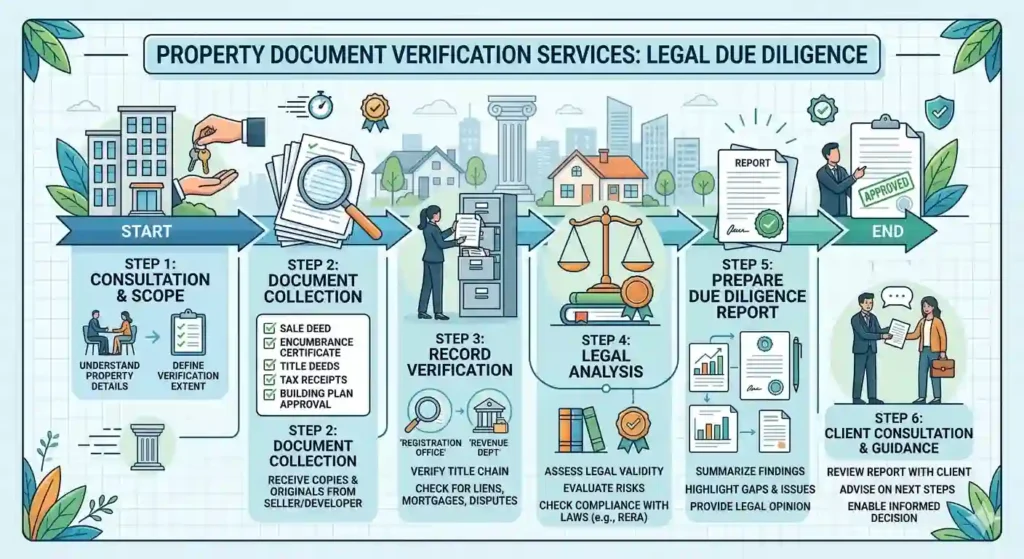
Paramount Law House follows a rigorous, multi-stage property due diligence methodology covering every legal and regulatory dimension. Therefore, every engagement begins with a client briefing to understand the property’s location, type, value, and intended purpose. Stage one involves collecting all available title documents, revenue records, and regulatory approvals from the client and authorities. Consequently, our property lawyers examine every document for authenticity, completeness, and legal compliance with applicable laws. Stage two involves independent verification through government portals — TNEGA, CERSAI, state RERA — and physical Sub-Registrar records. Additionally, a litigation search confirms no pending court proceedings, injunctions, or lis pendens affecting the subject property. Stage three delivers a comprehensive written Property Due Diligence Report covering title status, encumbrances, risks, and recommended remedies. Furthermore, Paramount Law House issues a formal Title Certificate for properties satisfying all due diligence parameters successfully. Our team provides post-report legal support — registration assistance, RERA complaints, FIR filing — as required by each client’s specific situation.
- Client Briefing: Understanding property details, transaction purpose, and budget constraints
- Document Collection: Gathering title deeds, EC, patta, building plan, and RERA documents
- Title Chain Examination: Tracing 30-year ownership history through Sub-Registrar records
- Revenue Record Verification: Patta, chitta, adangal cross-check at Tahsildar office
- Encumbrance Search: EC verification supplemented by CERSAI and DRT searches
- Regulatory Compliance Check: Building plan, OC, RERA registration, land use verification
- Litigation Search: Civil court and High Court records for pending property disputes
- Due Diligence Report: Comprehensive written opinion with title status and risk assessment
- Title Certificate: Formal certificate for clean title properties confirming marketability
- Post-Report Support: Registration assistance, RERA complaints, FIR filing as needed
Legal Remedies Available When Property Document Defects Are Discovered After Purchase
Discovering property document defects after purchase demands immediate, multi-track legal action to protect the buyer’s investment. Therefore, Paramount Law House provides swift legal opinion on the available remedies specific to each post-purchase defect scenario. Cancellation of fraudulent sale deeds requires a declaratory civil suit under the Specific Relief Act, 1963 before the Civil Court. Consequently, courts grant cancellation decrees where fraud, misrepresentation, or forgery in the sale deed is established. Criminal complaints under BNS Sections 316–318 run parallel to civil suits to freeze assets and prosecute fraudsters. Additionally, RERA complaints against defaulting builders recover refunds with 10.75% interest under RERA Section 18 provisions. Consumer complaints before DCDRC and SCDRC address builder deficiency in possession, quality, and completion timelines. Furthermore, SARFAESI challenges before the DRT protect borrowers from illegal bank enforcement of mortgaged property. High Court writ petitions quash arbitrary government orders affecting the purchased property’s legal status. Paramount Law House deploys the optimal combination of remedies to maximise post-purchase property dispute recovery for every client.
- Declaratory Suit: Civil Court — declaration of title and cancellation of fraudulent deed
- Specific Performance: Civil Court — compelling seller to complete agreed property transfer
- RERA Complaint: State RERA Authority — refund + 10.75% interest on builder default
- Consumer Complaint: DCDRC / SCDRC — compensation for builder deficiency and delays
- FIR Under BNS: Police Station — prosecution of fraudster under BNS Sections 316–318
- DRT Challenge: Debt Recovery Tribunal — SARFAESI enforcement dispute resolution
- Writ Petition: High Court — challenging illegal government orders affecting property
- Injunction Application: Civil Court — restraining further alienation of disputed property
Frequently Asked Questions: Property Document Verification and Legal Due Diligence — Paramount Law House 2026
Q1. What is property document verification and why is it important?
Property document verification is a lawyer’s systematic examination of all title, revenue, and regulatory documents before purchase. It prevents fraud, encumbrance, and title defects. Paramount Law House delivers comprehensive due diligence reports. Never purchase property without prior legal verification.
Q2. How many years of title chain should be verified for a property?
A minimum 30-year title chain is required for clear and marketable title certification in India. Some lenders demand 50 years for mortgage purposes. Our lawyers trace the full ownership history through Sub-Registrar records meticulously. Contact Paramount Law House for your title search today.
Q3. What is an Encumbrance Certificate and how do I obtain it?
An EC confirms no mortgage, charge, or lien exists on a property for the specified period. Apply at the Sub-Registrar’s Office or online through the state portal. Request Form 16 (nil EC) for clean properties. We supplement EC with CERSAI searches for complete verification.
Q4. Can a GPA-based property sale be legally challenged in India?
Yes. The Supreme Court in Suraj Lamp v. State of Haryana held that GPA sales do not confer legal title. Such transactions are legally vulnerable and can be challenged in civil courts. Paramount Law House identifies GPA-based title defects during due diligence before any purchase proceeds.
Q5. What happens if I buy a RERA-unregistered property in India?
Purchasing from an unregistered project is legally risky and the builder faces penalties under RERA Section 59. Buyers can file complaints for refund with 10.75% interest under RERA Section 18. Always verify RERA registration on the state portal before payment. We verify RERA compliance thoroughly.
Q6. What is patta and why is it important for property purchase?
Patta is the revenue ownership document issued by the Tahsildar confirming legal possession and land classification. It must match the seller’s name in the sale deed. Discrepancies indicate title defects requiring resolution before purchase. Paramount Law House verifies patta records at the Tahsildar’s office directly.
Q7. How does BNS 2023 protect property fraud victims in India?
BNS Section 316 punishes property document forgery with up to 7 years imprisonment. BNS Section 318 targets users of forged documents. Victims file FIR at the jurisdictional police station under BNSS Section 173. Paramount Law House files FIRs and simultaneously pursues civil recovery suits effectively.
Q8. What is CERSAI and why should property buyers check it?
CERSAI is the Central Registry of Securitisation recording equitable mortgages created by deposit of title deeds. These do not appear in the standard EC from the Sub-Registrar. A CERSAI search detects hidden bank charges. Paramount Law House always includes CERSAI verification in property due diligence reports.
Q9. Can digital land records from TNEGA or Bhoomi be used as court evidence?
Yes. BSA 2023 Section 57 makes certified electronic records from government portals admissible as primary court evidence. Proper authentication through the portal administrator is required. Paramount Law House prepares BSA-compliant digital evidence packages for property litigation across all Indian civil and criminal courts.
Q10. Why should I choose Paramount Law House for property document verification?
Paramount Law House offers 30-year title tracing, EC verification, CERSAI search, RERA compliance checks, and litigation searches in every due diligence engagement. We deliver written reports and formal title certificates. Our property lawyers practise before all Indian civil courts, RERA authorities, and revenue forums. Contact us before you buy.
Read More
- Property Documentation Review: Ensure Accuracy and Compliance
- Property Exchange Deed Assistance: Expert Guidance
- Property Fraud Prevention: Legal Protection in Place
- Property Gift Deed Drafting: Ensure Legally Valid Documents
- Property Gift Deed Rules Clarified: Legal Expertise
- Department of Land Resources