Family Settlement Suit Representation: Experienced Lawyers
Family Settlement Suit Representation – Family settlement disputes often involve ancestral property, self-acquired assets, inheritance rights, succession claims, partition disagreements, and settlement…
Family Settlement Suit Representation – Family settlement disputes often involve ancestral property, self-acquired assets, inheritance rights, succession claims, partition disagreements, and settlement deed interpretation. Paramount Law House provides experienced legal representation for individuals, families, senior citizens, women, NRIs, trusts, and legal heirs across India. Moreover, early legal advice reduces prolonged disputes and protects valuable family relationships. Our advocates analyse ownership documents, revenue records, registered settlement deeds, wills, succession certificates, and applicable statutes before recommending legal action. Furthermore, disputes may proceed before Civil Courts, High Courts, mediation centres, Lok Adalats, or appellate forums depending upon jurisdiction. Relevant laws include the Code of Civil Procedure, Bharatiya Nyaya Sanhita, Bharatiya Nagarik Suraksha Sanhita, Bharatiya Sakshya Adhiniyam, Registration Act, Transfer of Property Act, Hindu Succession Act, Indian Succession Act, and other applicable property laws. Strategic legal representation strengthens settlement enforcement while protecting lawful ownership rights.
Family Settlement Suit Representation: Experienced Lawyers – Paramount Law House
Understanding Family Settlement Suits in India
Family settlement suits resolve disputes concerning ownership, inheritance, possession, partition, and distribution of family properties. Therefore, parties should understand legal consequences before initiating litigation. Paramount Law House advises clients regarding settlement deeds, oral family arrangements, partition agreements, succession disputes, and contested property claims. Family settlement litigation frequently involves multiple stakeholders and complex documentary evidence. Additionally, courts examine registration requirements, possession, revenue records, intention of parties, and surrounding circumstances before granting relief. Proper legal drafting reduces ambiguity and future disputes. Early negotiation may also prevent lengthy litigation and preserve family harmony. Furthermore, advocates evaluate limitation, jurisdiction, title, and evidentiary issues before filing proceedings. Professional legal guidance improves enforceability while protecting legitimate interests of every family member.
Common Legal Issues in Family Settlement Disputes
Family settlement matters involve several legal and factual questions requiring professional evaluation. Consequently, advocates examine every document before suggesting legal remedies. Frequently encountered issues include:
- Partition disputes
- Settlement deed cancellation
- Will disputes
- Inheritance conflicts
- Property possession disputes
- Undivided ancestral property
- Fraudulent documentation
- Forgery allegations
- Illegal property transfers
- Boundary disputes
Furthermore, disputes may involve revenue authorities, registration departments, civil courts, and appellate forums. Criminal allegations involving forgery, cheating, intimidation, or criminal breach of trust may require proceedings before nearby Police Stations under applicable provisions of the Bharatiya Nyaya Sanhita. Early legal assessment improves litigation strategy and evidence preservation.
Courts and Authorities Handling Family Settlement Cases
Several judicial and administrative authorities decide family settlement disputes depending upon legal issues and jurisdiction. Therefore, selecting the appropriate forum remains essential for effective dispute resolution. Paramount Law House advises clients regarding competent authorities.
Important forums include:
| Authority | Primary Function |
|---|---|
| Civil Courts | Property and settlement disputes |
| High Courts | Appeals and writ jurisdiction |
| Supreme Court | Constitutional and appellate matters |
| Lok Adalat | Settlement through compromise |
| Mediation Centres | Alternative dispute resolution |
| Sub-Registrar | Registration matters |
| Revenue Authorities | Revenue record disputes |
Moreover, parties may approach Police Stations when criminal offences accompany property disputes. Proper forum selection strengthens procedural compliance while reducing avoidable litigation delays.
Essential Documents for Family Settlement Litigation
Successful family settlement litigation depends upon complete and reliable documentary evidence. Therefore, litigants should preserve every relevant record before commencing proceedings. Paramount Law House assists clients in organising legally admissible documentation.
| Document | Purpose |
|---|---|
| Settlement Deed | Establishes agreed distribution |
| Title Deeds | Proves ownership |
| Revenue Records | Shows property entries |
| Encumbrance Certificate | Verifies transactions |
| Registered Will | Supports succession claims |
| Legal Heir Certificate | Identifies beneficiaries |
| Property Tax Receipts | Establishes possession |
| Identity Documents | Confirms party details |
Additionally, courts may consider family correspondence, photographs, bank records, mutation orders, survey records, and witness testimony. Evidence must satisfy admissibility requirements under the Bharatiya Sakshya Adhiniyam. Comprehensive documentation significantly strengthens claims involving ownership, possession, and settlement enforcement.
Strategic Legal Assistance for Family Property Settlements
Family property disputes require careful legal planning, factual analysis, and effective courtroom advocacy. Paramount Law House represents individuals, legal heirs, executors, beneficiaries, companies, trusts, and NRIs in complex settlement litigation. Moreover, our advocates examine title documents, statutory provisions, revenue records, and judicial precedents before recommending legal strategies. We assist with legal notices, settlement negotiations, mediation proceedings, plaint drafting, written statements, injunction applications, evidence preparation, and appellate proceedings. Furthermore, our legal team protects client interests before Civil Courts, High Courts, appellate forums, and registration authorities. Professional representation improves dispute resolution while safeguarding ownership rights, family harmony, and long-term property security.
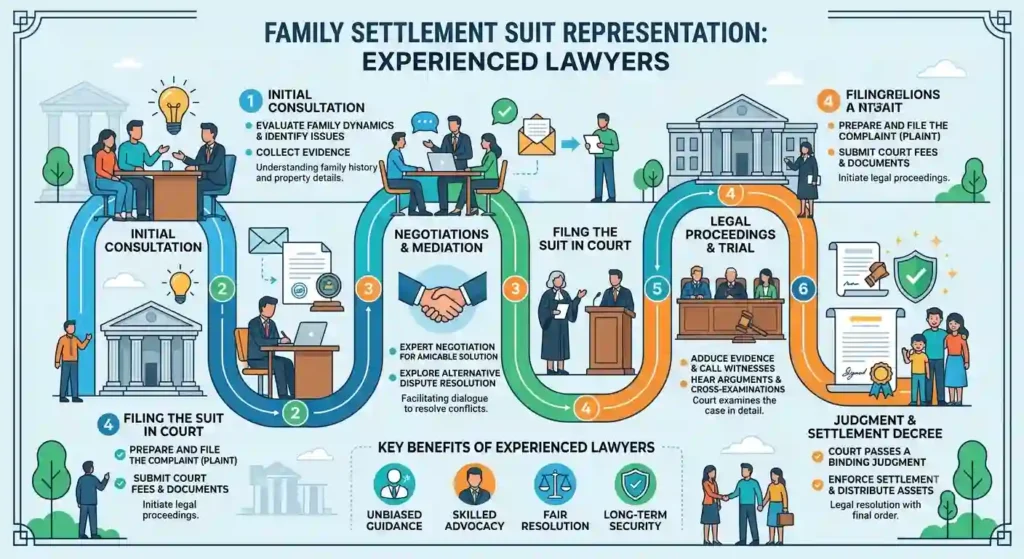
Legal Procedure for Filing a Family Settlement Suit
A properly drafted family settlement suit protects ownership rights and reduces procedural complications. Therefore, litigants should obtain legal advice before initiating court proceedings. Paramount Law House evaluates title documents, limitation, jurisdiction, and available remedies before filing any suit. Generally, the legal process includes:
- Verify ownership and revenue records.
- Examine settlement deed or family arrangement.
- Issue a legal notice where appropriate.
- Prepare the plaint with supporting documents.
- File the suit before the competent Civil Court.
- Present documentary and oral evidence.
- Seek interim injunction when necessary.
- Pursue execution after obtaining the decree.
Furthermore, courts encourage mediation in suitable disputes. Early settlement frequently saves litigation costs while preserving family relationships. Proper legal strategy improves the possibility of a timely and effective resolution.
Civil Remedies in Family Settlement Disputes
Family settlement litigation offers several civil remedies depending upon the dispute and available evidence. Consequently, advocates recommend appropriate relief after evaluating the facts. Paramount Law House assists clients in protecting lawful ownership through suitable legal proceedings. Common remedies include:
- Declaration of ownership
- Permanent injunction
- Temporary injunction
- Partition decree
- Cancellation of fraudulent documents
- Recovery of possession
- Specific performance
- Mesne profits
- Mandatory injunction
- Execution of settlement terms
Moreover, courts consider documentary evidence, witness testimony, and applicable succession laws before granting relief. Proper pleadings strengthen judicial confidence while reducing procedural objections. Timely legal action also protects valuable property rights from unlawful transfers or encroachments.
Evidence Required for Successful Family Settlement Claims
Strong evidence forms the foundation of every successful family settlement suit. Therefore, parties should preserve original records and obtain certified copies whenever possible. Paramount Law House helps clients prepare legally admissible evidence before trial.
| Evidence | Legal Value |
|---|---|
| Registered Settlement Deed | Establishes family arrangement |
| Revenue Records | Confirms ownership entries |
| Encumbrance Certificate | Shows property history |
| Survey Sketch | Identifies property boundaries |
| Witness Statements | Supports disputed facts |
| Bank Records | Establish financial transactions |
| Photographs | Demonstrate possession |
| Expert Reports | Clarify technical disputes |
Additionally, electronic records may become admissible under the Bharatiya Sakshya Adhiniyam when statutory requirements remain satisfied. Comprehensive evidence strengthens claims involving title, possession, succession, and settlement enforcement before competent courts.
Alternative Dispute Resolution in Family Property Matters
Many family disputes conclude successfully through alternative dispute resolution mechanisms. Therefore, parties should evaluate settlement opportunities before pursuing prolonged litigation. Paramount Law House represents clients during negotiations, mediation, and settlement discussions. Common alternative mechanisms include:
- Court-annexed mediation
- Lok Adalat
- Private mediation
- Family negotiations
- Conciliation proceedings
Furthermore, negotiated settlements often reduce emotional stress and litigation expenses. Mediation also provides flexible solutions tailored to family circumstances. However, advocates carefully review every proposed settlement before execution. Legally drafted settlement agreements minimise future disputes while ensuring enforceability. Professional legal guidance protects family interests throughout alternative dispute resolution proceedings.
Criminal Issues Connected with Family Settlement Disputes
Certain family settlement disputes involve criminal allegations alongside civil litigation. Consequently, affected parties may require simultaneous criminal and civil legal representation. Rajendra Law House advises clients regarding offences connected with property disputes. Criminal allegations may include:
- Forgery of settlement deeds.
- Cheating regarding ownership.
- Criminal intimidation.
- Criminal breach of trust.
- Fabrication of documents.
- Trespass into disputed property.
- Misappropriation of family assets.
- Destruction of documentary evidence.
Moreover, investigations follow the Bharatiya Nagarik Suraksha Sanhita, while evidentiary standards follow the Bharatiya Sakshya Adhiniyam. Criminal proceedings may continue independently from civil suits. Early legal intervention protects evidence while safeguarding statutory rights before competent authorities.
Why Choose Paramount Law House for Family Settlement Representation
Family settlement litigation demands legal knowledge, negotiation skills, and strategic courtroom advocacy. Paramount Law House represents individuals, legal heirs, senior citizens, women, NRIs, executors, trustees, and beneficiaries across India. Moreover, our advocates analyse settlement deeds, wills, title records, revenue documents, succession rights, and judicial precedents before recommending legal action. Every matter receives careful examination regarding jurisdiction, limitation, evidence, and available remedies. We also coordinate with surveyors, valuers, revenue officials, and document experts whenever required. Furthermore, our legal team appears before Civil Courts, High Courts, appellate forums, mediation centres, Lok Adalats, and registration authorities. Professional legal representation protects ownership rights while encouraging practical settlements whenever possible. Early legal advice frequently prevents avoidable litigation and preserves valuable family relationships alongside property interests.
Practical Steps Before Filing a Family Settlement Suit
Effective family settlement litigation begins with careful preparation and organised documentation. Proper planning strengthens claims while reducing procedural objections. Therefore, affected parties should complete essential steps before approaching the court.
- Verify title and ownership documents.
- Collect certified revenue records.
- Preserve the original settlement deed.
- Obtain encumbrance certificates.
- Record possession details accurately.
- Identify all legal heirs.
- Maintain communication records.
- Consult an experienced property lawyer.
These practical measures improve legal strategy while strengthening documentary evidence. Comprehensive preparation also increases opportunities for negotiated settlements before trial. Timely legal guidance protects statutory rights and minimises future procedural complications during litigation.
Conclusion: Secure Your Family Rights Through Skilled Legal Representation
Family settlement suits resolve complex ownership, inheritance, and succession disputes while protecting lawful property rights. Therefore, parties should seek experienced legal assistance before commencing litigation. Paramount Law House provides comprehensive representation for settlement deed disputes, partition claims, inheritance conflicts, cancellation proceedings, possession recovery, and related property matters. Our advocates utilise the Code of Civil Procedure, Bharatiya Nyaya Sanhita, Bharatiya Nagarik Suraksha Sanhita, Bharatiya Sakshya Adhiniyam, Hindu Succession Act, Indian Succession Act, Registration Act, and Transfer of Property Act wherever applicable. Furthermore, we represent clients before Civil Courts, High Courts, appellate forums, mediation centres, Lok Adalats, and registration authorities. Professional legal advocacy safeguards family assets while promoting fair, lawful, and lasting dispute resolution.
Frequently Asked Questions
1. What is a family settlement suit?
A family settlement suit resolves disputes regarding ownership, inheritance, partition, possession, or enforcement of a family settlement involving movable or immovable property.
2. Can an unregistered family settlement be legally valid?
Depending upon facts and applicable law, certain family arrangements may receive legal recognition. Professional legal advice remains essential.
3. Which court handles family settlement property disputes?
Most family settlement property disputes proceed before the competent Civil Court having territorial and pecuniary jurisdiction.
4. Can criminal proceedings accompany a family settlement dispute?
Yes. Allegations involving forgery, cheating, intimidation, or fabricated documents may result in criminal proceedings under applicable laws.
5. What documents strengthen a family settlement case?
Settlement deeds, title documents, revenue records, wills, encumbrance certificates, legal heir certificates, tax receipts, and witness evidence strengthen claims.
6. Why should I hire a lawyer for a family settlement suit?
An experienced lawyer protects ownership rights, prepares evidence, drafts pleadings, negotiates settlements, and represents clients before competent courts and authorities.
Read More
- Gift Deed Drafting Services: Expert Legal Assistance
- Hire Purchase Agreement Assistance: Ensure Compliance
- House Owner Tenant Issue Resolution: Legal Support Available
- Housing Development Law Consultation: Expert Advice
- Illegal Possession of Immovable Property: Legal Remedies
- Legislative Department, Ministry of Law and Justice