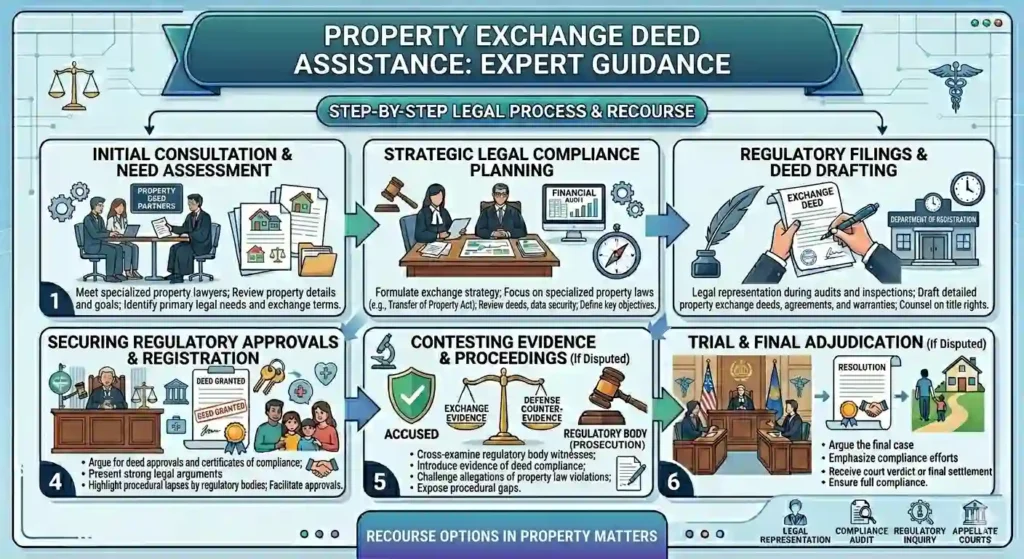
Property Exchange Deed Assistance: Expert Guidance
Property exchange deed assistance involve complex legal formalities that demand professional expertise. Paramount Law House provides comprehensive guidance for exchange deed matters…
Property exchange deed assistance involve complex legal formalities that demand professional expertise. Paramount Law House provides comprehensive guidance for exchange deed matters across Tamil Nadu and beyond. Our experienced legal team navigates every procedural step efficiently. Consequently, clients avoid costly errors that derail property transactions. An exchange deed legally transfers ownership between two parties swapping properties. Therefore, understanding the legal framework is absolutely essential for every property owner. Every exchange transaction must comply with the Transfer of Property Act, 1882. Furthermore, the Registration Act, 1908 mandates compulsory registration of such deeds. Our lawyers actively assist clients through document preparation, registration, and dispute resolution. Additionally, we ensure full compliance with the Indian Stamp Act, 1899 at every stage.
Understanding Property Exchange Deeds Under Indian Law
An exchange deed, under Section 118 of the Transfer of Property Act, 1882, transfers ownership mutually between two parties. Moreover, both parties must exchange properties of equivalent or assessed value. Courts actively scrutinize exchange transactions to prevent fraudulent transfers. Therefore, proper documentation protects both parties from future legal disputes. The Bharatiya Nyaya Sanhita, 2023 (BNS) criminalises fraudulent property transfers under relevant provisions. Additionally, the Bharatiya Nagarik Suraksha Sanhita, 2023 (BNSS) governs investigation procedures. The Bharatiya Sakshya Adhiniyam, 2023 (BSA) regulates admissibility of property-related evidence in courts. Furthermore, the Civil Procedure Code (CPC) governs suits for declaration and specific performance. Every exchange deed requires clear title investigation before execution. Consequently, our legal team performs thorough title searches before advising clients to proceed.
Essential Legal Elements of a Valid Exchange Deed
A valid exchange deed must satisfy specific essential conditions recognised by Indian courts. Primarily, both parties must have the legal capacity to contract under the Indian Contract Act, 1872. Additionally, the properties exchanged must be specifically identifiable with clear boundaries. Every deed must contain the names, addresses, and identification details of both parties. Furthermore, the nature of properties, survey numbers, and extent must appear precisely. The deed must clearly state that ownership transfers simultaneously between both parties. Moreover, adequate stamp duty must be paid as per the Indian Stamp Act, 1899 provisions. The Sub-Registrar’s office mandates proper execution before the registering authority. Therefore, both parties must be physically present during registration procedures. Consequently, our lawyers accompany clients and ensure smooth execution at the registration office.
Stamp Duty and Registration Requirements for Exchange Deeds
Stamp duty for exchange deeds is calculated on the higher-valued property involved in the transaction. Therefore, accurate property valuation by certified government valuers becomes critically important. The Tamil Nadu Stamp Act provisions govern stamp duty calculations for properties within the state. Additionally, the Inspector General of Registration (IGR) prescribes current guideline values for all properties. Our legal team actively assists clients in obtaining proper valuation certificates from authorised valuers. Furthermore, underpayment of stamp duty attracts penalties under Section 35 of the Indian Stamp Act. Consequently, clients must pay correct stamp duty to avoid impoundment of the exchange deed. The Registration Act, 1908 requires registration within four months of execution. Therefore, timely filing with the Sub-Registrar prevents additional fees and legal complications. Our lawyers meticulously track deadlines to ensure timely registration for all clients.
Documents Required for Exchange Deed Registration
Preparing accurate documents is the most critical step in the exchange deed process. Therefore, our team carefully verifies every document before submission to the Sub-Registrar. The following essential documents must be submitted during exchange deed registration:
- Original title documents and previous sale deeds of both properties
- Encumbrance Certificate from Sub-Registrar’s office (minimum 30 years)
- Patta and Chitta documents from the Revenue Department
- Adangal extract confirming land use and possession details
- Survey sketch approved by the Survey and Settlement Department
- Property Tax receipts from the respective Local Body or Corporation
- Identity proof: Aadhaar Card, PAN Card of both parties
- Two passport photographs of each party involved
- No Objection Certificate (NOC) from mortgagees, if applicable
- Stamp duty payment challan from authorised bank branches
Moreover, any missing document delays registration and attracts legal complications unnecessarily. Our team proactively assists clients in collecting all required documents efficiently.
Role of Government Departments in Exchange Deed Transactions
Multiple government departments actively participate in validating exchange deed transactions in Tamil Nadu. Therefore, understanding each department’s role helps clients navigate the process confidently. The Registration and Stamps Department manages deed registration through Sub-Registrar offices statewide. Additionally, the Revenue Department maintains land records, including Patta, Chitta, and Adangal documents. The Survey and Settlement Department provides official survey sketches and field measurement books. Furthermore, local bodies such as the Chennai Corporation and Municipalities verify property tax compliance. The Tamil Nadu Housing Board regulates exchanges involving housing board properties specifically. Moreover, CMDA and DTCP approve layouts in Chennai Metropolitan and other planning areas. The Income Tax Department monitors high-value property transactions under Section 194-IA of the Income Tax Act. Consequently, TDS compliance is mandatory for properties valued above fifty lakh rupees. Our lawyers coordinate with all departments simultaneously for faster transaction completion.
Legal Issues Arising in Property Exchange Deed Transactions
Property exchange transactions frequently generate legal disputes due to various procedural and substantive issues. Therefore, early legal intervention prevents escalation into costly and time-consuming litigation. Title defects are the most common issue encountered during exchange deed transactions. Additionally, fraudulent misrepresentation of property value leads to disputes after registration completion. Encumbrances such as mortgages, liens, or court attachments invalidate exchange transactions frequently. Furthermore, co-ownership disputes arise when all co-owners do not consent to the exchange. Boundary disputes between neighbouring landowners often surface during exchange deed execution. Moreover, agricultural land ceiling violations under Tamil Nadu Land Reforms Act create serious legal complications. Forest land and government poromboke land restrictions frequently affect exchange deed validity. The BNS, 2023 treats fraudulent property transfers as criminal offences punishable with imprisonment. Consequently, our lawyers actively investigate all potential legal issues before advising clients to proceed.
Common Title Defects and How to Resolve Them
Title defects significantly impair the validity of exchange deeds and must be resolved promptly. Therefore, a thorough title investigation going back at least thirty years is absolutely essential. Missing link deeds create chain of title defects that courts consistently refuse to overlook. Furthermore, succession disputes among legal heirs of deceased owners cloud property titles seriously. Our legal team files suits for Declaration of Title under the Specific Relief Act, 1963 when necessary. Additionally, Courts issue Declaratory Decrees under Section 34 of the Specific Relief Act to clear titles. Rectification deeds are executed to correct typographical or factual errors in previous deeds. Moreover, Partition deeds resolve co-ownership disputes and create clear individual title before exchange. The Civil Courts and High Courts actively hear title-related disputes under the CPC framework. Consequently, our lawyers represent clients before all relevant judicial forums to resolve title issues efficiently.
Types of Legal Disputes in Exchange Deed Matters
Exchange deed disputes arise in varied forms, each requiring distinct legal strategies and remedies. Therefore, identifying the exact type of dispute helps our lawyers plan effective legal responses promptly. The following table outlines common disputes, applicable laws, and corresponding legal remedies:
| Type of Dispute | Applicable Law | Legal Forum | Remedy |
|---|---|---|---|
| Fraudulent Exchange | BNS 2023, Sec. 316 | Sessions Court / Police Station | Criminal Complaint, FIR |
| Title Defect | Specific Relief Act, 1963 | Civil Court / High Court | Declaratory Decree |
| Stamp Duty Evasion | Indian Stamp Act, 1899 | Collector / High Court | Penalty Payment, Appeal |
| Registration Refusal | Registration Act, 1908 | District Registrar / Court | Appeal under Section 72 |
| Encumbrance Dispute | Transfer of Property Act | Civil Court / DRT | Injunction, Declaration |
| Co-Owner Dispute | CPC Order 1 Rule 1 | Civil Court | Partition Suit |
| Municipal NOC Refusal | Town and Country Planning Act | CMDA / High Court | Writ Petition |
| Agricultural Land Ceiling | TN Land Reforms Act, 1961 | Land Tribunal | Exemption Application |
Therefore, our experienced lawyers select the most appropriate legal forum for each dispute type. Timely action significantly improves outcomes in property exchange-related legal disputes.
Fraudulent Exchange Deeds and Criminal Remedies Under BNS 2023
Fraudulent exchange deeds are treated as serious criminal offences under the Bharatiya Nyaya Sanhita, 2023. Therefore, victims must act swiftly by filing a complaint at the nearest police station immediately. The BNS Section 316 punishes cheating involving property with imprisonment up to seven years. Additionally, Section 318 specifically addresses cheating by impersonation in property transactions. The BNSS, 2023 governs arrest, bail, and investigation procedures in such criminal cases. Furthermore, economic offences wings of city police stations handle complex property fraud cases. The Economic Offences Wing (EOW) of Tamil Nadu Police investigates large-scale property fraud cases actively. Moreover, victims may file complaints before the Judicial Magistrate under Section 223 of the BNSS. The BSA, 2023 governs admissibility of digital evidence such as emails and WhatsApp communications. Consequently, our criminal law team files FIRs and pursues criminal prosecution vigorously on behalf of clients.
Police Stations and Investigation Authorities for Property Fraud
Property fraud complaints are registered at jurisdictional police stations based on where the offence occurred. Therefore, identifying the correct jurisdictional police station is the first critical step for victims. The following key investigation authorities handle property exchange fraud cases in Tamil Nadu:
- Local Jurisdictional Police Station – First point for registering FIR under BNSS Section 173
- Economic Offences Wing (EOW), Chennai – Handles organised property fraud above ₹1 crore
- CB-CID (Crime Branch – Criminal Investigation Department) – Investigates multi-party complex fraud
- Cyber Crime Police Station – Handles online property fraud and digital forgery cases
- Directorate of Vigilance and Anti-Corruption (DVAC) – Investigates government official involvement
- District Crime Branch (DCB) – Handles district-level organised property fraud
- Women’s Police Station – Handles cases involving fraud against women property owners
Moreover, our legal team actively assists clients in identifying the correct authority and preparing detailed complaints. Prompt reporting significantly improves the chances of successful criminal prosecution and property recovery.
Courts and Tribunals Handling Exchange Deed Disputes
Exchange deed disputes are heard before various judicial forums depending on the nature of the claim. Therefore, choosing the right forum significantly impacts the speed and success of legal proceedings. Civil Courts at the Munsif level hear disputes involving properties valued below one lakh rupees. Additionally, District Courts handle property disputes exceeding the Munsif Court’s pecuniary jurisdiction. The High Court of Madras exercises original jurisdiction over specific high-value property matters. Furthermore, the High Court’s Appellate Division hears appeals against District Court judgments in property matters. The National Consumer Disputes Redressal Commission (NCDRC) handles cases involving builder-related exchange issues. Moreover, Debt Recovery Tribunals (DRT) handle exchange disputes involving mortgaged properties under SARFAESI Act. The Land Acquisition and Rehabilitation Tribunal adjudicates disputes involving government-acquired lands. Revenue Divisional Officers (RDO) resolve patta and land record correction disputes efficiently. Consequently, our lawyers regularly appear before all relevant courts and tribunals across Tamil Nadu.
Legal Remedies Available for Exchange Deed Disputes
Indian law provides multiple effective legal remedies for victims of defective or fraudulent exchange deeds. Therefore, understanding available remedies empowers clients to make informed decisions about their legal strategy. The following are the principal legal remedies available in exchange deed disputes:
- Specific Performance – Court order compelling the defaulting party to complete the exchange
- Declaration of Title – Court declares rightful ownership under Specific Relief Act, 1963
- Cancellation of Deed – Court cancels a fraudulent or void exchange deed under Section 31
- Permanent Injunction – Court restrains parties from dealing with disputed property
- Temporary Injunction – Interim relief under Order 39 CPC pending final disposal
- Rectification of Deed – Corrects errors in registered exchange deeds through court order
- Damages and Compensation – Monetary relief for losses suffered due to breach
- Criminal Prosecution – FIR and prosecution under BNS 2023 for fraud and cheating
- Writ Petition – High Court remedy for illegal administrative or departmental actions
- Appeal to District Registrar – Under Section 72 of Registration Act against registration refusal
Furthermore, our lawyers evaluate each case carefully and recommend the most effective combination of remedies. Timely pursuit of remedies prevents further deterioration of the client’s legal position.
Exchange Deed Disputes Involving Agricultural and Revenue Land
Agricultural land exchanges involve additional regulatory requirements under Tamil Nadu land laws. Therefore, parties must verify whether the land is subject to ceiling restrictions before executing the deed. The Tamil Nadu Land Reforms (Fixation of Ceiling on Land) Act, 1961 limits individual agricultural land holdings. Additionally, Section 5 of this Act strictly prohibits transfers that circumvent ceiling provisions. Revenue officials at the Tehsildar level verify land classification before approving patta mutations. Furthermore, the District Collector has powers to investigate suspicious agricultural land exchange transactions. Special Land Acquisition Courts adjudicate compensation disputes when exchanged land is subsequently acquired. Moreover, the Land Tribunal resolves disputes involving tenancy rights and agricultural land ownership effectively. The Revenue Divisional Officer adjudicates classification disputes between wet and dry land categories. Consequently, our lawyers specialising in revenue law actively assist clients with agricultural land exchange matters throughout Tamil Nadu.
NRI and Overseas Indian Property Exchange: Special Legal Considerations
Non-Resident Indians (NRIs) exchanging properties in India face additional regulatory requirements under FEMA, 1999. Therefore, RBI regulations and FEMA guidelines must be strictly complied with in NRI property exchanges. Section 6 of FEMA governs capital account transactions including NRI property exchange transactions specifically. Additionally, Form IPI-7 must be filed with the RBI for properties acquired before certain regulatory dates. NRIs must obtain Permanent Account Numbers (PAN) from the Income Tax Department before deed execution. Furthermore, TDS deduction under Section 195 of the Income Tax Act applies to NRI property exchanges mandatorily. Power of Attorney granted by NRIs must be registered and duly notarised in the concerned foreign country. Moreover, the Consulate or Embassy of India must attest such Power of Attorney documents properly. FEMA violations attract penalties under Section 13 of the Foreign Exchange Management Act, 1999. Consequently, our NRI legal team provides specialised guidance to overseas Indians throughout the entire exchange process.
Types of Legal Support Provided by Paramount Law House
Paramount Law House provides end-to-end legal support for all property exchange deed matters comprehensively. Therefore, clients receive integrated assistance covering advisory, documentation, registration, and litigation services. Our legal support services are structured as follows for maximum client benefit and convenience:
- Title Investigation and Due Diligence – Comprehensive 30-year title search and encumbrance verification
- Draft Deed Preparation – Legally accurate exchange deed drafting by experienced property lawyers
- Stamp Duty Calculation and Payment – Accurate computation and facilitation of stamp duty payment
- Registration Assistance – Complete support at Sub-Registrar office including document coordination
- Mutation and Patta Transfer – Revenue office assistance for post-registration record changes
- Dispute Resolution and Litigation – Court representation in civil, criminal, and revenue forums
- Criminal Complaint Filing – FIR drafting and police station coordination for fraud cases
- NRI Legal Assistance – FEMA compliance, POA registration, and RBI filing support
- Writ Petition Filing – High Court representation for administrative remedy matters
- Arbitration and Mediation – ADR services for faster and cost-effective dispute resolution
Moreover, our lawyers provide personalised strategies tailored to each client’s specific legal needs. Therefore, clients consistently achieve favourable outcomes across all types of property exchange matters.
Post-Registration Legal Steps After Exchange Deed
Completing registration is not the final step in an exchange deed transaction process. Therefore, parties must diligently complete several post-registration legal formalities to secure full ownership rights. Mutation of revenue records must be done at the Tehsildar office within the prescribed period. Additionally, Patta transfer applications must be submitted with certified copies of the registered exchange deed. Property tax records must be updated with the respective Municipal Corporation or Gram Panchayat immediately. Furthermore, electricity and water service connections must be transferred to the new owner’s name promptly. Khata transfer at the municipal level is necessary for obtaining future building plan approvals. Moreover, society share certificate transfers are required for properties in cooperative housing societies. Income Tax returns must reflect the exchanged property in the appropriate assessment year. The GST Department must be informed if the exchange involves commercial property transactions. Consequently, our legal team provides comprehensive post-registration assistance ensuring complete legal ownership is secured.
Frequently Asked Questions (FAQs) – Property Exchange Deed
1. What is a Property Exchange Deed under Indian law?
A Property Exchange Deed is a legal document where two parties mutually transfer ownership of their respective properties. It is governed by Section 118 of the Transfer of Property Act, 1882, and requires compulsory registration under the Registration Act, 1908.
2. Is stamp duty payable on both properties in an exchange deed?
Stamp duty is calculated on the higher-valued property involved in the exchange transaction. The Indian Stamp Act, 1899 and respective state stamp schedules govern the applicable rates. Underpayment attracts penalties and possible deed impoundment by authorities.
3. Can a property exchange deed be cancelled after registration?
Yes. A registered exchange deed can be cancelled by a Civil Court under Section 31 of the Specific Relief Act, 1963, if it is found to be fraudulent, void, or executed under coercion. Both parties must consent, or a court order is required for cancellation.
4. What legal action can be taken against a fraudulent exchange deed?
A victim can file an FIR at the jurisdictional police station under BNS 2023 Sections 316 and 318. Additionally, a civil suit for cancellation of deed and declaration of title may be filed before the competent Civil Court simultaneously.
5. Is a No Objection Certificate required for exchange deed registration?
Yes, if the property is mortgaged, the mortgagee’s NOC is mandatory before registration. Properties under court attachment or lis pendens also require clearance. Our lawyers assist in obtaining all required clearances before proceeding to registration.
6. Can NRIs execute an exchange deed for Indian property?
Yes, NRIs can exchange Indian properties, subject to FEMA 1999 compliance and RBI guidelines. A registered Power of Attorney is required if they cannot attend registration personally. TDS under Section 195 of the Income Tax Act is also mandatory for NRI transactions.
7. Which court handles property exchange deed disputes in Tamil Nadu?
Civil Courts at the Munsif and District level handle most exchange deed disputes based on property value. The High Court of Madras has jurisdiction over complex title and constitutional matters. Revenue disputes go before Revenue Divisional Officers and Land Tribunals.
8. What happens if the exchange deed is not registered within the prescribed period?
Under Section 23 of the Registration Act, 1908, an exchange deed must be registered within four months of execution. Late registration attracts penalty fees. Beyond the extended period, the deed becomes inadmissible as evidence in property dispute proceedings.
9. Can agricultural land be exchanged freely in Tamil Nadu?
No. Agricultural land exchanges must comply with the Tamil Nadu Land Reforms (Fixation of Ceiling on Land) Act, 1961. Transactions violating ceiling limits are void. Revenue Department approval and Tehsildar verification are mandatory before executing agricultural land exchange deeds.
10. How does Paramount Law House assist in property exchange deed matters?
Paramount Law House provides complete legal support including title investigation, deed drafting, registration assistance, mutation, and litigation. Our experienced team handles civil, criminal, revenue, and FEMA matters efficiently. We represent clients before all courts, tribunals, police stations, and government departments across Tamil Nadu.
Read More
- Property Fraud Prevention: Legal Protection in Place
- Property Gift Deed Drafting: Ensure Legally Valid Documents
- Best ODI Filing Consultant in India for Overseas Investment Compliance
- Property Gift Deed Rules Clarified: Legal Expertise
- Property Litigation Representation: Experienced Lawyers
- Department of Land Resources (Ministry of Rural Development)