
Buyer Beware: 15 Legal Checks Before Purchasing Immovable Property
Buyer must verify ownership, title, approvals, possession, liabilities, and statutory compliance before paying substantial consideration. Buying immovable property involves far more than…
Buyer must verify ownership, title, approvals, possession, liabilities, and statutory compliance before paying substantial consideration. Buying immovable property involves far more than comparing prices, locations, and amenities. In Chennai and other Tamil Nadu locations, property due diligence may involve the Registration Department, Revenue Department, CMDA, Greater Chennai Corporation, local bodies, banks, courts, and tribunals. Therefore, a legal property verification process should begin before signing an agreement for sale. Buyers should examine original documents, revenue records, registration history, planning permissions, encumbrance records, and litigation information. Moreover, purchasers should verify whether the seller actually possesses transferable rights over the property. The Transfer of Property Act, 1882 governs important principles concerning transfers of immovable property. The Registration Act, 1908 governs registration requirements for specified instruments. Accordingly, professional legal assistance can identify title defects before they become expensive disputes. Paramount Law House provides property legal assistance covering title verification, documentation, transactions, disputes, and litigation support across Chennai and Tamil Nadu.
Why Legal Due Diligence Matters Before Buying Property
Property Purchases Require Evidence, Not Promises
A property advertisement rarely provides enough information to establish clear and marketable title. Therefore, buyers should treat every representation as a statement requiring independent verification. The seller may describe the property as approved, dispute-free, mortgage-free, or fully transferable. However, each representation requires documentary support from appropriate authorities. A registered sale deed establishes an important transaction record, but it does not replace comprehensive title investigation. Buyers should examine the entire chain of title and connect every transfer with supporting documents. Additionally, revenue records can reveal information about possession, classification, survey identity, and patta records. Planning authorities can reveal whether the proposed development complies with applicable planning controls. Banks may also require legal scrutiny before approving property finance. Consequently, an independent property lawyer can compare documents, identify inconsistencies, and advise the purchaser before financial commitments become difficult to reverse. This approach reduces exposure to title disputes, fraudulent transfers, boundary conflicts, mortgage claims, and regulatory violations.
The Buyer Should Build a Property Document File
A disciplined document file helps the purchaser organise evidence and identify missing records. The file should contain the seller’s identity documents, title deeds, previous conveyances, revenue records, tax receipts, approvals, and encumbrance certificates. It should also contain the latest agreement draft, property schedule, survey details, and correspondence with the seller. Importantly, buyers should compare every document against the same survey number, subdivision number, extent, boundaries, and property description. Even a minor mismatch can create serious registration or litigation complications later. Therefore, purchasers should avoid relying solely upon photocopies supplied by brokers or sellers. Instead, they should request certified or officially verifiable records wherever appropriate. A legal verification report can then record identified documents, missing documents, inconsistencies, and recommended corrective actions. This systematic process creates a clear audit trail for the purchase decision. It also helps future lawyers, lenders, or courts understand the documentary history if a dispute later arises.
Check 1: Verify the Seller’s Identity and Authority
The first legal check concerns the identity and authority of the person selling the property. Buyers should compare the seller’s name, age, address, identification details, and ownership documents. Where multiple owners exist, every necessary owner should participate in the transaction. Special attention becomes necessary when an attorney holder, company, partnership, trust, executor, guardian, or legal representative acts for the owner. The buyer should examine the authority document and determine whether it permits the proposed transaction. A power of attorney does not automatically establish ownership. Similarly, a company representative must demonstrate proper corporate authority for the transaction. Buyers should also investigate whether the seller has restrictions affecting the transfer. For inherited property, succession documents and the rights of all relevant heirs require examination. Where a deceased owner’s estate remains unsettled, purchasing directly from one claimant can create substantial litigation risk. Accordingly, identity verification should occur before negotiations progress into substantial advance payments or registration arrangements.
Check 2: Examine the Complete Chain of Title
Title investigation should trace ownership through earlier transactions rather than examining only the seller’s latest deed. The lawyer should review prior sale deeds, settlement deeds, gift deeds, partition deeds, release deeds, wills, court decrees, and other relevant instruments. Each transfer should logically connect the previous owner with the subsequent owner. The property description should remain consistent across the chain. Furthermore, the lawyer should examine whether any missing link creates uncertainty about ownership. A defective earlier transfer can affect later purchasers even when the latest deed appears properly registered. The Transfer of Property Act contains important rules concerning transfers of immovable property. Section 54 specifically addresses sale and the manner of transferring certain immovable property through a registered instrument. Therefore, buyers should not treat a sale agreement as equivalent to completed conveyance. A professional title opinion can identify gaps, adverse claims, inheritance complications, or defective instruments before the buyer proceeds toward final registration.
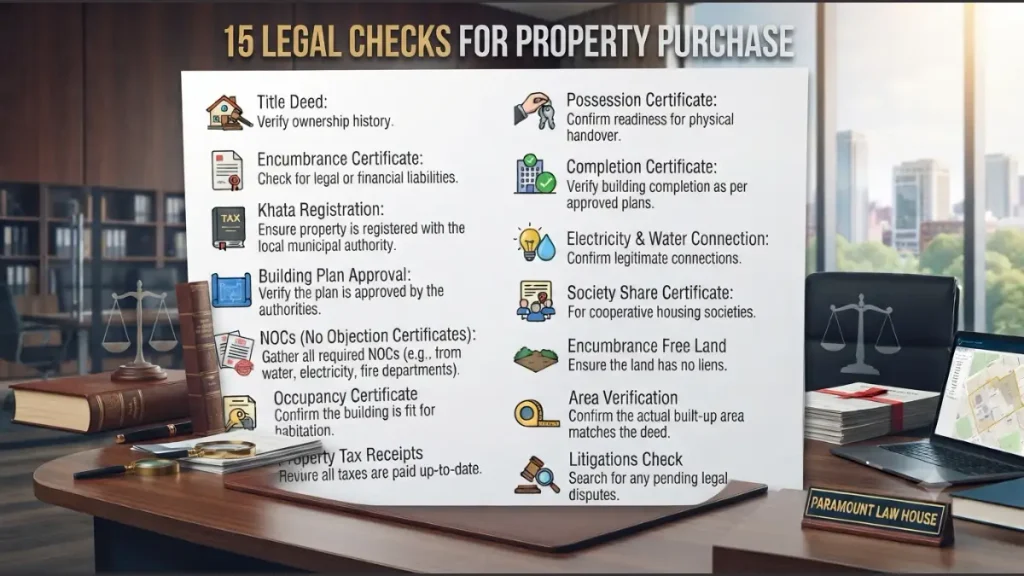
Check 3: Obtain and Review the Encumbrance Certificate
An Encumbrance Certificate remains an important component of Tamil Nadu property due diligence. Buyers should obtain appropriate EC records from the Registration Department covering a meaningful historical period. The certificate can disclose registered transactions and certain registered encumbrances affecting the property. However, buyers should understand that an EC does not constitute a universal guarantee of defect-free title. Unregistered claims, certain disputes, possession issues, and other matters may require separate investigation. Therefore, the EC should complement, rather than replace, a comprehensive title search. Tamil Nadu provides online facilities for applying for Encumbrance Certificates using property and registration details. Buyers should carefully compare EC entries with the seller’s title documents and previous transactions. If a mortgage, attachment, settlement, release, or sale appears in the record, the underlying document should receive legal scrutiny. Any unexplained entry deserves clarification before payment. This check can expose undisclosed transactions and help purchasers avoid acquiring property subject to unexpected registered interests.
Check 4: Verify Patta, Chitta, A-Register, FMB and TSLR Records
Revenue records provide important information for property verification in Tamil Nadu. Buyers should compare the title deed with applicable Patta, Chitta, A-Register, Field Measurement Book, and TSLR records. Urban and rural properties may involve different records and administrative details. Therefore, the buyer should use the appropriate government record for the property location. Tamil Nadu’s digital land-record services allow citizens to view several records using district, taluk, village, survey, subdivision, town, block, and ward information. Recent state initiatives also provide integrated land-record information and patta-transfer history. Nevertheless, revenue entries should not automatically be treated as conclusive proof of civil title. Instead, they should support the broader title investigation. Any mismatch between the sale deed and revenue records requires clarification before registration. The buyer should also verify whether the property remains classified correctly and whether the survey identity matches physical boundaries. Legal review can help distinguish revenue-record issues from substantive ownership disputes requiring civil court remedies.
Check 5: Confirm Survey Numbers, Boundaries and Physical Extent
Property descriptions must correspond with the property physically available on the ground. Buyers should compare the registered documents with survey numbers, subdivision numbers, measurements, boundaries, access roads, and actual possession. A qualified surveyor may become necessary when the site contains complicated boundaries or neighbouring disputes. Furthermore, the purchaser should compare available survey records with the physical layout. Encroachments can occur when compound walls, structures, pathways, or neighbouring constructions cross recorded boundaries. Such problems can later lead to injunction suits, declaration proceedings, partition disputes, or boundary litigation. Buyers should therefore inspect the property personally and document its present condition. Photographs, measurements, and survey records can preserve useful evidence. Where an access road forms part of the transaction, the buyer should verify the legal basis for access. Easement rights may require separate examination. A visually attractive property may still contain serious boundary or access defects. Consequently, physical verification should accompany documentary title verification before the buyer finalises the transaction.
Check 6: Investigate Existing Mortgages, Charges and Financial Liabilities
A purchaser should determine whether the property secures any loan, mortgage, charge, attachment, or financial obligation. Buyers should ask the seller to disclose all outstanding liabilities and obtain supporting documents for their discharge. If a bank holds the original title documents, the purchaser should understand the proposed release process before paying the seller. A lender’s written confirmation can become particularly important when loan closure and sale registration occur close together. Buyers should never assume that a seller’s verbal assurance eliminates a mortgage. Furthermore, the legal team should review the EC and available registration records for registered encumbrances. Court attachments and other claims may require separate investigation. If the transaction involves a developer, project-level financing and statutory disclosures may also require scrutiny. A properly structured sale agreement should allocate responsibility for clearing outstanding liabilities before completion. Therefore, the buyer should link final payment to documented satisfaction of agreed conditions. This approach reduces the risk of acquiring property burdened by an unresolved financial claim.
Check 7: Verify Land Use, Planning Permission and Development Approval
Planning compliance becomes essential when buying plots, houses, apartments, commercial premises, or development land. In Chennai, buyers may need to examine CMDA planning permissions, approved layouts, building approvals, land-use permissions, and applicable local-body approvals. The applicable authority depends upon the property’s location and proposed use. A purchaser should therefore verify whether the approved use matches the intended use. For example, residential use may not automatically permit every commercial activity. Similarly, an unapproved subdivision or layout can create serious development and resale problems. Buyers should compare approved plans with the physical construction and property documents. Deviations may create enforcement, regularisation, financing, or occupancy complications. CMDA planning materials emphasise ownership evidence and approved plans within development applications. Therefore, approval verification should involve both ownership documents and planning records. Legal advice can help determine whether an identified deviation requires correction, additional approval, regularisation, or reconsideration of the purchase.
Check 8: Verify RERA Registration and Promoter Compliance
Apartment and project purchases from promoters require a separate regulatory review under the Real Estate (Regulation and Development) Act, 2016. Buyers should verify whether the project requires RERA registration and whether the promoter has made the required disclosures. Project details can include approvals, land information, development status, timelines, and other regulatory disclosures. Buyers should compare promotional claims with officially available project information. RERA also addresses promoter obligations concerning conveyance, possession, and defective land title. Section 18 provides statutory remedies in specified circumstances involving delayed or unsuccessful project completion. Additionally, defective land title can create compensation consequences under the Act. Therefore, purchasers should examine the registered agreement for sale, payment schedule, possession date, specifications, and promised facilities. Any material discrepancy should receive legal attention before substantial payment. If a dispute develops, the appropriate RERA authority and appellate mechanism may become relevant. A property lawyer can assess whether a particular complaint belongs before RERA, a civil court, consumer forum, or another competent authority.
Check 9: Confirm Building Approval, Completion and Occupancy Status
Purchasing a constructed property requires verification beyond land ownership. Buyers should examine sanctioned building plans, planning permission, building approval, completion documentation, and occupancy-related records where applicable. The physical structure should correspond reasonably with approved plans and permitted development. Unauthorized additional floors, altered setbacks, converted parking areas, or structural deviations can create future complications. These issues may affect utilities, insurance, financing, resale, and municipal enforcement. Therefore, buyers should ask for the complete approval file before executing the final deed. An apartment purchaser should also examine common-area documents, association information, maintenance obligations, and promised amenities. For older properties, additional checks may concern property tax records and structural alterations. Where a developer has constructed the project, RERA disclosures and local approval records should be compared. Legal counsel can coordinate with architects or technical consultants when a technical inspection becomes necessary. This multidisciplinary approach provides stronger protection because title, planning, construction, and possession issues can overlap in complex property transactions.
Check 10: Search for Pending Litigation and Court Orders
A property may face litigation even when the seller presents a registered title deed and recent EC. Buyers should therefore conduct appropriate litigation searches based on the seller, property, survey details, previous owners, developer, and known disputes. Potential proceedings can arise from partition claims, inheritance disputes, mortgage actions, boundary conflicts, injunctions, specific performance claims, land acquisition, tenancy, or construction issues. Court orders may also restrict sale or possession. Consequently, a lawyer should examine available court records and ask targeted questions about known proceedings. Civil disputes generally involve appropriate civil courts under the Code of Civil Procedure, 1908, subject to jurisdiction and statutory provisions. The Specific Relief Act may become relevant to claims involving specific performance, declarations, and injunctions. If litigation appears, the purchaser should understand the pleadings, interim orders, property schedule, and current procedural status. Never rely solely upon the seller’s statement that a case is insignificant. A single interim injunction can materially affect possession or transaction rights.
Check 11: Check Possession, Tenancy and Occupancy Rights
Physical possession deserves independent investigation because ownership and possession can involve different legal issues. Buyers should identify every person occupying the property and determine the legal basis for that occupation. Tenants, licensees, caretakers, family members, employees, former owners, and informal occupants can create different legal complications. The purchaser should request lease agreements, rent receipts, termination notices, and possession documents where relevant. A property cannot become practically usable merely because the sale deed transfers ownership. If an occupant refuses to vacate, the buyer may require appropriate civil proceedings after completing the purchase. Therefore, possession should ideally transfer through a clearly documented process. The sale agreement should identify the expected possession date and consequences for delay. Buyers should also inspect whether any third party claims possessory rights. In disputed situations, lawyers may advise against completing registration until possession and title issues receive adequate resolution. A careful possession check prevents buyers from discovering an expensive occupant dispute after transferring the purchase price.
Check 12: Examine Tax, Utility and Municipal Dues
Outstanding property tax, water charges, electricity dues, maintenance charges, association assessments, and other liabilities require careful examination. Buyers should obtain current receipts and verify whether amounts remain outstanding. Municipal records can also reveal discrepancies involving property identification, assessment, usage, or ownership information. However, a tax receipt does not establish perfect title. It primarily demonstrates payment or assessment information. Therefore, tax documents should supplement rather than replace title documents. For apartments, buyers should obtain a written statement concerning maintenance dues and association liabilities. The sale agreement should clearly allocate responsibility for liabilities arising before completion. Similarly, electricity and water connections should be transferred using appropriate procedures after the transaction. Where commercial property changes hands, additional statutory registrations and licences may require separate verification. A comprehensive closing checklist should confirm that agreed liabilities have been settled before the final payment. This simple step can prevent avoidable post-registration disputes and unexpected demands from authorities, associations, utilities, or service providers.
Documents, Registration and Transaction Safeguards
Draft the Agreement for Sale With Clear Conditions
An agreement for sale should do more than record the purchase price. It should establish legally meaningful conditions that protect the purchaser during the period before final conveyance. The agreement should accurately describe the property, title documents, consideration, payment schedule, completion date, possession arrangements, and seller obligations. It should also address title defects, encumbrances, approvals, litigation disclosures, document delivery, and consequences of default. Importantly, the agreement should avoid vague assurances that cannot be objectively verified. Buyers should negotiate appropriate representations and warranties based on the transaction. If the seller must obtain a release deed, mortgage discharge, approval, or heir consent, the agreement should identify that requirement clearly. Similarly, advance payments should follow documented milestones wherever possible. A properly drafted agreement can create stronger evidence if disputes later reach a court or tribunal. The Registration Act and Transfer of Property Act provide important statutory context for property transactions. Therefore, legal drafting should precede substantial payment rather than occur after commercial terms have already become fixed.
Use Registration Procedures Carefully
Registration provides an important public record for transactions that require registration under applicable law. Section 17 of the Registration Act identifies instruments requiring compulsory registration in specified circumstances. Buyers should therefore determine whether the proposed document requires registration before relying upon it. A registered conveyance deed remains central to an ordinary sale of immovable property covered by Section 54 of the Transfer of Property Act. However, registration alone does not cure every underlying title defect. The purchaser must still establish that the transferor possesses transferable rights. Registration also does not substitute for planning approval, revenue verification, possession checks, or litigation searches. Therefore, buyers should complete legal due diligence before attending the Sub-Registrar’s Office. The final deed should accurately reproduce the agreed property schedule, consideration, parties, boundaries, and rights being transferred. Any unexplained alteration should receive legal review before execution. Buyers should also preserve registration records, payment evidence, identity documents, and supporting papers after completion. These records may become essential for future mutation, resale, financing, or litigation.
Preserve Digital and Documentary Evidence
Modern property transactions generate substantial electronic evidence, including emails, payment records, scanned documents, messages, online applications, approvals, and digital land records. Buyers should preserve important electronic communications in their original form whenever practical. The Bharatiya Sakshya Adhiniyam, 2023 recognises electronic or digital records subject to its evidentiary requirements. Consequently, purchasers should avoid deleting messages that document representations, admissions, payment arrangements, or title disclosures. Screenshots can provide useful context, but original electronic sources may offer stronger evidentiary value. Buyers should maintain organised folders containing agreements, receipts, bank records, registration documents, government extracts, and professional reports. Additionally, lawyers should advise clients about preserving evidence when a dispute appears likely. This approach becomes especially important in fraud cases involving forged documents or misleading online representations. If litigation arises, documentary integrity can materially affect the presentation of evidence. Proper evidence preservation therefore forms part of modern property legal support rather than an administrative afterthought.
Check 13: Verify Payment Structure, Stamp Duty and Registration Costs
Financial planning should account for more than the negotiated purchase price. Buyers should identify applicable stamp duty, registration charges, taxes, professional fees, loan costs, association payments, and other transaction expenses. The agreement should clearly record the amount paid as advance, the balance payable, and the payment method. Large payments should follow traceable banking channels and documented contractual milestones. Cash arrangements can create evidentiary and compliance complications. Buyers should also understand whether the transaction triggers tax deduction or other statutory obligations applicable to the particular transaction. Stamp duty and registration requirements can depend upon the property, document, consideration, and applicable Tamil Nadu rules. Therefore, purchasers should obtain current cost calculations before finalising the transaction. The registered document should accurately reflect the agreed consideration and legally relevant transaction particulars. A lawyer can coordinate with the registration professional, tax adviser, and lender when multiple compliance obligations overlap. Clear financial documentation reduces later disputes about payment, possession, completion, or contractual default.
Check 14: Investigate Family, Succession and Co-owner Rights
Family-owned property requires careful investigation because title may involve several present or potential claimants. Buyers should determine how the seller acquired the property and whether inheritance, partition, settlement, or succession issues remain unresolved. Where a previous owner died, the lawyer should examine the relevant succession documents and identify persons who may possess legal interests. A will may require separate verification depending upon the circumstances and applicable law. Similarly, a partition deed should be reviewed to determine whether the seller received the specific property offered for sale. Release deeds and family settlements also require careful scrutiny. A purchaser should not assume that one family member can sell the entire property merely because that person possesses the original documents. Joint ownership requires proper participation or legally effective authority from relevant co-owners. Therefore, the buyer should obtain appropriate legal confirmations before paying the balance consideration. If competing inheritance claims exist, legal advice may recommend resolving those claims before completing the purchase. This check becomes particularly important for ancestral, inherited, jointly held, or family-settled properties.
Check 15: Obtain a Written Legal Opinion Before Final Payment
The final legal check should consolidate all earlier findings into a documented professional assessment. A property lawyer should review the title chain, EC, revenue records, approvals, litigation searches, possession status, tax records, seller authority, and transaction documents. The opinion should identify both established facts and unresolved issues. Buyers should ask specifically whether the seller appears entitled to convey the property and whether identified defects require correction. The lawyer should also explain whether additional documents remain necessary before registration. Where issues cannot be resolved immediately, the buyer should understand the legal and financial consequences of proceeding. A written opinion creates a useful decision record and can guide negotiations with the seller. It can also help lenders evaluate the property when financing is involved. Paramount Law House can assist with property title verification, document review, legal opinions, transaction drafting, dispute assessment, and litigation strategy. Ultimately, professional review allows the purchaser to approach the transaction with documented information rather than assumptions.
Legal Remedies and Professional Support After a Property Dispute
What Buyers Can Do When Problems Appear
Property problems require remedies matched to the specific legal issue, documents, parties, and jurisdiction. A buyer facing fraud may need criminal and civil remedies, while a title defect may require declaratory or corrective proceedings. Contractual breaches may involve specific performance, refund, damages, or injunctions depending upon the facts. RERA disputes may follow statutory complaint and appellate mechanisms where the transaction falls within its jurisdiction. Revenue-record problems may require proceedings before appropriate revenue authorities rather than ordinary civil litigation. Planning violations may involve CMDA or the competent local planning authority. Therefore, the first step should involve identifying the legal nature of the dispute. Buyers should preserve all documents, payment evidence, communications, photographs, and government records. They should then obtain advice before issuing notices or filing proceedings. Premature action can sometimes create procedural complications. A property dispute lawyer can determine the appropriate forum, limitation concerns, evidence requirements, and available remedies. This approach ensures that legal action responds to the actual defect rather than merely the buyer’s immediate frustration.
Civil Court Remedies for Title and Possession Disputes
Civil courts remain important forums for disputes involving title, possession, contractual rights, declarations, injunctions, partition, and other civil causes. The Code of Civil Procedure, 1908 establishes procedural rules governing civil litigation, subject to statutory modifications and jurisdictional requirements. The Specific Relief Act, 1963 also provides important remedies concerning specific relief. Depending upon the facts, a purchaser may require a declaration of rights, specific performance, cancellation, possession, or injunction. The appropriate remedy depends on the transaction documents and nature of the dispute. Courts may also consider interim relief where immediate protection becomes necessary. Therefore, buyers should provide their lawyer with the complete documentary record before litigation strategy is finalised. The property schedule should receive particular attention because inaccurate descriptions can create enforcement problems. Jurisdiction may depend upon the property’s location, defendant residence, cause of action, and applicable statutory provisions. Accordingly, Chennai property disputes may involve the appropriate civil court or the Madras High Court depending upon jurisdiction and procedural circumstances.
RERA, Consumer and Regulatory Forums
A property purchaser may interact with several statutory forums depending upon the transaction structure. RERA authorities can address specified disputes involving registered real estate projects and promoters. Consumer forums may have jurisdiction in appropriate consumer-service disputes, subject to the applicable statutory framework and judicial principles. Banking or financial disputes can sometimes involve specialised forums or tribunals when lenders assert recovery rights. Revenue authorities may handle particular land-record matters, while planning authorities address development permissions and violations. Consequently, forum selection requires legal analysis rather than automatic filing. A purchaser should first determine whether a statutory remedy exists and whether another proceeding could create jurisdictional complications. The nature of the relief also matters. A buyer seeking title declaration may require civil proceedings even when another forum can grant compensation or regulatory relief. Legal counsel can coordinate proceedings and notices when multiple causes of action overlap. Proper forum selection saves time and prevents avoidable procedural objections during an already stressful property dispute.
Criminal Remedies for Property Fraud and Forged Documents
Fraudulent property transactions may involve criminal offences in addition to civil consequences. The Bharatiya Nyaya Sanhita, 2023 now forms part of the current criminal-law framework and includes provisions addressing cheating, forgery-related conduct, and dishonest property transactions. The Bharatiya Nagarik Suraksha Sanhita, 2023 governs criminal procedure. Therefore, buyers who encounter forged deeds, fabricated records, impersonation, fraudulent inducement, or deliberate deception should preserve the evidence immediately. Relevant records may include original documents, certified copies, payment records, messages, emails, recordings, and digital communications. A complaint may be appropriate depending upon the facts and applicable criminal provisions. The appropriate police station depends upon territorial and procedural considerations. In Chennai, purchasers should identify the police jurisdiction covering the relevant transaction or property rather than relying upon a generic station. Lawyers can assist with complaint drafting, evidence organisation, follow-up, and appropriate court remedies. Civil and criminal proceedings can sometimes proceed concurrently when their legal requirements differ.
Police Complaints and Nearby Police Jurisdiction
A property fraud complaint should identify the property, parties, documents, payments, representations, and suspected fraudulent conduct clearly. Buyers should attach available documentary evidence and maintain proof of submission. The relevant police jurisdiction generally depends upon the location and circumstances of the alleged offence. Therefore, purchasers should verify the correct local police station for the property or transaction before filing. A lawyer can help identify whether the matter primarily concerns a civil title dispute or also contains allegations requiring criminal investigation. This distinction matters because not every contractual disagreement constitutes a criminal offence. Conversely, deliberate deception, forged documents, impersonation, or fraudulent inducement may raise separate criminal issues. The BNSS provides the current procedural framework for criminal proceedings. Buyers should therefore avoid making unsupported allegations and should present verifiable facts. If police action does not adequately address a legally cognisable complaint, additional procedural remedies may become available. Legal counsel can advise on escalation options based upon the actual facts, documents, and procedural stage.
Tribunals, Authorities and Specialist Forums
Some property disputes fall within specialised statutory frameworks rather than ordinary civil litigation. RERA authorities handle specified promoter-allottee disputes, while appellate mechanisms address challenges to applicable regulatory decisions. Debt-related property disputes may involve the Debt Recovery Tribunal where statutory conditions apply. Planning disputes can involve competent planning authorities and appellate structures. Revenue matters can require proceedings before designated revenue officials. Therefore, a buyer should map the dispute before selecting the forum. Filing in the wrong forum can cause delay and additional expense. Furthermore, some statutes impose specific limitation periods, preconditions, or appeal procedures. A legal property dispute assessment should identify these requirements before any proceeding begins. Paramount Law House can assist buyers with forum identification, notices, pleadings, evidence preparation, settlement strategy, and court representation. Where negotiation remains practical, structured settlement may resolve a dispute without prolonged litigation. However, urgent title or possession threats may require immediate legal protection. The correct remedy therefore depends upon the property’s legal status and the precise relief required.
Practical Legal Support From Paramount Law House
Paramount Law House provides 24×7 legal assistance for property disputes and transactions involving buyers, sellers, investors, developers, landlords, and property stakeholders. Legal support can begin with preliminary document screening and progress into detailed title investigation. The legal team can examine sale deeds, parent documents, EC records, revenue records, approvals, tax records, agreements, and litigation information. Buyers can also seek assistance with agreement drafting, sale deed review, registration preparation, possession documentation, and transaction risk assessment. For disputes, support may extend to legal notices, civil proceedings, RERA matters, criminal complaints, injunction applications, appeals, and settlement negotiations. Each property requires fact-specific analysis because title history and regulatory requirements differ. Therefore, purchasers should provide complete documents rather than relying on isolated extracts. Early legal intervention can also improve negotiation because identified defects can be addressed before registration. A carefully managed transaction protects both the buyer’s financial investment and future ownership rights. Buyers should treat legal due diligence as an essential purchase expense rather than an optional administrative step.
Buyer Due-Diligence Closing Checklist
Before signing the final sale deed, buyers should conduct a final review covering documents, title, possession, approvals, finances, and litigation. The following checklist provides a practical closing reference for residential, commercial, and land transactions:
| Verification Area | Key Documents or Action | Main Risk Addressed |
|---|---|---|
| Seller identity | ID and ownership records | Impersonation |
| Title chain | Parent and current deeds | Defective title |
| EC search | Current and historical EC | Registered encumbrances |
| Revenue records | Patta, Chitta, A-Register, FMB, TSLR | Record mismatch |
| Survey verification | Survey and boundary inspection | Encroachment |
| Mortgage search | Bank release and EC | Existing charge |
| Planning approval | CMDA or competent authority records | Unapproved development |
| Building approval | Sanctioned plan and completion records | Illegal construction |
| RERA | Project registration and disclosures | Promoter risk |
| Litigation | Court and case searches | Pending disputes |
| Possession | Occupant and tenancy verification | Possession conflict |
| Dues | Tax, utility and maintenance receipts | Financial liabilities |
| Succession | Will, probate, partition or release documents | Heir claims |
| Agreement | Legally reviewed sale agreement | Contractual risk |
| Final opinion | Written property legal opinion | Unresolved defects |
Buyers should proceed to final registration only after material defects receive satisfactory legal resolution. If a significant issue remains unresolved, the transaction should be reassessed with independent legal advice.
Frequently Asked Questions
How many legal checks should I complete before buying property?
A purchaser should conduct multiple checks covering title, seller authority, encumbrances, revenue records, approvals, litigation, possession, dues, succession, and registration. Fifteen checks provide a practical due-diligence framework.
Is an Encumbrance Certificate enough to confirm clear property title?
No. An EC mainly records registered transactions and certain encumbrances. Buyers should also examine title deeds, revenue records, litigation, possession, approvals, inheritance issues, and other relevant records.
Should I verify CMDA approval before buying property in Chennai?
Yes, when CMDA jurisdiction applies. Buyers should verify planning permission, approved layout, land use, building approval, and relevant local-body records before purchasing land or constructed property.
Can a buyer file a criminal complaint for property fraud?
Potentially, depending on the facts. Forgery, impersonation, deliberate deception, or fraudulent inducement may raise criminal issues under current law. Civil remedies may also remain available separately.
What remedies exist when a developer delays possession?
Eligible allottees may have statutory remedies under RERA, including specified interest, refund, compensation, or other relief. The precise remedy depends upon the agreement, project status, and applicable statutory provisions.
Why should a property lawyer review documents before registration?
A lawyer can identify title gaps, encumbrances, authority defects, litigation, approval problems, succession claims, and contractual risks. Early review can prevent avoidable disputes after substantial payment or registration.
Legal Notice: This article provides general legal information for property buyers and does not constitute case-specific legal advice. Property laws, government procedures, planning rules, and forum requirements can vary according to location and transaction facts. Buyers should obtain independent legal verification before completing a purchase.
Paramount Law House: 24×7 legal assistance for property disputes and transactions can assist with property title verification, sale deed review, document due diligence, property litigation, injunctions, RERA matters, registration support, legal notices, and property dispute resolution.
Read More
Below is a publication-ready WordPress article designed around the requested 15-check property due-diligence framework. The legal references reflect the current framework applicable in 2026, including the Registration Act, Transfer of Property Act, RERA, CPC, BNS, BNSS, and BSA.